Safaricom shareholders could receive higher dividends in the financial year ending March 2027 after the telecommunications company reported a 35.9 per cent increase in half-year net income to Ksh58.2 billion.
The performance, recorded in the six months ended September 30, 2026, has strengthened expectations of a larger shareholder payout, with the company maintaining a policy of distributing 80 per cent of its consolidated net profit after tax, subject to adjustments for minority interests.
Safaricom’s latest results show that the company is building on the financial performance that enabled it to pay Ksh2 per share for the financial year ended March 2026.
However, the Ksh58.2 billion half-year profit does not automatically translate into a new dividend of a particular amount. The final payout will depend on full-year earnings and the board’s dividend decision.
Safaricom’s dividend policy provides a direct link between its profitability and shareholder returns.
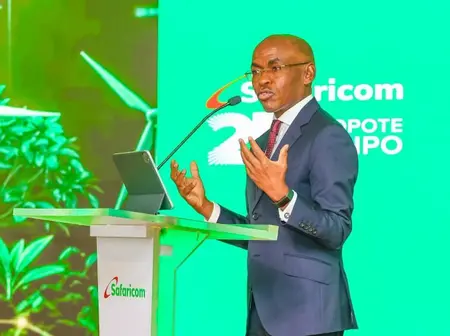
Speaking after the release of the half-year results, Group Chief Finance and Innovations Officer Dilip Pal said the company had not changed its distribution policy.
“Our dividend policy has not changed, which is to payout 80 percent of consolidated net profit after tax, adjusted for minority interests,” Pal said.
This means that stronger profits can support a higher dividend, provided the earnings available for distribution also increase.
For the previous financial year, Safaricom distributed Ksh80.13 billion, equivalent to Ksh2 per ordinary share. This comprised an interim dividend of Ksh0.85 and a final dividend of Ksh1.15.
The payout was 66.7 per cent higher than the Ksh1.20 per share distributed in FY2025.
The mobile money platform generated Ksh100.1 billion in revenue during the six-month period, representing a 13.6 per cent increase from Ksh88.1 billion recorded a year earlier.
Group service revenue also grew by 13.1 per cent to Ksh226.1 billion, while earnings before interest, tax, depreciation and amortisation increased by 27.5 per cent to Ksh129.2 billion.
Safaricom Kenya recorded service revenue of Ksh216 billion, while its Ethiopian operation generated Ksh10.6 billion, a 71.6 per cent increase.
Ethiopia’s improving performance is also important because its narrowing losses could reduce the pressure that the expansion has placed on group earnings.
The company has not declared a new interim dividend alongside the half-year results.
For investors, the next important development will therefore be the board’s decision on how much of the full-year earnings will be distributed.
If earnings continue growing and the dividend policy remains unchanged, shareholders could receive a higher payout than the Ksh2 per share recorded in FY2026.
The actual amount, however, will only be established after the company announces its dividend recommendation.
Leave a Reply