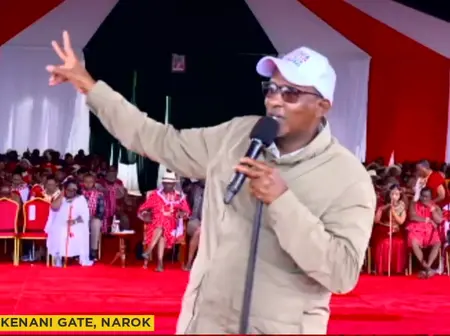
Health Cabinet Secretary Aden Duale has challenged opposition leaders over their demand to scrap the Independent Electoral and Boundaries Commission’s (IEBC) national presidential tallying centre, arguing that their proposal contradicts the Constitution, the Elections Act and established court decisions.
In a statement issued on the night of Friday, November 20, 2026, Duale accused the opposition of selectively interpreting the Constitution to advance its political position, insisting that the law gives IEBC a collective responsibility to tally and verify presidential election results before its chairperson declares the winner.
His remarks came amid an escalating dispute over the handling of presidential results ahead of the August 10, 2027 General Election, following a walkout by opposition leaders during a consultative meeting with IEBC on November 19, 2026.
The opposition wants the national tallying centre at Bomas of Kenya abolished, proposing that presidential results declared at constituency level should be final, with the national centre only receiving, aggregating and announcing the results.
However, Duale maintained that the commission cannot abandon its constitutional responsibility to verify and tally the results nationally.
“The Opposition’s argument is a selective reading of the Constitution that disregards the Elections Act and established court decisions. The law must be read as a whole, not selectively to advance political arguments,” he stated.
The CS pointed to Article 88(5) of the Constitution, which requires IEBC to perform its functions in accordance with the Constitution and national legislation.
He also cited Article 138(3)(c), which requires the commission to tally and verify votes counted at polling stations before declaring the presidential election results.
According to Duale, Article 138(10) separately provides that the IEBC Chairperson is responsible for declaring the presidential election result.
He argued that the two provisions establish complementary responsibilities rather than conflicting mandates.
Under this arrangement, the commission collectively handles the tallying and verification process, while the chairperson makes the final declaration.
Duale said the constitutional provisions did not support the opposition’s proposal to limit the national tallying centre to merely receiving and announcing results.
The Cabinet Secretary also relied on the Supreme Court’s judgment following the 2022 presidential election petition to support his argument.
“On tallying and verification: The Supreme Court’s 2022 presidential election judgment affirmed that tallying and verification at the national level are collective responsibilities of the IEBC, not the Chairperson acting alone,” Duale stated.
In Odinga & 16 Others v Ruto & 10 Others, the Supreme Court examined the respective responsibilities of IEBC and its chairperson in processing presidential election results.
The court affirmed that the responsibility of tallying and verifying presidential results at the national tallying centre belongs to IEBC as a collective institution, rather than the chairperson acting alone.
It distinguished this responsibility from the declaration of the final presidential election result, which Article 138(10) assigns to the chairperson.
The judgment also addressed the role of the commission’s other members in the tallying and verification process, rejecting an arrangement that would give the chairperson exclusive control over responsibilities vested in the commission collectively.
Duale argued that this established legal position should guide discussions about electoral reforms ahead of the 2027 elections.
The CS’s argument also draws support from a September 22, 2026 High Court judgment in consolidated petitions challenging the legality of the national tallying centre.
The petitions were filed by activist Okiya Omtatah and opposition leaders, including Kalonzo Musyoka, Rigathi Gachagua, Fred Matiang’i and other political figures.
In Okoiti & another v Independent Electoral and Boundaries Commission & 5 Others [2026] KEHC 13916 (KLR), Justice Gregory Mutai upheld the constitutionality of Section 39 of the Elections Act and Regulation 83(2) of the Elections (General) Regulations, which provide for national tallying and verification of presidential election results.
The petitioners had argued that results declared and certified by constituency returning officers should be final and should not undergo further tallying or verification at the national level.
However, the court ruled that IEBC has a constitutional responsibility to aggregate and verify the constituency results nationally to establish whether a presidential candidate has attained the constitutional threshold for election.
The judgment therefore upheld the legal basis of the National Tallying Centre.
However, the court also placed important limits on the commission’s powers.
It ruled that IEBC cannot alter, cancel, or vary certified constituency results at the national tallying centre, except under a court order.
The physical results declared and certified at constituency level must remain the authoritative reference documents, and electronic figures cannot override them where discrepancies arise.
The judgment therefore preserved national tallying and verification while reaffirming the finality of certified constituency results.
Led by Wiper Party leader Kalonzo Musyoka, the leaders said they were dissatisfied with the commission’s engagement on electoral preparedness and the reforms they wanted addressed before the 2027 polls.
One of their central proposals is to abolish Bomas of Kenya as the national presidential tallying centre.
They want constituency-declared presidential results to be final, with the national centre limited to receiving, aggregating and announcing the figures.
The opposition has also called for a clean and verifiable voters’ register, secure electronic voting for Kenyans in the diaspora and livestreaming of voting, counting and results announcements at polling stations and tallying centres.
The leaders argue that decentralising the process would strengthen transparency and reduce opportunities for manipulation during the transmission and verification of presidential results.
IEBC Chairperson Erastus Ethekon subsequently criticised the opposition’s decision to leave the November 19 meeting, saying walking away from dialogue would not resolve electoral concerns.
In a statement issued on November 20, the commission said the leaders left after making preliminary remarks and presenting their demands, before IEBC could present its position and substantive discussions could begin.
The commission invited the political leaders to formally submit their proposed reforms, maintaining that consultations should continue in good faith.
IEBC also said the opposition had missed an opportunity to hear about its state of preparedness, progress made, and challenges ahead of the 2027 General Election.
Leave a Reply