At 27, Huang Shihua is living the Chinese Dream.
He works as an engineer for a leading humanoid robot company in Shenzhen. The sprawling south-eastern metropolis is touted by China as the origin story for a high-tech future powered by artificial intelligence, robotics and homegrown innovation.
Drones soar across the sky to deliver your dinner, driverless taxis play relaxing music as you journey to your destination, and robots don't just hand you a cappuccino – they explain the origin of your coffee beans.
"We have created a miracle in Shenzhen," Huang says, surrounded by humanoid robots making coffee and playing chess. "Many young people from across China, full of passion and dreams, have flocked here."
Now they all spend their days figuring out ways to make robots smarter.
The Chinese call Shenzhen the "city of dreams". The moniker suits it: one of China's wealthiest, it is close to Hong Kong and the place where the country's explosive growth took off decades ago.
Its manufacturing inventory mirrors China's rise: cabbage patch dolls, then TVs, later iPhones, electric vehicles, drones and now the robots, which are drawing Huang and a new generation of Chinese ambition.
The "miracles" these young engineers are chasing are central to Xi Jinping's bold vision for China. So where better to show it off than Shenzhen, which will be centre-stage when US President Donald Trump, Russian leader Vladimir Putin and others arrive for a global economic summit this week.
And yet there is another side to this flashy, coastal city, a side that they will not get to see. Drive away from towering skyscrapers towards Shajing and Songgang, once the source of much of the world's electronics, and you will run into the challenges confronting Xi's China.
"Everyone feels life is hard," one construction worker tells us. "Lots of factories have relocated and workers lost their jobs."
China remains exceptionally good at making things – and Shenzhen is proof of that. But the city also holds the evidence for what ails the world's second-largest economy. The property crisis is not over, denting confidence in the future. This is one of China's most expensive cities but even here, our taxi driver tells us, his house is now only worth a third of its original price.
A weak property market and sluggish consumer spending mean many households are buying less. Factories are increasingly relying on exports while many manufacturers have cut production, downsized, automated or moved elsewhere in search of cheaper labour.
The result is a growing number of workers turning to temporary jobs in the gig economy, often with lower pay and fewer benefits.
"Shenzhen is not a magic place," says one delivery driver in his 40s, unwilling to give his name.
"Some say there is gold everywhere in Shenzhen, but it's not like that anymore. It's not a city where you can come and thrive. If you don't work hard, you won't have anything."
The BBC spent several days in Shenzhen exploring these two very different sides of China's progress: on the one hand is the dazzling promise of AI, and on the other are the anxieties of workers who worry if there will be room for them in the future it creates.
Wednesday is sandwich and bubble tea day in the offices of DexForce Technologies.
The elevator is packed with young engineers and developers headed to the right floor for the free carbs and sugar that will fuel their afternoon. They jostle past their creations en route: human-sized, yellow robots whose limbs fill every available corner.
"I believe that in a decade, robots will be able to better serve humanity by taking on highly repetitive or even dangerous tasks," Huang says. That could be anything from serving coffee to working in mines, and they are being trained for all of that in this laboratory for the future, where machines flail, jerk or lurch into motion as they learn to behave.
To him, "Shenzhen is another 'America'. Because, much like in the US, many young people have been able to realise their dreams and earn the wealth they desire."
This is what Xi wants to hear as he pushes China to lead the world in advanced tech. Shenzhen has indeed long been a place for seeking opportunity but Huang and his colleagues want to do much more. They don't simply want to continue China's manfuacturing supremacy. They want to transform it.
Beyond making "our lives more convenient and comfortable", Huang sees AI as helping "the entire world become one family – a global village. AI has the potential to foster equality and the prospect of AI-driven equality is, to me, the most exciting possibility of all."
Smiling enthusiastically, he explains how he hopes that robots can help emerging economies across Africa and South East Asia catch up by reshaping their production lines too.
This tech-charged optimism, which is everywhere in the building, jars with the uncertainty elsewhere in Shenzhen, where robots are nowhere to be found. Yet. But that's just the first of the differences.
In Huang's side of the city, tech and finance workers stroll to the office after a morning workout, sipping coffee that probably cost more than 30 yuan ($4.50; £3.40).
On the other side, scooters whizz through streets piled high with goods being shuttled between factories as vendors sell whole breakfast plates of spicy noodles for under 3 yuan.
Outside one of the city's tallest skyscrapers, 50-year-old Ms Lu has a phone to her ear and a pen in her right hand while grabbing a bag with her left from a delivery driver.
She shouts four key numbers at her co-worker: instructions for another Chinese woman who is waiting to take the delivery up the elevator to someone sitting at their desk.
This is the lunchtime rush outside SEG plaza, home to 70 storeys of thousands of tenants. Lu used to be one of them. "I ran a small business on the second floor. I sold circuit boards," she says. "But it's getting so hard to do business these days and the rental fees got higher."
Often likened to China's Silicon Valley, Shenzhen has seen rents soar with the influx of new capital, squeezing out smaller, more traditional businesses. At 50, Ms Lu couldn't find another job until the delivery drivers came to her with a plan.
The wait for the elevator can take half an hour – wasted money for a driver trying to fill as many orders as possible. So Ms Lu became a new layer in the ever-evolving gig economy.
"The delivery drivers bring food here to the building entrance. We pick it up and take it upstairs. The drivers pay us 2 yuan per order," she explains, always on the move. Delivery drivers earn between four to eight yuan per order, so Ms Lu gets a decent cut of their earnings.
"The lunch peak time only lasts two or three hours… if they use our service, they can get more orders done, and we can earn some money as well. But the market is bad. These days I only earn around 200 yuan per day."
An estimated 200 million Chinese workers, roughly 40% of the urban labour force, now depend on some form of gig work. Many delivery drivers in Shenzhen tell us they chose temporary work because there are fewer opportunities at factories than before.
"We need to adapt to the situation we find ourselves in," one driver told us, "rather than waiting for it to adapt to our needs." A group of them are waiting outside the gates of an e-cigarette factory to make industrial deliveries.
Others nod in agreement. Another driver says he has little choice: "I have two children to raise and I can't stop working. I don't have time to think about anything else."
Permanent jobs often require contributions to social security and pension, which reduces take-home pay. But gig work means more cash in hand and flexibile hours.
"Most workers prefer jobs with a fixed, shorter-term duration. It allows them the flexibility to resign and leave whenever they choose; they have no desire to become permanent employees," says job agent Li Xiaohe.
Increasingly, he puts up boards on pavements advertising temporary factory jobs that pay around 22 yuan an hour for assembling small electronics.
Although agents also appear to be in a shrinking pool, with several former shop fronts shuttered: yet another sign of the downturn in traditional manufacturing.
"Our business is perhaps not as optimistic as it once was," Li admits. "We can feel the effects of Shenzhen going through a transformation."
That transformation is hard to miss.
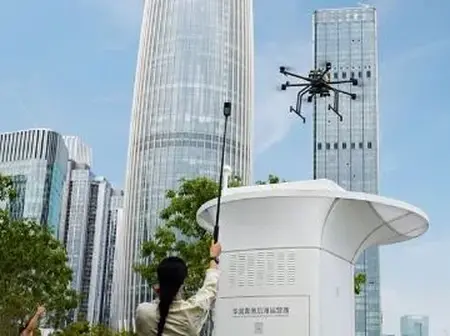
Drones buzz above the lush grounds of a purpose built "talent park" along the city's waterfront, dipping and darting as they deliver meals to a dedicated platform. Phones held high, tourists capture them landing with their lunch.
"This is amazing. The technology is just great. I wish we had this back at home," exclaims one Canadian tourist. Our coffee order – for a five-yuan delivery – arrives in just over 15 minutes, the drone landing seamlessly so I can pick up my order.
"I heard that many years ago, Shenzhen was a fishing village," says Anle, who is visiting from Vietnam. "Ha – no more fishing village," he laughs as he orders milk tea to be delivered by drone for him and his wife.
For all the ingenuity on display, it feels more like a demonstration of what is possible rather than a mundane reality. The deliveries, which are only possible in certain locations, stop at 20:00 local time. The driverless cars, which need a separate app to order, are also a novelty – they even offer you a massage when you are on your way.
At night, in the glow of a thousand dancing lights, the drones take on a different role. They fly above the park warning people to behave and not cause trouble.
Far from the glittering skyline, workers gather around plastic tables outside restaurants serving cheap hotpot and seafood skewers.
There are more expensive restaurants along the street, but they too have taken a hit. One owner told us business is down by more than 70% as workers are hesitant to splurge on dinner.
Many of them have spent decades here, including 58-year-old construction worker Mr Wu. He arrived in Shenzhen from Sichuan in the 1990s not long after China opened the city up to foreign businesses.
He was among millions of migrants from poorer provinces who came to work on production lines or build skyscrapers. They are still coming.
All the people we spoke to came from elsewhere. They often labour up to 14 hours a day and live in shared dormitories, sustained by the prospect of stable work and decent pay to send home to their families.
For these workers, the Covid pandemic, when Chinese manufacturing hit a record low, appears to have been the first turning point.
"After Covid, our salary dropped by at least a third," Mr Wu recalls, after which wages never fully recovered.
"I will continue to work," he adds. "As long as you keep working, you will have an income. More salary or not? It doesn't matter. As long as you keep working, you will have an income. If the economy slows down, we all slow down. If it grows, we all get better."
For all these decades, Shenzhen lived up to its bargain: work hard, and your life would improve.
But now, in a city that is being redefined by automation and AI, that old promise feels less secure.
Leave a Reply