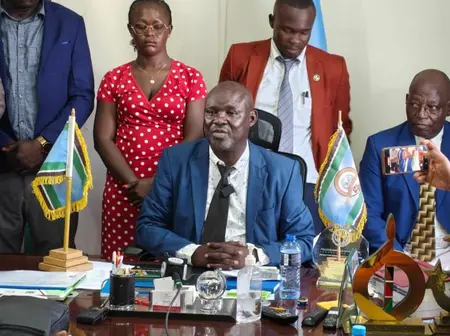
The leadership crisis in the Kisumu County Assembly has deepened after a dramatic confrontation saw Members of the County Assembly (MCAs) eject Speaker Elisha Jack Oraro and install East Kano Wawidhi MCA Moses Ochelle as acting Speaker.
Ochelle, who assumed the position following the chaotic proceedings, has pledged to unite the divided ward representatives and fast-track stalled institutional reforms, promising to address administrative challenges that have frustrated MCAs.
Speaking after the dramatic takeover on November 26, 2026, the newly installed acting Speaker said his immediate priority would be restoring order and ensuring the Assembly resumes its legislative and administrative functions.
However, Oraro has rejected his removal, describing the proceedings as illegal, unconstitutional and a nullity, setting the stage for a potentially prolonged battle over the control of the county legislature.
The political drama unfolded in scenes of chaos, with flying fists, confrontations and a tug-of-war over the Assembly’s Mace, the symbol of legislative authority.
A group of MCAs moved against Oraro after accusing him of failing to provide effective leadership, presiding over questionable tendering processes and delaying members’ allowances.
The legislators claimed their grievances had persisted without meaningful intervention, arguing that a change of leadership was necessary to restore the Assembly’s operations.
Kolwa Central MCA George Oraro and Muhoroni-Koru MCA Komudo Vitalis spearheaded the removal motion, which was seconded by Richard Kwach. MCAs Gad Olima and Moses Ngeta were also instrumental in pushing through the ouster.
The group claimed that 33 MCAs were present during the proceedings, although 29 had initially signed the petition, with two others reportedly joining later.
The confrontation escalated after Oraro dropped the gavel and adjourned the House sine die, effectively suspending its sittings indefinitely.
The MCAs, however, defied the adjournment and resisted attempts by Oraro, accompanied by area Officer Commanding Station (OCS) Benson Matheka and armed police officers, to enter the chamber and retrieve the Mace.
In the ensuing confusion, Deputy Speaker Nereah Okombo briefly occupied the Speaker’s chair for approximately two minutes, with Regina Kizito backing her, before MCA Gad Olima pushed her aside to pave the way for Ochelle’s installation.
Following the takeover, Ochelle proceeded to the Speaker’s office, which was locked. He subsequently gained entry alongside a group of youths as several MCAs watched.
The youths were later seen consuming refreshments reportedly prepared for visitors before the new leadership addressed journalists.
Ochelle eventually adjourned the sitting until Tuesday.
Oraro has maintained that the MCAs disregarded established parliamentary procedures and denied him an opportunity to respond to the allegations against him.
Addressing journalists on Friday, November 27, 2026, the embattled Speaker said he had received notice of the intended motion at the last minute and advised the members to follow the proper channels before proceeding with the removal.
He claimed the legislators ignored his advice and pushed ahead with the process without giving him a fair hearing.
“I will have to gazette when members will return, because I acknowledged receipt of the motion of notice and advised them to file it in a procedural way and they still defied. So as things stand I am the substantive clerk. By the time I was being removed there were no Clerks of the Assembly to ratify,” Oraro claimed.
He further questioned the legitimacy of the proceedings, arguing that the absence of the Clerk and the Hansard record undermined the validity of the decisions made during the sitting.
“The clerk wasn’t present, there was no Hansard after I left the House,” he claimed.
Oraro also linked his political troubles to succession politics ahead of the 2027 General Election, where he is reportedly eyeing the Kisumu West parliamentary seat.
He alleged that his political rivals were uncomfortable with his decision to support Kisumu West MP Rosa Buyu’s gubernatorial ambitions, suggesting that the differences contributed to the push for his removal.
He dismissed allegations that he had received money to influence MCAs, describing the claims as baseless.
The embattled Speaker also defended his administrative record, pointing to changes in the digital financial management system that he said had restricted his ability to authorise questionable payments that could be rejected by the Controller of Budget.
Beyond the political confrontation, the dispute has raised serious questions about whether the MCAs followed the legal procedures required to remove a county assembly Speaker.
Section 11 of the County Governments Act provides the framework for the removal of a Speaker, including the requirement for a written notice supported by at least one-third of all members of the County Assembly.
The process also requires the motion to be handled through the appropriate parliamentary procedures, including consideration by the relevant House committee, placement on the Order Paper and an opportunity for the Speaker to defend himself against the allegations.
The Constitution further guarantees fair administrative action under Article 47 and the right to a fair hearing under Article 50.
These provisions are likely to form a central part of any legal challenge arising from the Kisumu Assembly standoff.
Deputy Speaker Nereah Okombo has also challenged the legality of the proceedings, arguing that the Assembly could not lawfully conduct business after Oraro had adjourned it sine die.
“Until the Speaker issues a formal notice reconvening the House—or the Clerk gazettes a special sitting upon a valid requisition by members under the Standing Orders—all MCAs remain on recess and cannot pass binding resolutions, motions, or legislation,” Okombo argued.
She described the removal as unprocedural, insisting that the Assembly could not simply resume business without following the required procedures.
However, Deputy Majority Leader Patrick Lumumba dismissed her position, maintaining that the MCAs acted within the Standing Orders and had overcome attempts to take away the Mace and frustrate the proceedings.
Chief Whip Seth Kanga, meanwhile, criticised the police response, accusing officers of using excessive force during the confrontation.
Regina Kizito also questioned the presence of armed officers inside the Assembly, demanding to know who had invited them into the legislative chamber and whether their actions violated parliamentary privilege.
Leave a Reply