The final moments of Zimbabwean businessman Wicknell Chivayo's flight have attracted fresh public attention after details surrounding the incident were reportedly pieced together. The emerging findings have raised interesting questions, leaving many people eager to understand what exactly happened.
Chivayo is a well-known Zimbabwean businessman whose activities and public appearances have frequently attracted attention. Consequently, any development involving him is likely to generate considerable interest, especially when it touches on aviation, public safety and the possible involvement of government institutions.
The role of aviation authorities is also important in understanding such developments. Whenever questions arise concerning an aircraft or a flight, investigators are expected to examine available records, technical information and other relevant evidence before reaching conclusions.
Such investigations require patience because initial reports do not always provide the complete picture. Information must be carefully examined to establish what happened, when it happened and whether any unusual circumstances contributed to the incident.
The involvement of Zimbabwe's Ministry of Transport in the public discussion has also drawn attention. Members of the public will naturally expect clear communication from the relevant authorities, particularly where unanswered questions could create confusion or speculation.
However, it is important to distinguish between confirmed findings, preliminary information and claims circulating on social media. Until an official explanation is provided, conclusions should be avoided.
Ultimately, transparency and credible information will be essential in addressing the concerns surrounding the flight.
**What do you think about the latest findings concerning Wicknell Chivayo's flight? Do you believe the available information answers the important questions, or should Zimbabwean authorities provide further clarification?**
A Spanish rescue vessel has brought 134 migrants to the island of El Hierro after completing a seven-day journey from Guinea-Bissau, highlighting the growing migration crisis along the Atlantic route to Europe.
The rescued group includes seven women and two minors who arrived safely after spending a week at sea. Their arrival comes amid an increase in the number of migrants attempting to reach Spain through dangerous sea routes.
According to reports, more than 3,000 migrants reached the Canary Islands over the weekend, putting additional pressure on rescue teams and local authorities responsible for receiving and assisting new arrivals.
The growing number of arrivals has also created challenges at several island ports, where hundreds of migrants have reportedly been left stranded as authorities struggle to manage the situation.
Rescue operations remain important in preventing further loss of life, as many migrants undertake risky journeys across the Atlantic in search of better living conditions, employment opportunities and safety.
The journey from West Africa to the Canary Islands is particularly dangerous because of unpredictable weather, strong ocean currents and the possibility of boats experiencing mechanical problems. Many migrants travel in overcrowded vessels with limited food, water and medical supplies.
The latest rescue highlights the continuing challenges facing Spain and other European countries as migration numbers increase. Authorities are expected to strengthen rescue operations while working with African countries to address the factors forcing people to leave their homes.
The arrival of the 134 migrants demonstrates the urgent need for cooperation, humanitarian assistance and safer migration policies to protect vulnerable people at sea.
Lodwar town in Turkana County had an unexpected visitor this week. A woman identified as Chinese spent about seven days in the town, and her presence got many residents talking.
Curious locals gathered around her during her stay. Many wondered why she was in Lodwar and what her reason for being there was. For several days, “her welfare and final destination remain unknown” to the public.
The story went viral after photos and videos of the woman circulated online. Some people raised concerns about her safety and age.
According to police, her passport and other travel documents were in order. Verification showed that she is a young adult in her mid-20s.
Authorities also clarified that she is legally travelling in Kenya under an adventure programme. This clears earlier speculation that she might be a minor.
Even with the clarification, many people online and in Lodwar are still asking questions. The woman was spotted in different parts of the town over the week.
Some residents said they approached her to check if she needed help. Others shared her photos online asking if anyone knew her or her mission in Turkana.
Police said she is in the country legally as part of an adventure programme. Adventure travel often involves young people exploring remote areas, learning about different cultures, and volunteering.
However, officials have not shared details about which organization she is with or her exact plans in Turkana.
Now that her legal status is clear, the big question remains: should local authorities and support organizations continue checking on her?
Many people say yes. Turkana is a vast and hot region with limited services in some areas. A solo traveler, especially a foreigner unfamiliar with the area, may still need support with food, water, transport, and safety.
Motorists planning to travel from Nairobi to Nakuru and other parts of western Kenya during the December holidays may have to contend with construction-related delays for longer than expected, despite Government assurances that part of the busy highway will be opened before Christmas.
A fresh inspection of the Rironi-Mau Summit Road project on Monday, November 16, 2026, has revealed that the wider Rironi-Naivasha-Gilgil stretch may not be fully usable until March 2027, raising questions about how much relief motorists will get during the festive season.
The inspection was conducted by Parliament’s Departmental Committee on Social Protection, led by Chairperson Alice Ng’ang’a, alongside officials from the National Social Security Fund (NSSF), which is an investment partner in the project.
During the tour of the 81-kilometre Rironi-Gilgil section, the committee was informed that construction was approximately 40 per cent complete.
Ng’ang’a said the contractor had assured the delegation that the entire Rironi-Naivasha-Gilgil stretch could be fully usable by March 2027.
The update is significant because it comes after the Government announced that the Rironi-Naivasha section would be opened to traffic in December 2026, ahead of the Christmas travel rush.
The two timelines relate to different stages of the road works and should not be treated as the same commitment.
On October 30, Roads and Transport Cabinet Secretary Davis Chirchir announced that the Rironi-Naivasha section would be opened to motorists in early December.
He announced an inspection by the National Assembly’s Departmental Committee on Transport and Infrastructure, saying more than 90 construction teams had been deployed to accelerate the works.
The CS said construction was progressing at approximately four kilometres per week and that the Government had secured sufficient bitumen to sustain the project.
However, the November 16 inspection brought a further update from the contractor: the wider 81-kilometre Rironi-Naivasha-Gilgil section could only be fully usable by March 2027.
This means the December target concerns opening the Rironi-Naivasha stretch, while March is the latest indicated timeline for the full Rironi-Gilgil section.
The Government has also indicated that it may allow motorists to use sections where the initial asphalt layer has been completed before contractors return to apply the final road surface.
During an inspection on November 10, Chirchir said completed sections would temporarily be opened to traffic in the coming weeks as construction continued.
He explained that contractors had laid the initial asphalt layer, known as Dense Bituminous Macadam (DBM), on some sections.
The remaining work would involve applying an additional five-centimetre asphalt finishing layer to provide the final road surface.
The CS said the Rironi-Naivasha corridor would be open to traffic by Christmas 2026, while acknowledging that some associated works, including road furniture, might not be completed by then.
The temporary opening is expected to provide some relief to motorists, although traffic management arrangements may still be necessary where contractors are working.
One of the measures announced by the Government to accelerate the project is the deployment of additional asphalt paving equipment.
Chirchir disclosed on November 10 that 10 asphalt paving machines had arrived in Mombasa.
Five were expected to work from the Rironi side, while the other five would operate from the Naivasha side.
The arrangement is intended to allow contractors to work simultaneously from opposite directions and speed up the application of the asphalt layers.
The CS said the availability of the equipment would accelerate the remaining works, particularly on sections where the road base had already been completed.
The Government had also reported deploying more than 1,000 pieces of heavy-duty machinery along the wider Rironi-Mau Summit corridor.
However, the November 16 inspection’s 40 per cent progress estimate for the 81-kilometre section underlines the amount of work still required before the entire stretch is ready for unrestricted use.
The Rironi-Mau Summit highway is one of Kenya’s most important transport corridors, linking Nairobi with Nakuru, western Kenya and neighbouring countries.
It carries private vehicles, public service vehicles and heavy commercial trucks transporting goods towards Uganda, Rwanda, the Democratic Republic of Congo and other regional markets.
During the December holidays, the route experiences increased demand as families travel from Nairobi to upcountry destinations, while businesses and transporters continue moving goods.
Construction along the highway has already affected motorists, traders and public transport operators, with diversions and reduced operating space contributing to delays in some sections.
The completion of the dual carriageway is expected to improve traffic flow, increase road capacity and reduce travel time along the corridor.
Geography Awareness Week starts today. It is the perfect excuse to look beyond the usual travel circuits.Whenever a weekend approaches, Kenyans naturally default to the Coast or Naivasha. However, the country offers much more.Here are a few hidden travel gems offering views and absolute peace, completely free from overwhelming crowds and inflated prices.
Kenya Railways has introduced an additional Madaraka Express train service to help manage the travel rush that comes with the festive season. The extra service runs daily, giving passengers more options on the busy Nairobi–Mombasa route at a time when demand for seats climbs sharply.Nairobi to Mombasa: Departure at 9:40 am
Kenya Railways has announced additional Madaraka Express passenger train services between Nairobi and Mombasa to accommodate increased demand during the 2026 Christmas and New Year festive season.The additional Standard Gauge Railway (SGR) services will operate daily from December 1, 2026, to January 4, 2027, giving travellers more options when planning holiday journeys between Nairobi, Mombasa and destinations along the railway corridor.
ArraignedThe DPP accused the three of defrauding a complainant of Ksh5.8 million to facilitate accommodation, travel and transit-related expenses.On Monday, November 16, the Director of Public Prosecutions (DPP) charged three suspects over a hotel booking and travel arrangement fraud scheme.The DPP accused the three of defrauding a complainant of Ksh5.8 million to facilitate accommodation, travel and transit-related expenses for tourists visiting the country.
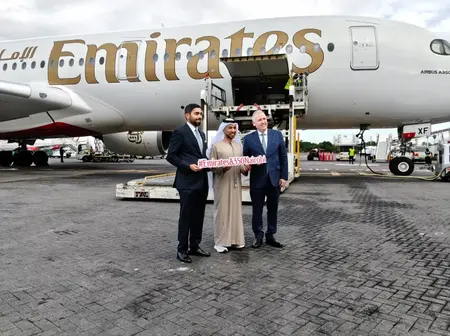
Emirates is deploying newer, fuel-efficient aircraft on its Nairobi route as the airline seeks to contain rising operating costs while responding to growing passenger demand between Kenya and its global network.
The Dubai-based carrier has introduced the Airbus A350 on the Nairobi-Dubai route, adding a new aircraft type to its Kenyan operations as it expands capacity and upgrades its passenger offering.
The move comes amid mounting pressure on airlines from rising global fuel prices, with carriers increasingly looking to modernise their fleets and improve fuel consumption to protect margins.
Rashid Al Arda, Emirates Vice President for Commercial Operations in Sub-Saharan Africa, said the A350 offers better fuel efficiency and lower unit costs compared with the larger Boeing 777, despite carrying fewer passengers.
“The A350, in terms of capacity, offers fewer seats than the 777, but we think it offers greater efficiency in terms of consumption and unit cost,” said Al Arda.
He said the aircraft's introduction was part of the airline's broader strategy to expand its operations in Kenya while improving efficiency and passenger experience.
Emirates has also increased its Nairobi operations to three daily flights, with the additional frequency aimed at meeting rising demand from passengers travelling to and from Kenya.
Kenya is among the airline's five largest markets in Sub-Saharan Africa and its second-biggest market in the region by capacity after South Africa.
The additional flight also strengthens connections through Dubai for travellers from Europe and the United States, making Nairobi an important part of the airline's international network.
Despite introducing the newer aircraft, Emirates says it does not intend to adjust ticket prices on the Nairobi route because of the change in aircraft.
Al Arda said the airline was instead relying on measures such as fuel hedging and other cost-management strategies to cushion itself against volatility in global fuel prices.
“The aviation industry as a whole is under a lot of pressure due to fuel prices globally. Emirates is no exception. We continue to try and mitigate these costs with strategies such as hedging fuel,” he said.
The aircraft deployment also forms part of Emirates' wider fleet modernisation programme, which includes a $5 billion investment to upgrade more than 200 Boeing 777 and Airbus A380 aircraft.
The refurbishment programme has already passed the 100-aircraft mark, with the airline targeting approximately 115 upgraded aircraft by the end of this year.
However, the programme has faced delays linked to global supply chain constraints, while delayed deliveries of Boeing's 777X aircraft have also affected the airline's fleet expansion plans.
Emirates is continuing to receive new A350 aircraft monthly, which it is deploying on routes capable of accommodating the aircraft.
On the Nairobi route, the airline will continue operating two Boeing 777 aircraft alongside the A350. The 777s will retain first-class cabins, while the refurbishment programme is expected to introduce refreshed interiors and premium economy seating.
The A350 brings Emirates' latest premium economy product to Kenya, alongside updated business and economy class cabins.
The airline expects the combination of newer aircraft, improved fuel efficiency and upgraded cabins to strengthen its competitiveness in the Kenyan market.
Al Arda said Emirates would continue evaluating opportunities to expand its African operations, although its immediate priority was to make the additional Nairobi frequency commercially successful.
The airline is also expanding A350 operations across African markets, including Ethiopia, Uganda and Cape Town, as it gradually introduces newer aircraft across its network.
A Sudanese man living in Kenya is among hundreds of people who have been making trips to Lodwar town in Turkana County to catch a glimpse of the young Chinese woman who has been wandering around the municipality for several days.A video shared by Kenyan content creator Collins Ekutan, popularly known as Kenyan Statue Man, on Facebook on Sunday, November 15, 2026, showed the Sudanese man arriving alongside some of his friends at a section of the road where the young woman was seated.