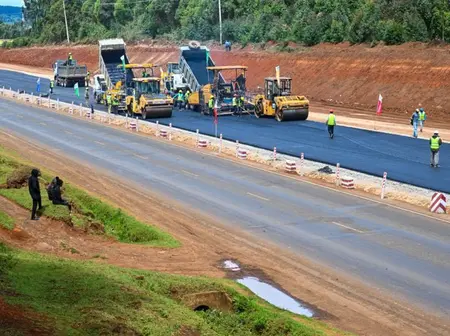
Motorists planning to travel from Nairobi to Nakuru and other parts of western Kenya during the December holidays may have to contend with construction-related delays for longer than expected, despite Government assurances that part of the busy highway will be opened before Christmas.
A fresh inspection of the Rironi-Mau Summit Road project on Monday, November 16, 2026, has revealed that the wider Rironi-Naivasha-Gilgil stretch may not be fully usable until March 2027, raising questions about how much relief motorists will get during the festive season.
The inspection was conducted by Parliament’s Departmental Committee on Social Protection, led by Chairperson Alice Ng’ang’a, alongside officials from the National Social Security Fund (NSSF), which is an investment partner in the project.
During the tour of the 81-kilometre Rironi-Gilgil section, the committee was informed that construction was approximately 40 per cent complete.
Ng’ang’a said the contractor had assured the delegation that the entire Rironi-Naivasha-Gilgil stretch could be fully usable by March 2027.
The update is significant because it comes after the Government announced that the Rironi-Naivasha section would be opened to traffic in December 2026, ahead of the Christmas travel rush.
The two timelines relate to different stages of the road works and should not be treated as the same commitment.
On October 30, Roads and Transport Cabinet Secretary Davis Chirchir announced that the Rironi-Naivasha section would be opened to motorists in early December.
He announced an inspection by the National Assembly’s Departmental Committee on Transport and Infrastructure, saying more than 90 construction teams had been deployed to accelerate the works.
The CS said construction was progressing at approximately four kilometres per week and that the Government had secured sufficient bitumen to sustain the project.
However, the November 16 inspection brought a further update from the contractor: the wider 81-kilometre Rironi-Naivasha-Gilgil section could only be fully usable by March 2027.
This means the December target concerns opening the Rironi-Naivasha stretch, while March is the latest indicated timeline for the full Rironi-Gilgil section.
The Government has also indicated that it may allow motorists to use sections where the initial asphalt layer has been completed before contractors return to apply the final road surface.
During an inspection on November 10, Chirchir said completed sections would temporarily be opened to traffic in the coming weeks as construction continued.
He explained that contractors had laid the initial asphalt layer, known as Dense Bituminous Macadam (DBM), on some sections.
The remaining work would involve applying an additional five-centimetre asphalt finishing layer to provide the final road surface.
The CS said the Rironi-Naivasha corridor would be open to traffic by Christmas 2026, while acknowledging that some associated works, including road furniture, might not be completed by then.
The temporary opening is expected to provide some relief to motorists, although traffic management arrangements may still be necessary where contractors are working.
One of the measures announced by the Government to accelerate the project is the deployment of additional asphalt paving equipment.
Chirchir disclosed on November 10 that 10 asphalt paving machines had arrived in Mombasa.
Five were expected to work from the Rironi side, while the other five would operate from the Naivasha side.
The arrangement is intended to allow contractors to work simultaneously from opposite directions and speed up the application of the asphalt layers.
The CS said the availability of the equipment would accelerate the remaining works, particularly on sections where the road base had already been completed.
The Government had also reported deploying more than 1,000 pieces of heavy-duty machinery along the wider Rironi-Mau Summit corridor.
However, the November 16 inspection’s 40 per cent progress estimate for the 81-kilometre section underlines the amount of work still required before the entire stretch is ready for unrestricted use.
The Rironi-Mau Summit highway is one of Kenya’s most important transport corridors, linking Nairobi with Nakuru, western Kenya and neighbouring countries.
It carries private vehicles, public service vehicles and heavy commercial trucks transporting goods towards Uganda, Rwanda, the Democratic Republic of Congo and other regional markets.
During the December holidays, the route experiences increased demand as families travel from Nairobi to upcountry destinations, while businesses and transporters continue moving goods.
Construction along the highway has already affected motorists, traders and public transport operators, with diversions and reduced operating space contributing to delays in some sections.
The completion of the dual carriageway is expected to improve traffic flow, increase road capacity and reduce travel time along the corridor.
Leave a Reply