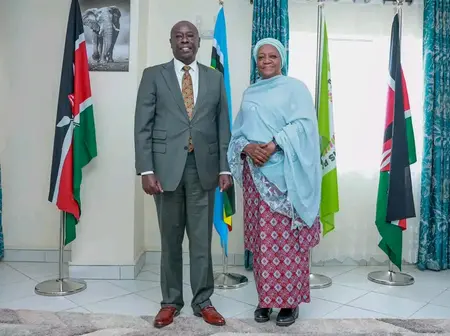
Unlike his frequent public appearances at his Wamunyoro residence and the DCP offices, Gachagua was this time photographed inside a different setting that appeared to be his private office.
In one photo, room featured large wooden executive desk positioned at the centre, with several papers, books and documents spread across its surface.
The arrangement gave the workspace a formal appearance, suggesting an environment used for official meetings and administrative duties.
The office setting provided a different glimpse into the former Deputy President's daily engagements away from political rallies and public gatherings.
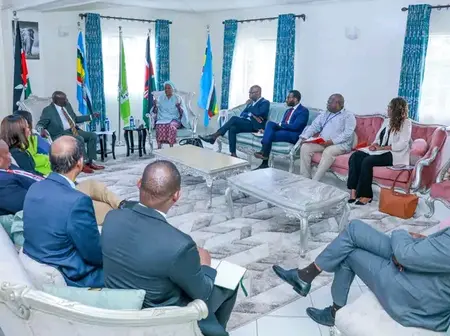
In his accompanying statement, Gachagua disclosed that he had held discussions with Bangura on issues affecting Kenya, including human rights violations, political violence and concerns surrounding the Independent Electoral and Boundaries Commission (IEBC) ahead of the August 10, 2027, General Election.
He said he had asked the United Nations to encourage dialogue among electoral stakeholders and urge the government to respect human rights & the rule of law.
Western Kenya could be entering a new chapter in its political history as different leaders continue to explore new ways of mobilising residents ahead of the 2027 General Election.
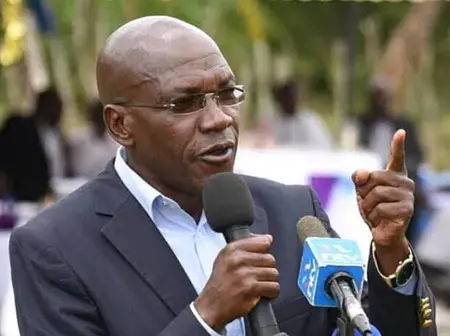
According to Khalwale, the involvement of Nairobi Senator Edwin Sifuna, Trans Nzoia Governor George Natembeya and other political figures has created renewed political energy among residents of Western Kenya.
His remarks point to growing political conversations about leadership, accountability and the future direction of the region.
For many years, Western Kenya has remained an important political battleground because of its voting numbers and influence in national elections. However, questions about political representation, development and the region's position in national decision-making continue to shape public debate.
The Linda Mwananchi movement appears to be presenting an alternative political platform for leaders and supporters who want their voices heard in national affairs.
Edwin Sifuna has increasingly attracted attention through his outspoken political positions, while George Natembeya has continued to establish himself as an influential voice in Western Kenya politics.
Their association with other like-minded leaders could create an opportunity for broader political cooperation.
However, political awakening is not measured by the number of rallies attended or the popularity of individual politicians. It must also be demonstrated through clear policies, practical solutions and the ability to address challenges affecting ordinary citizens.
Residents of Western Kenya have important expectations, including better roads, employment opportunities, affordable healthcare, improved education and support for farmers.
Therefore, the movement's ability to translate political enthusiasm into meaningful commitments will be an important test of its credibility.
Khalwale's statement raises an important question: Is Western Kenya preparing for a major political realignment, or is this another season of political excitement ahead of the elections?
Ultimately, the people will have the final say through their votes.
What is your opinion about the political awakening described by Boni Khalwale? Do you believe Linda Mwananchi can reshape Western Kenya's political future? Comment and share your ideas.
A family in Keiyo South is grieving the sudden death of Mike Birir, a Kenyan working in Qatar, who reportedly died just four days after flying back to the Gulf country following a visit to his loved ones.
Birir had travelled home to reconnect with relatives before resuming work abroad, as many Kenyans in the diaspora do.
The circumstances surrounding his death remain unclear. No details have been made public on what happened, and it is not yet known when his body will be repatriated or what burial plans the family has made.
Relatives, friends and acquaintances have been left devastated, especially because Birir had only recently been with them.
The timing has made the loss harder to bear for a family that had barely settled back into routine after his departure.
The news has also struck a chord with Kenyans living and working overseas, many of whom spend long stretches away from home in pursuit of better opportunities.
For such families, a short visit is often the only chance to reunite, and a sudden loss soon afterwards can feel especially cruel.
Messages of condolence have poured in for the departed, with friends and well-wishers praying for the family to find strength during this difficult period.
Birir's family is expected to share more information on funeral arrangements once they get official details from the relevant authorities.
Former North Horr Member of Parliament Francis Chachu Ganya is receiving urgent medical treatment in a Nairobi hospital after being found drugged and dumped along Ngong Road following a tense 24-hour disappearance.
According to Kenyans.co.ke and People Daily, the former lawmaker went missing on Saturday, November 21, 2026, under unclear circumstances.
His successor, current North Horr MP Adhe Wario, raised the alarm on Sunday after family and friends failed to reach him, calling on the Ministry of Interior, the Directorate of Criminal Investigations (DCI), and the National Police Service to track him down immediately.
Hours after that urgent appeal, Wario confirmed that Ganya had been located alive along Ngong Road, though in a worrying state.
Reports indicate that the former legislator was allegedly drugged and held hostage for more than a day before his captors abandoned him by the roadside, making off with his mobile phone and an undisclosed amount of cash.
"We have found Hon. Francis Chachu. Sadly, he was drugged along Ngong Road, and he's been rushed to the hospital for medical attention. A team of investigators has also been dispatched to where he was taken hostage. Please keep him in your prayers," Wario stated.
Ganya, who served three consecutive terms as North Horr MP between 2007 and 2022 before joining the Kenya Wildlife Service (KWS) Board, is widely regarded as a key peacebuilder in Marsabit County.
By Monday morning, November 23, DCI detectives had launched active investigations to establish the motive behind the attack and track down the suspects involved.
For official crime reporting channels, public safety advisories, and investigation updates, citizens can visit the National Police Service (NPS) website.
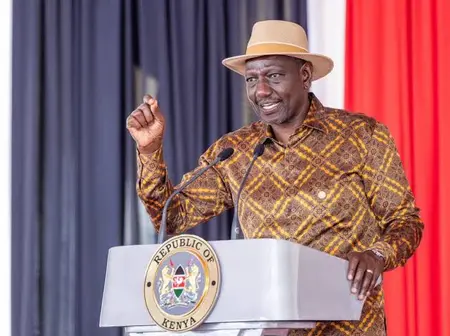
President William Ruto has expressed confidence that Kenya will soon achieve self-sufficiency in sugar production, promising that the country will stop importing sugar and begin exporting its own products to other nations.
According to Ruto, the country could achieve this ambitious goal within one, two or three years, marking a major shift in Kenya's agricultural development.
## Government Targets Increased Sugar Production
Kenya has struggled with sugar production for many years, forcing the country to depend on imports to meet local demand.
The challenges facing the industry include outdated factory equipment, high production costs, delayed payments to farmers and limited investment in sugarcane farming.
Ruto's latest remarks suggest that his administration believes these challenges can be addressed through reforms and increased investment.
The government has been working to revive sugar factories, improve access to affordable fertiliser and encourage farmers to expand sugarcane production.
If these measures succeed, Kenya could produce enough sugar for domestic consumption and generate additional supplies for export markets.
## What This Promise Means for Sugarcane Farmers
The President's announcement could bring hope to thousands of farmers in Western Kenya, Nyanza and other sugar-producing regions.
Sugarcane farming supports many households, but farmers have frequently complained about delayed payments and low earnings.
A reliable sugar industry would provide farmers with a stable market, improve household incomes and encourage more people to invest in agriculture.
However, farmers will need more than political promises. They require timely payments, affordable farm inputs, reliable factories and fair prices for their produce.
## Can Kenya Achieve This Target?
Kenya's ambition to become a sugar exporter is achievable, but it will require consistent action.
The government must also address the financial challenges facing sugar millers and protect farmers from exploitation.
If these measures are implemented successfully, Kenya could reduce its import bill, create employment opportunities and strengthen its agricultural economy.
Ruto's promise has therefore placed the sugar industry at the centre of an important national debate.
**Do you believe Kenya can stop importing sugar and become an exporter within three years? Share your views in the comments.**
Kamukunji MP Yusuf Hassan has launched a scathing attack on Nairobi County leadership over the rising cases of building collapses, accusing the county government of failing to prevent disasters and respond effectively to emergencies.
The legislator said the incident exposed serious weaknesses in Nairobi’s emergency response systems, warning that more lives could be lost if the county fails to address the problems.
Speaking during an interview on Monday, November 23, 2026, Hassan said he had sought a parliamentary statement on the Eastleigh tragedy shortly after Parliament resumed in November.
He explained that the request had taken time to reach the House floor because of parliamentary engagements, including the State of the Nation Address.
Hassan said he expected the matter to appear on the Order Paper on Tuesday, November 24, adding that he would push for answers on how the rescue operation was handled.
He argued that the first 72 hours of a rescue operation are critical in saving people trapped beneath debris, but the response in Eastleigh fell short of expectations.
According to Hassan, rescue teams lacked adequate resources, fuel and proper coordination, forcing operations to stop at night.
He defended the personnel who participated in the rescue, including officers from the National Youth Service (NYS), Kenya Red Cross, Kenya Defence Forces and Nairobi County, saying the problem was not their commitment but the absence of effective leadership.
“The problem is not the rescuers. The National Youth Service, the Red Cross, the Kenya Defence Force, the Nairobi County officers, they did a great job. But they did not have the leadership,” Hassan said.
He claimed that rescue workers at times lacked food and relied on the local community for breakfast, lunch and dinner.
Hassan further revealed that a Chinese rescue team had reportedly identified two people alive beneath the rubble during the early stages of the operation, but rescuers lacked the capacity to reach them quickly.
He argued that some of the eight victims could have survived if the county had provided the necessary equipment, resources and coordination within the first 24 hours.
Hassan also criticised the county government over its handling of families who lost relatives in the Eastleigh disaster.
He said some families endured additional suffering as they waited for DNA tests to identify bodies before they could be released for burial.
According to the MP, Nairobi County had promised to meet the DNA testing costs and assist affected families with burial arrangements but failed to honour the commitment.
He said some families were still searching for missing relatives, with three names reportedly remaining unaccounted for at the time of the interview.
Hassan described the experience as a second period of mourning for families who had already endured the trauma of waiting for their loved ones to be recovered from the rubble.
The legislator also called for the dismantling of Nairobi County’s planning department, which he accused of being compromised and allowing questionable construction approvals.
He questioned Governor Johnson Sakaja’s response to the disaster, arguing that blaming the collapse on the absence of building approvals was not enough.
Hassan said Nairobi residents expected the governor to explain what measures he would take to prevent similar incidents and improve emergency response.
He claimed that county officials who appeared before the Nairobi County Assembly had distanced themselves from responsibility for planning decisions, alleging that some decisions were instead being made politically from the governor’s office.
“The planning department is rotten, and I suggested to him that the best thing he could do for us is to dismantle it,” he said.
The MP further questioned the absence of accountability despite subsequent building collapses in Nairobi, which he said had resulted in additional deaths.
At the time, rallying behind Matiang’i looked like the best approach to stand a chance of winning the Kisii gubernatorial race, considering how Kenyans often vote based on political alignments. Fast forward to today, and Onyonka has taken a strong political stance that could cost him his gubernatorial bid.
Onyonka has defended his move as a stand against tribal politics, arguing that supporting Sifuna for the presidency proves his national outlook. On paper, rejecting ethnic mobilization is a noble ideal. In practice, however, local elections in Kenya rarely reward idealism that clashes with regional aspirations.
The danger for Onyonka's bid becomes even steeper when looking at the broader cracks within the opposition. Despite repeated assurances from opposition leaders that they will eventually unite behind a single candidate, their actions on the ground tell a story of two distinct, competing camps.
If these two factions fail to agree on a single flagbearer—a scenario that looks increasingly likely as both sides consolidate their bases—Matiang’i and Sifuna will become rivals. For Onyonka, that would be a political nightmare. As a senior official in Linda Mwananchi, he would find himself campaigning against Matiang’i on his own home turf while simultaneously asking Kisii voters to trust him with the county’s top job.
In the survey conducted by Mwelekeo Insights between November 18 and November 21, 2026, Wanga placed first with 27,066 responses, or 40.3 per cent, narrowly ahead of Waiguru, who garnered 26,482 responses, or 39.4 per cent.
The two county bosses were separated by 584 responses—a margin of 0.9 percentage points—leaving the other 19 women leaders on the list to share the remaining 20.3 per cent of responses.
Behind the top two, Susan Nakhumicha came third with 2.0 per cent (1,319 responses), followed by Naisula Lesuuda at 1.7 per cent (1,157), Wavinya Ndeti at 1.7 per cent (1,154), and Agnes Kagure at 1.6 per cent (1,066).
Because the exercise was an open online poll rather than a probability-sampled scientific survey, analysts note that it reflects voluntary participation during the voting window rather than a statistically representative measure of national public opinion.
Even so, such rankings regularly spark conversation around visibility, grassroots mobilisation, and leadership profile among prominent women figures ahead of the August 10, 2027 General Election.
Observers note that online polls often mirror active digital mobilisation and regional engagement by supporters, while broader voter choices in next year’s elections will depend on party structures, coalition deals, and performance records.
With less than nine months remaining before Kenyans head to the ballot box on August 10, 2027, how prominent women leaders convert public visibility into coalition influence and voter support will remain closely watched.
In a statement shared after the engagement, the Democracy for the Citizens Party (DCP) leader said they discussed several issues affecting Kenya, including alleged human rights violations, political violence and concerns surrounding the Independent Electoral and Boundaries Commission (IEBC).
Gachagua claimed that cases of abductions, extrajudicial killings and attacks against young people were threatening the country's democratic values.
He urged the United Nations to engage the Kenyan government and call for respect for human rights and the rule of law.
The former Deputy President also questioned the independence of the IEBC, alleging that the electoral body had lost public confidence ahead of the August 10, 2027, General Election.
He argued that the commission needed to demonstrate impartiality and consult different political stakeholders to address concerns about its credibility.
Gachagua further appealed to the United Nations to intervene by encouraging dialogue between the electoral agency and other interested parties before the next election.
He maintained that the country needed transparent, free, fair and verifiable elections to strengthen public confidence in democratic institutions.
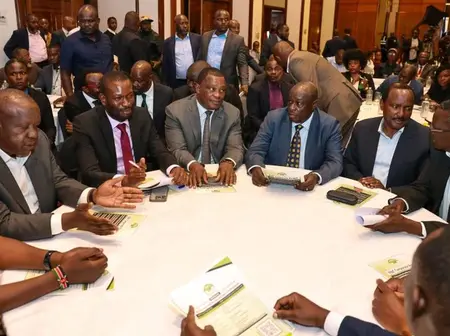
The coalition—bringing together figures including former Chief Justice David Maraga, Rigathi Gachagua, Kalonzo Musyoka, Edwin Sifuna, Justin Muturi, Martha Karua, Fred Matiang’i, and Caroli Omondi—has pressed for sweeping changes to voter roll verification, results handling, diaspora voting, and transparency.
Specifically, the opposition’s key demands centre on:
Clean and verifiable voter register: An independent audit to remove duplicate entries, deceased persons, and ineligible voters while ensuring all eligible citizens are registered.
Abolition of Bomas as final tallying centre: Making presidential results declared at the 290 constituency tallying centres final, limiting the national centre to receiving, aggregating, and announcing already declared results.
Electronic voting for the diaspora: Piloting secure electronic voting for Kenyans abroad—estimated by Maraga at around 1.4 million—to remove barriers tied to travelling to diplomatic missions.
Mandatory livestreaming and server access: Live-streaming voting, counting, and result announcements at polling and tallying centres, alongside read-only access to election servers and biometric systems for parties, candidates, and the media.
Leaders walked out of the November 19 session after arguing the IEBC’s agenda omitted key reform concerns, while IEBC Chairperson Erastus Ethekon criticised the exit as cutting short substantive dialogue.
Across Kenya’s pre-election environment, disputes over electoral administration, tallying rules, and institutional trust test how parties and the commission manage friction ahead of national polls.
With less than nine months remaining before Kenyans head to the ballot box on August 10, 2027, how these reform demands, legal challenges, and IEBC engagements unfold will remain closely watched.