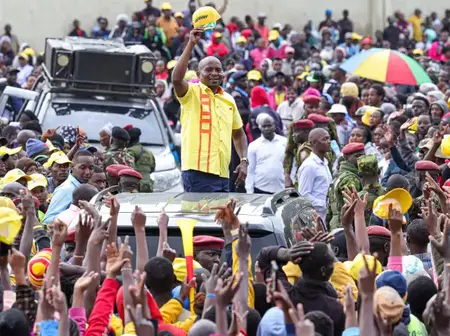
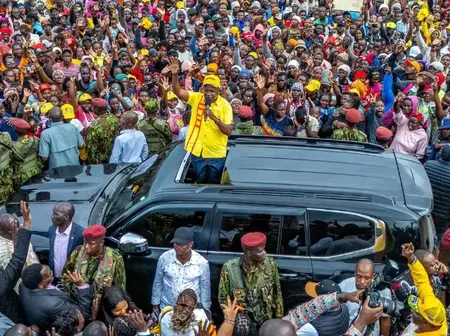
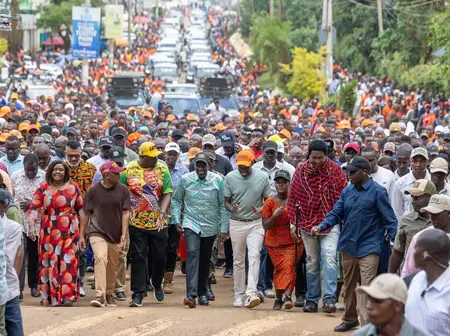
Addressing supporters on Saturday, November 21, Gachagua said the events at Sekenani on November 14 had exposed what he considered a breakdown in government authority.
He particularly took issue with reports that chiefs and senior government administrators ran for safety when rival groups clashed during the festival, arguing that public officers were expected to maintain order rather than abandon their responsibilities.
“That is the day I confirmed ya kwamba Kasongo ataenda nyumbani,” Gachagua said, referring to Ruto using the nickname Kasongo.
The Democracy for the Citizens Party (DCP) leader said his previous experience as a District Officer had taught him that administrators serving in uniform should remain calm and protect members of the public, even when tensions escalate.
He also criticised chiefs, assistant chiefs, deputy county commissioners and the county commissioner over their alleged conduct during the incident.
“Serikali ikitoroka iende… iende kabisa!” he declared.
The November 14 confrontation involved rival groups linked to Narok Governor Patrick Ole Ntutu and Narok West MP Gabriel Tongoyo, who is seeking to become the county's next governor. Supporters associated with Kajiado Governor Joseph Ole Lenku were also reportedly involved.
The clashes briefly interrupted the cultural celebrations attended by Ruto, prompting Narok Governor Ntutu and Senator Ledama Olekina to appeal for calm. Presidential security officers subsequently moved to protect the Head of State as the programme continued.
Gachagua also warned Maa community leaders against allowing political competition to overshadow cultural gatherings. He urged them to protect their traditions and resist attempts to turn such occasions into partisan platforms.
He further alleged that Ruto abandoned a planned return visit to the region after receiving reports of possible hostility, although this claim was not independently confirmed.
His latest remarks add another chapter to the increasingly public political confrontation between the former Deputy President and his former boss as the country approaches the 2027 General Election.
Deputy President Kithure Kindiki is increasingly attracting political support to retain his position as President William Ruto's running mate in the 2027 General Election, as competition for the influential seat gathers momentum. The emerging contest is exposing competing political interests, regional bargaining and questions of loyalty within the broad-based government, with several leaders arguing that maintaining the current leadership arrangement would provide continuity at the highest levels of government.
Kindiki's growing support has received a boost from political leaders in Nakuru and other parts of the country, who have publicly defended his position and called for the continuation of his partnership with President Ruto. Among those backing him are Nakuru Governor Susan Kihika and Nakuru Town East MP David Gikaria, who have dismissed growing demands from some political leaders seeking changes to the current arrangement. Their endorsements have added to the debate over whether Ruto should retain his current deputy or consider another political figure as he prepares for the next presidential election.
TIFA Poll Adds to Kindiki's Political Momentum
Kindiki's growing political support is also reflected in recent opinion polling. A survey by Trends and Insights for Africa (TIFA) Research released on November 12, 2026, identified him as the most preferred running mate among supporters of President Ruto. According to the findings, 55 per cent of Ruto's supporters preferred Kindiki to retain the position in the 2027 General Election.Homa Bay Governor Gladys Wanga emerged second with 12 per cent, followed by Mining and Blue Economy Cabinet Secretary Hassan Joho at nine per cent.
Other personalities mentioned included Prime Cabinet Secretary Musalia Mudavadi, National Assembly Speaker Moses Wetang'ula and ODM leader Oburu Oginga, who each received four per cent. The survey involved 2,036 respondents drawn from nine regions across the country. However, the findings reflect the preferences of Ruto's supporters and should not be interpreted as a nationwide endorsement or a final decision on the presidential ticket.
Mt Kenya Politics Complicates the Running Mate Debate
Despite the endorsements, the Deputy President faces an increasingly competitive political environment, particularly within the wider Mt Kenya region. Leaders from Mt Kenya West have been advancing arguments for greater representation in the country's second-highest executive office, with Kirinyaga Governor Anne Waiguru, Laikipia East MP Mwangi Kiunjuri and Ndia MP George Kariuki among politicians whose names have featured in discussions. Some leaders from the region argue that its significant voter population should give it a stronger voice in negotiations over the 2027 presidential ticket.
However, supporters of Kindiki, particularly from Mt Kenya East, maintain that replacing him would undermine the political understanding that brought the region into the Kenya Kwanza government. They argue that Meru, Embu and Tharaka Nithi should continue enjoying representation at the highest level of government. The competing positions have exposed differences within the wider Mt Kenya political bloc, raising questions about how regional interests will influence the next presidential election.
Ruto's Working Relationship with Kindiki Under Scrutiny
Another major factor shaping the debate is the working relationship between President Ruto and his deputy. Kindiki assumed office on November 1, 2024, following the impeachment of former Deputy President Rigathi Gachagua.Since his appointment, he has maintained a visible presence in government activities, frequently accompanying the President during official engagements and defending the administration's development agenda.
Supporters argue that the relationship between the two leaders has created an established working arrangement that should be maintained as the country approaches another election cycle. They also point to Kindiki's political loyalty and his involvement in government programmes as reasons for retaining him on the presidential ticket. However, the final decision will involve more than personal relationships, with regional representation, coalition negotiations and the interests of political partners likely to feature prominently.
Competing Political Interests Could Shape Ruto's Decision
The growing debate also comes against the backdrop of negotiations within the broad-based government, where different political formations are seeking recognition and influential positions ahead of 2027.Leaders associated with ODM and other political formations have featured in discussions about possible changes to the presidential ticket, reflecting the importance of coalition arrangements in the next electoral contest. The challenge for Ruto will be navigating these competing interests while maintaining political relationships across different regions. For Kindiki, the public endorsements and favorable polling provide additional backing in the ongoing debate, although they do not guarantee his automatic retention.
2027 Decision Remains in Ruto's Hands
As political realignments continue to take shape, the question of who will deputies Ruto in 2027 is expected to remain a major subject of discussion within government and political circles. While Kindiki's supporters are pushing for continuity, other leaders are positioning themselves and their regions for a possible role in the next administration. Ultimately, the choice of running mate will depend on political negotiations, coalition arrangements and the President's decision as the election approaches.
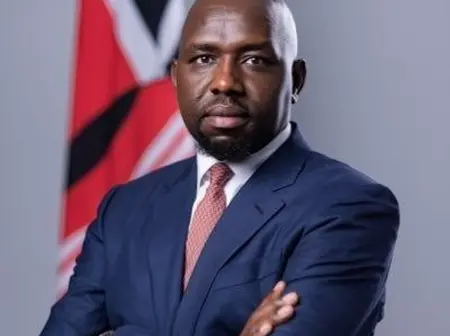
Interior Cabinet Secretary Kipchumba Murkomen has criticised opposition leaders, accusing them of lacking a clear political agenda as the country moves closer to the 2027 General Election.
“Badala ya kutafuta presidential candidate, manifesto na mpango, wanaenda kupigana na referee (IEBC),” Murkomen said, arguing that the opposition should be concentrating on identifying a presidential candidate and preparing a comprehensive manifesto.
The Interior CS further described the opposition as confused, claiming that its leaders had failed to formulate policies that could convince Kenyans to support them.
“That is a confused opposition with no policy to share with Kenyans,” Murkomen argued.
His remarks come amid growing political activity as various leaders begin positioning themselves ahead of the 2027 elections.
The opposition has continued to raise concerns about electoral preparedness, the credibility of the electoral commission and the need for reforms to ensure a transparent and fair election.
However, Murkomen believes that political leaders should prioritise presenting solutions to the challenges facing ordinary citizens rather than engaging in constant confrontations with the electoral body.
The comments are likely to intensify political debate between government allies and opposition leaders, who are expected to begin outlining their political strategies and campaign agendas in the coming months.
As the election approaches, Kenyans will be watching closely to see which political formations present convincing policies, credible leadership and practical solutions to the country's economic and social challenges.
Deputy President Prof. Kithure Kindiki has appealed to leaders and supporters of the United Democratic Alliance (UDA) and Orange Democratic Movement (ODM) to maintain unity and work together as they prepare for the 2027 General Election.
Kindiki warned that unnecessary political confrontations, internal disagreements and personal attacks could weaken the broad-based political arrangement supporting President William Ruto's administration and his re-election bid.
Speaking during a public engagement rally at Kiratina Grounds in Nakuru East Constituency on Friday, November 20, 2026, the Deputy President challenged members of the two political parties to put aside their differences and focus on strengthening their working relationship.
He maintained that although UDA and ODM have different political identities, their members should recognise the importance of cooperation, especially as the country approaches another election period.
"I appeal to all our political parties supporting the government to work together in unity. Let us not undermine one another or engage in unnecessary confrontations," Kindiki said.
The Deputy President acknowledged that political competition would be unavoidable, particularly as aspirants begin positioning themselves for various elective seats. However, he insisted that such competition should not destroy relationships among leaders supporting the same administration.
He further observed that political parties could present different candidates in constituencies and counties while maintaining mutual respect and supporting President Ruto's re-election campaign.
According to Kindiki, the broad-based political arrangement should be strengthened through cooperation and a shared commitment to national development.
He also challenged opposition leaders to present alternative policies and development programmes instead of engaging in personal attacks and political hostility.
Kindiki emphasised that politics should not be treated as warfare, warning politicians against mobilising communities along ethnic lines or encouraging divisions among Kenyans.
He questioned why competition for approximately 2,000 elective positions should become a reason for conflict in a country with more than 55 million people.
The Deputy President further challenged elected leaders, including governors, senators, Members of Parliament and MCAs, to explain their development records and present their plans to voters.
His remarks come amid growing political realignments and increasing competition among leaders ahead of the August 2027 General Election.
As political activities intensify, Kindiki wants UDA, ODM and other government-aligned parties to maintain a united front while allowing democratic competition to take place peacefully.
PAY ATTENTION:TUKO is in WhatsApp Channels now! Subscribe and read news in your favourite messenger.
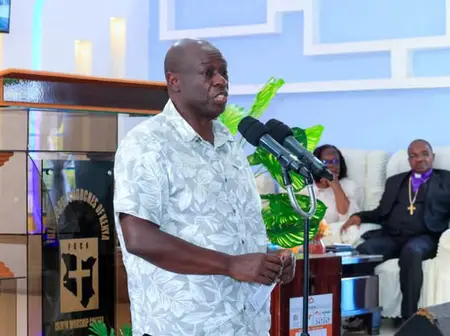
Narok Senator Ledama Olekina has denied that any personal vehicle belonging to him was placed under auction, pushing back against a widely circulated video showing him in a heated confrontation with a group of men near a vehicle.
Olekina issued a statement on the night of Saturday, November 21, hours after the footage spread online.
In the video, the senator is heard telling one of the men, "Nitakupiga risasi kichwa" ("I will shoot you in the head"). The encounter was a clash with alleged auctioneers over an unpaid car loan, a characterisation the senator flatly rejected.
Edwin Sifuna introduces beautiful woman who changed his life in Nairobi
According to Ledama, the men who appeared in the video were individuals claiming to be court-appointed auctioneers who had entered the premises of a private company in which he holds shares.
He said they took the keys to a delivery truck belonging to the company and claimed they were acting to recover KSh 365,000 allegedly owed to a former Narok Senate office employee named Rotiken, who had filed an unfair termination claim.
PAY ATTENTION:TUKO is in WhatsApp Channels now! Subscribe and read news in your favourite messenger.
The senator traced the dispute to 2017, when a Senate staff member attached to his office was dismissed for absconding from duty.
He said a Labour Court later issued ex parte orders authorising the attachment of his personal property in connection with that employment matter, a development he learnt of only when the men arrived to execute the order.
According to him, the disputed sum was KSh 622,000 and the ex parte judgment KSh 336,000, figures that differ slightly from the KSh 365,000 cited in his public statement.
49-year-old Baringo herdsman goes missing, family links police to his abduction
Ledama argued the claim should never have been directed at him personally. He said Senate staff salaries and employment obligations are funded through public appropriations managed by the Parliamentary Service Commission, not by individual senators.
The senator went further, accusing his political opponents of exploiting the story and naming a specific outlet he said was involved.
He also raised broader legal questions about whether a Labour Court order can legitimately attach the personal assets of a senator or the property of an unrelated private company to satisfy an employment claim against a public institution.
Ledama warned anyone trespassing on private property, stating that such individuals "should be ready to face the consequences."
Democracy for the Citizens Party (DCP) leader Rigathi Gachagua has accused the Independent Electoral and Boundaries Commission (IEBC) of holding secret meetings with government officials and electoral officers in parts of Northern Kenya and Nyanza ahead of the 2027 General Election.
Speaking at his Wamunyoro home in Nyeri County, Gachagua alleged that the commission was working with the Ministry of Interior to influence electoral preparations in the regions.
He specifically claimed that Interior Principal Secretary Dr Raymond Omollo was issuing directives concerning electoral activities in Mandera, Wajir and Garissa counties, as well as Nyanza.
Gachagua warned that opposition supporters would take to the streets and stage protests outside IEBC offices across the country from January 2027 if the commission failed to engage political leaders in discussions over preparations for the next general election.
He also took aim at the Orange Democratic Movement (ODM) over its reported power-sharing negotiations with the ruling United Democratic Alliance (UDA).
The former Deputy President questioned ODM leaders for pursuing government positions after previously criticising him for seeking a share of the Kenya Kwanza administration.
During separate meetings at his Wamunyoro residence, Gachagua also hosted delegates from Narok County, where concerns were raised over community land in Limanet earmarked for affordable housing.
He further met ward representatives from Murang'a County and DCP party delegates from Kiambu County.
Barely twenty-four hours after former Chief Justice David Maraga declined to join the newly rebranded Linda Mwananchi Movement (LMM), Nairobi Senator Edwin Sifuna answered with an audacious counter-move officially inaugurating the movement’s first international headquarters in Hackettstown, New Jersey, on Saturday, November 21, 2026.
In Kenyan electoral politics, emerging outfits frequently suffocate before the ballot choked off by state surveillance of local financiers, party-hopping buyouts, and expensive grassroots mobilization. By establishing a permanent operational base in New Jersey and packing his itinerary with business community dinners in Maryland, Gen-Z and 6.25 Movement forums in the capital, and high-dollar dinners in Oakland and Silicon Valley, Sifuna is building an independent fundraising pipeline directly within Kenyan-American remittance hubs.
Following similar American courtships by Rigathi Gachagua and David Maraga, Sifuna’s tour aims to prove that Linda Mwananchi can command serious international muscle without leaning on established opposition heavyweights.
Yet overseas enthusiasm alone does not win Kenyan constituencies. Sifuna has already pledged to fly straight from California into a high-stakes rally in Eldoret right inside President William Ruto’s Rift Valley backyard. Whether New Jersey’s launchpad rewrites his 2027 war chest will depend on how quickly diaspora dollars translate into boots on Kenyan ground.
Speaking during a The Mwananchi Party (TMP) rally in Nairobi on Saturday, November 21, Owino said lowering the fees would ease the financial burden on traders and make it cheaper to operate businesses in the city.
He also pledged to improve the school feeding programme, arguing that access to meals remains an important part of supporting children in public schools. However, he did not explain how the proposed changes would be financed or implemented.
On infrastructure, the legislator promised to upgrade drainage networks across Nairobi, saying poor water management contributes to flooding, environmental pollution and health problems whenever heavy rains hit the city.
Owino said his administration would prioritise drainage works to reduce stagnant water and improve sanitation in residential and commercial areas.
The MP also used the rally to defend his development record in Embakasi East, citing education projects as evidence of what he could deliver if given the opportunity to lead the county.
He claimed that four schools he had committed to constructing were already complete, while work on two others was approaching completion.
Owino further said he had supported renovations in primary and secondary schools and acquired buses for learning institutions within his constituency.
He attributed his confidence to his parliamentary performance, claiming he had previously been ranked the top MP nationally. He also referred to another ranking that placed him at position 44 but did not identify the organisation behind the assessment.
His latest remarks place business costs, education and drainage infrastructure at the centre of his proposed agenda as he seeks to expand his political ambitions beyond Embakasi East.
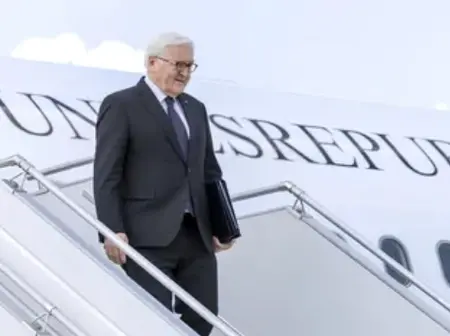
German President Frank-Walter Steinmeier is expected to visit Kenya on Wednesday, November 25, 2026, as part of a five-day diplomatic tour of three African countries.
Steinmeier's visit will include high-level talks with President William Ruto at State House, Nairobi, where the two leaders are expected to discuss bilateral relations and strengthen cooperation between Kenya and Germany.
According to a statement published on the German President's official website, Steinmeier's African tour will run from November 22 to 26, with planned visits to Côte d'Ivoire, Ghana and Kenya.
The German presidency said the tour was intended to recognise the importance of the three African countries and strengthen existing partnerships.
"The aim of the visit is to pay tribute to and further expand the close partnerships with the three African countries," the statement said.
During his stay in Kenya, Steinmeier is scheduled to begin his engagements at Tatu City, where he will visit a mobile hospital operated by Zuri Health.
The German Head of State will also tour Call Centre International Kenya (CCI Kenya), a provider of digital services, as well as CareerBox, a non-profit organisation involved in training and skills development.
The visits are expected to highlight areas of cooperation involving healthcare, technology, digital services and employment opportunities.
His meeting with President Ruto at State House will form a key part of the diplomatic engagements, providing an opportunity for both countries to explore ways of strengthening their longstanding relationship.
Germany has maintained diplomatic and development cooperation with Kenya across several sectors, including education, vocational training, trade, technology and sustainable development.
Steinmeier's visit also comes as Kenya continues pursuing international partnerships aimed at supporting economic growth, investment and job creation.
The three-country tour will provide the German President with an opportunity to engage African leaders and institutions while reinforcing Germany's diplomatic and economic ties with the continent.
Steinmeier's November 25 visit will therefore place Kenya at the centre of Germany's African diplomatic engagements during the final week of November 2026.
As Kenya heads towards the August 2027 General Election President William Ruto is banking on visible development projects and a nationwide mobilisation drive to strengthen his re-election bid. His frequent county tours have become a defining feature of his presidency.
His approach rests on a simple calculation. Tangible development and a visible government presence could persuade voters more than opposition criticism. He has taken government work beyond State House to launch projects and inspect works.
In November alone he toured Western Kenya after similar visits to Ukambani and the Rift Valley. His itinerary covered electricity connections and markets and affordable housing and roads and water projects. The government has also moved to revive sugar factories like Mumias and Nzoia.
Supporters say the pace of delivery shows a government determined to keep its promises. They argue that his direct engagement with communities sets him apart from past administrations.
Critics are not convinced. They question the value for money of some projects and raise concerns about the debt burden and the planned sale of state assets. Many households still worry about the cost of food and transport and electricity and jobs.
The June 2024 protests led by young Kenyans showed how deep public frustration runs. Development announcements alone may not secure votes. Ruto must convince Kenyans of long-term transformation while easing their immediate financial pressure.
The opposition is working to build an alternative. Former Deputy President Rigathi Gachagua now leads the Democracy for the Citizens Party. He has launched an aggressive grassroots recruitment drive and attracted defectors to his party.
He accuses the government of sidelining the Mount Kenya region. He has also questioned the credibility of the electoral process and the tallying of presidential results.