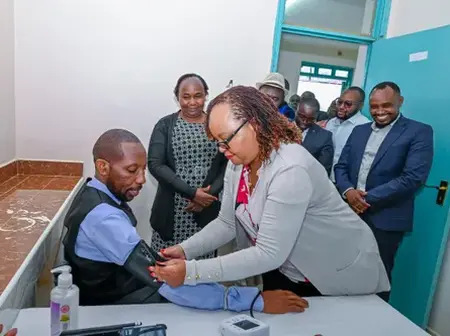
Kiambu Governor Kimani Wamatangi announced that construction of the facility is now complete, with storage shelves already installed as preparations for its intended operations continue. The warehouse is expected to serve as a central distribution point for pharmaceutical and non-pharmaceutical supplies used in hospitals across the county.
The project comes at a time when reliable access to medicines, medical equipment and other essential supplies remains an important concern for patients seeking services in public hospitals. Stock shortages can inconvenience patients and healthcare workers, making efficient procurement and distribution systems an important part of delivering quality healthcare.
With the building completed and shelves already fixed, attention is expected to shift towards operational readiness, including the organisation of supplies and distribution arrangements. The effectiveness of the facility will ultimately depend on how efficiently it is managed and how consistently hospitals receive the items they need.
The central store is intended to support both pharmaceutical and non-pharmaceutical supplies, meaning its role could extend beyond medicines to other essential items required in the day-to-day running of healthcare facilities.
What remains important is ensuring that the completed infrastructure translates into dependable service delivery for patients and medical staff.
What is your opinion on Kiambu County's new central medical store, and do you think it could improve the availability of supplies in public hospitals? Share your views and remarks in the comment section.
The government is set to distribute 10.7 million mosquito nets across 18 malaria-endemic counties as part of renewed efforts to combat malaria infections and reduce deaths caused by the disease.
The distribution campaign aims to strengthen malaria prevention, particularly among vulnerable groups, including children under five years and pregnant women, who face a higher risk of severe complications from malaria. The mosquito nets are expected to provide protection against mosquito bites, especially at night when malaria-transmitting mosquitoes are most active.
The 18 counties targeted in the exercise are among areas that continue to experience a high malaria burden due to climatic conditions, environmental factors and the prevalence of mosquito breeding sites. The intervention is expected to improve access to preventive measures for households, particularly those in rural and underserved communities.
Health authorities have continued to encourage residents to use insecticide-treated mosquito nets consistently and correctly, noting that prevention remains one of the most effective ways of reducing malaria transmission. Communities have also been urged to maintain clean surroundings, drain stagnant water where possible and seek medical attention promptly whenever symptoms such as fever, headache, chills and body weakness develop.
The mass distribution of mosquito nets is expected to complement other malaria control interventions, including testing, treatment, health education and indoor residual spraying in high-risk areas.
The government has reiterated its commitment to reducing the malaria burden through sustained investment in preventive and curative health services, while calling on communities to support public health initiatives aimed at eliminating the disease.
Malaria remains a major public health concern in the country, particularly in regions where transmission rates are high. Health experts have emphasized that consistent use of mosquito nets, coupled with early diagnosis and effective treatment, is critical in preventing severe illness and deaths.
The distribution exercise is expected to play a significant role in protecting households and strengthening the country's efforts towards reducing malaria-related infections and improving overall health outcomes.
The 2026/2027 Mass Long-Lasting Insecticidal Nets Distribution Campaign will cover 99 sub-counties, targeting communities that continue to experience high malaria transmission rates.
The exercise was officially launched on Thursday, November 19, 2026, at Bayula Stadium in Sirisia Sub-County, Bungoma County. The event brought together national government officials, county representatives and development partners.
According to the Ministry of Health, a total of 10,791,601 mosquito nets will be distributed to households. The allocations have been determined based on population needs, malaria transmission patterns and levels of insecticide resistance in different regions.
Public Health and Professional Standards Principal Secretary Mary Muthoni said the initiative forms part of the government's broader efforts to strengthen preventive healthcare and improve access to essential health services under the Universal Health Coverage programme.
She urged residents in the targeted counties to participate in the exercise, collect their allocated mosquito nets and ensure they use them consistently.
The campaign comes at a time when access to insecticide-treated mosquito nets has declined in several households, raising concerns about the country's ability to sustain progress in the fight against malaria.
Findings from the 2025–2026 Kenya Mini Demographic and Health Survey indicate that only 41 per cent of households own at least one insecticide-treated mosquito net, down from 54 per cent recorded in 2022.
The survey also established that only 42 per cent of children under the age of five and 39 per cent of pregnant women slept under an insecticide-treated mosquito net on the night preceding the survey.
Children and pregnant women remain among the groups most vulnerable to severe malaria complications, making access to preventive measures particularly important.
A key component of the latest distribution exercise is the introduction of next-generation mosquito nets containing two active insecticides. These nets are designed for use in areas where mosquitoes have developed resistance to conventional insecticides, which has reduced the effectiveness of some traditional mosquito nets.
The Ministry of Health will also use the DigiMal-KE digital platform to verify households, identify beneficiaries and monitor the distribution process in real time. The system is expected to strengthen accountability and help ensure that the nets reach their intended recipients.
The campaign builds on progress made under the Kenya Malaria Strategy 2023–2027, which has recorded a 34 per cent decline in confirmed malaria cases, from 5.54 million in 2023 to 3.64 million in the latest reported year.
Malaria incidence among children under five has also fallen from 194 to 119 cases per 1,000 population. Meanwhile, testing through microscopy and rapid diagnostic tests now covers nearly 90 per cent of suspected cases.
Despite these gains, malaria remains a major public health challenge, particularly in western Kenya and other regions where transmission remains high.
The government aims to reduce malaria incidence by 80 per cent and malaria-related deaths by 90 per cent from 2023 levels by 2027/2028.
The latest distribution exercise is expected to strengthen household protection, particularly for children and expectant mothers, as Kenya continues its efforts to reduce malaria infections and move closer to eliminating the disease.
Claims by Kikuyu elders that disposable nappies are to blame for short penises in Grade Nine learners have sparked debate. However, medical experts say there is no scientific backing to this claim.
“There is no research to show nappies cause short penises. Several biological factors, including genetic make up and hormones influence penis size,” urologist Dr Shirley Achoka said.
An image of a fork and a sausage. | COURTESY
This helps to create changes in male genitalia. As each boy matures at a different rate, comparing the maturity of boys of the same age may be misleading.
Generally, penises will start to enlarge as the testicles enlarge in puberty. The speed and time of puberty varies from person to person.
Therefore, if it appears that someone is less well developed than others, they may just be in a different stage of puberty.
Achoka added that temperature can influence apparent penis size. If it is cold, your penis may temporarily appear to be shorter. If you weigh more, again it may appear that you have a smaller penis.
This is due to fat in the pubic region meaning that less of the shaft can be seen. This does not always mean that the penis is any smaller.
Although elders play an important role in guiding youth through their initiation, all health related claims should be confirmed by health professionals.
If parents or guardians are concerned about their child’s development, it would be best to consult a healthcare professional.
They will be able to assess whether or not the child is developing in line with their age and if any further investigations are required.
Unless there is reliable evidence to suggest that nappies are causing smaller penises, experts recommend that genetics, hormone development and individual variation be considered.
This should give reassurance to families that natural individual variation exists in development.
Siah Wanja has revealed that she underwent surgery after suffering complications from an ovarian cyst, sharing an update that confirmed she had come out of the operating theatre.Wanja shared the news on Wednesday, November 18, 2026, expressing relief after the medical procedure and thanking God for helping her through the experience.
Kiambu Governor Kimani Wamatangi has announced the completion of the Ruiru Central Medical Store, a development expected to improve the management and distribution of medical supplies across public health facilities in the county.
The project is part of the county government's broader strategy to strengthen the healthcare sector by addressing challenges that have previously affected the availability of essential medicines and medical commodities in public hospitals and dispensaries.
The newly completed facility is expected to serve as a central storage and distribution point for medical supplies, making it easier for healthcare facilities to access the products they require to serve patients.
According to details previously shared by the county government, the medical store is expected to support the supply chain serving 114 public health facilities across Kiambu County.
The facility is also expected to operate alongside a digital Health Management Information System designed to improve the tracking, monitoring and distribution of medical commodities.
Through the system, county officials will have an improved way of monitoring stock levels and identifying facilities that require urgent replenishment. This is expected to reduce unnecessary delays and minimise cases of essential medicines running out in public health institutions.
The announcement comes at a time when residents continue to call for improved healthcare services, with many families relying on government hospitals and dispensaries for affordable treatment.
Wamatangi's administration has maintained that improving healthcare infrastructure remains among its key development priorities.
Apart from the Ruiru medical store, the county government has been undertaking various projects targeting the expansion and improvement of health facilities, medical equipment and other essential services.
The governor has also continued to highlight the importance of completing development projects that directly address the needs of ordinary residents.
The completion of the medical store is therefore expected to strengthen the county's healthcare supply chain and improve the efficiency of service delivery.
Nevertheless, residents will be looking forward to seeing the facility become fully operational and deliver tangible improvements, particularly in ensuring that patients can access prescribed medicines without unnecessary interruptions.
If effectively managed, the project could become an important component of Kiambu County's efforts to establish a more reliable and accessible public healthcare system.
The Kenya Medical Practitioners, Pharmacists and Dentists Union (KMPDU) Secretary General Davji Atellah announced on Thursday, November 19, after meeting Principal Secretary for Medical Services Ouma Oluga.
Atellah disclosed that the November 2026 payroll had been allocated KSh76 million towards the partial settlement of salary arrears owed to doctors under the Department of Medical Services.
The payments cover outstanding dues accumulated between 2017 and 2024 and are expected to reflect in doctors' November payslips.
According to the union boss, individual payments will vary depending on the amount owed to each beneficiary, with some doctors expected to receive as much as KSh3 million.
December Deadline for Remaining Arrears
The November allocation will only cover part of the outstanding payments, with the government committing to clear the remaining verified balances in December 2026.
Atellah revealed that KMPDU and the Ministry of Health had established a joint taskforce to review and establish the correct amounts owed to individual doctors.
The exercise will cover arrears accumulated between 2017 and June 2026, including payments involving doctors working in health facilities and those based at the department's headquarters.
Once the verification process is completed, the outstanding amounts are expected to be included in the December payroll.
The meeting also addressed differences in doctors' remuneration, with Oluga committing to engage the Salaries and Remuneration Commission (SRC) over harmonisation of facility-based salary rates.
The proposed changes are expected to take effect in January 2027, subject to the necessary approvals.
Call Allowances Scheduled for July 2027
The government also committed to making provisions for outstanding doctors' call allowances in the 2027/2028 financial year budget.
According to KMPDU, payments are expected to commence in July 2027, marking another milestone in negotiations over doctors' remuneration.
The latest commitments come after years of disagreements between medical practitioners and the government over salary adjustments, collective bargaining agreements and working conditions.
In May 2024, doctors ended a nationwide strike that had lasted nearly two months following negotiations with the government.
KMPDU has also been pushing county governments to implement agreed salary adjustments. On November 4, the union issued a 21-day strike notice to 17 counties over the failure to reflect the adjustments in doctors' payslips, setting November 25 as the compliance deadline.
Alcohol addiction rarely announces itself loudly. Sometimes it begins with a drink after work, a weekend habit, a way of dealing with stress, loneliness, heartbreak or financial pressure. Before long, what once felt like a choice can become a routine that is difficult to control.
Quitting alcohol is not a sign of weakness. It is an act of courage, self-awareness and a decision to reclaim your health, relationships, finances and future.
If you have been thinking about stopping drinking, or have tried before and relapsed, you are not a lost cause. Recovery is possible, and it begins with small, deliberate steps.
Here are five effective practices that can help you break free from alcohol.
The first step towards quitting alcohol is being honest with yourself. Do not allow excuses such as “I can stop whenever I want,” “I only drink on weekends,” or “everyone drinks anyway” to prevent you from examining the impact alcohol has on your life.
Ask yourself:
Write down the reasons you want to quit. Perhaps you want to become a better parent, save money, improve your health, focus on your career, restore your relationship or simply regain control of your life.
Your reasons will become your motivation on the days quitting feels difficult.
One of the biggest mistakes people make is believing they must overcome alcohol addiction entirely on their own. Alcohol dependence can affect both the body and mind, and seeking professional help is a sign of strength.
Talk to a healthcare professional, counsellor, addiction specialist or trusted person who can support your recovery. If you drink heavily or daily, or experience shaking, sweating, anxiety, nausea or other withdrawal symptoms when you stop, seek medical advice before quitting abruptly.
Important: Severe alcohol withdrawal can be life-threatening. Seizures, hallucinations, severe confusion or extreme agitation require urgent medical attention. Do not attempt to detox alone if you may be physically dependent.
There is no shame in seeking treatment. You do not have to wait until alcohol destroys your health, your family or your finances to ask for help.
You cannot keep feeding the same habit and expect a different outcome.
If certain friends, places, routines or situations trigger your drinking, start changing them. You may need to avoid drinking environments for a while, distance yourself from people who pressure you to drink, and stop keeping alcohol in your home.
If your drinking usually begins after work, create a new after-work routine. If weekends are your biggest challenge, plan your weekends before they arrive.
Your environment can either support your recovery or constantly pull you back into the habit.
You don't necessarily need to hate your friends or cut everyone off forever. But you may need to protect your recovery by setting boundaries and choosing who gets access to your time.
Sometimes changing your surroundings is the first step towards changing your life.
Quitting alcohol leaves a space in your routine. If you do not fill that space with something meaningful, boredom, stress and cravings may push you back towards drinking.
Start building new habits that make your life better:
Do not just focus on what you are giving up. Focus on what you are gaining.
Imagine what your life could look like after three months, six months or one year without alcohol. Better sleep, more money, improved focus, healthier relationships and renewed self-confidence can become powerful rewards.
Recovery is not always a straight line. You may experience cravings, difficult days, emotional struggles or setbacks. If you drink again after trying to quit, do not use that moment as an excuse to abandon your recovery.
A lapse does not have to become a relapse into your old lifestyle.
Identify what triggered the drinking, learn from the experience, reconnect with your support system and seek additional help if needed. Keep track of your progress and celebrate milestones, even the small ones.
Instead of overwhelming yourself with the thought of “I will never drink again for the rest of my life,” focus on the commitment you can make today.
Today, I choose not to drink.
Tomorrow, make that choice again.
YOUR RECOVERY CAN START TODAY.
If this article speaks to you or someone you know, share it. It might reach someone who has been silently fighting a battle they don't know how to talk about. ❤️
Kirinyaga, Kenya: Kirinyaga county has recorded over 9000 diabetic cases, out of which 3,000 also suffer from hypertension.The 9,000 is the data available, but not exact as the county intensifies a mass sensitization to residents, and showing them the importance of regular screenings.