The government has cleared Sh1.2 billion in outstanding contributions to the civil servants’ pension scheme-the Public Service Superannuation Scheme (PSSF)-which had remained pending at the end of the fiscal cycle to June 2025.
New disclosures from the fund show the State remedied all outstanding contributions during the financial year to June 2026, after management pushed the National Treasury to make the remittances.
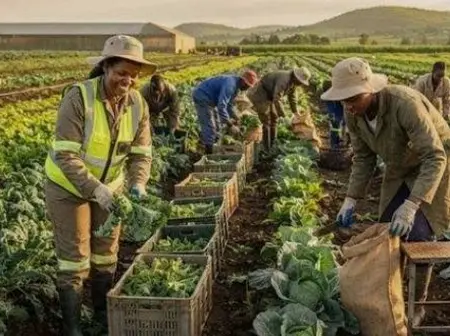
The United Kingdom has reopened applications for its Seasonal Worker visa programme, creating opportunities for foreign nationals, including Kenyans, to take up temporary jobs on British farms.
The programme allows successful applicants to work in horticulture and poultry production for periods of up to six months.
It aims to address labour shortages during harvesting seasons and the busy Christmas poultry production period.
For the 2026 and 2027 seasons, the UK has allocated 41,000 positions for horticultural workers and 1,900 slots for poultry workers.
The scheme has also been extended until 2029 to provide employers and recruitment operators with greater certainty.
Horticultural jobs include picking strawberries and other fruits, harvesting mushrooms, working in flower production and managing tree nurseries.
Meanwhile, poultry positions cover 12 occupations, including poultry processing, butchering, poultry catching and food operations.
However, applicants must arrive between October 2 and December 31, with applications closing by November 15.
The financial benefits are among the main attractions for Kenyans considering the opportunity. Workers aged 21 and above are entitled to the UK's national minimum wage of £12.71 per hour, equivalent to approximately KSh 2,270.
This is significantly higher than Kenya's general minimum monthly wage of approximately KSh 15,200. However, workers should account for accommodation and other expenses when calculating their potential savings.
Farm accommodation typically costs around £77 (KSh 13,800) weekly, which may be deducted from workers' earnings.
Applicants must also pay a visa application fee of £340 (approximately KSh 61,200). Additionally, they must demonstrate access to at least £1,270 (KSh 227,700) in savings held for 28 consecutive days, unless their sponsor agrees to cover their maintenance.
The Kenyan government has promoted the programme through its Mkulima Majuu initiative, working with recruitment partners to connect young people with overseas agricultural employment.
However, the arrangement comes with risks that applicants should carefully consider.
Workers are tied to their sponsoring employers and cannot freely change jobs. They are also prohibited from accessing public funds or bringing family members under the visa arrangement.
Recruitment-related debts and dependence on employers for accommodation have raised concerns about possible labour exploitation.
Kenyans interested in the opportunity should therefore deal only with approved scheme operators. They should also avoid agents promising employment or visas without the required Certificate of Sponsorship.
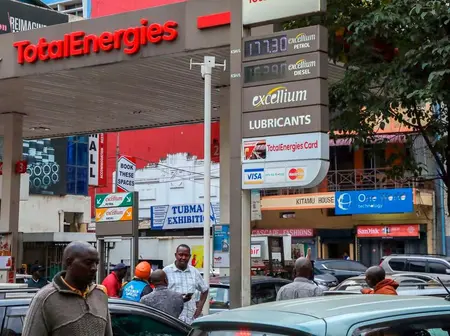
TotalEnergies Marketing Kenya PLC is fighting a directive that could see it investigated for allegedly charging oil dealers millions of shillings for fuel which was not delivered.
The oil marketer has asked the High Court to quash an Energy and Petroleum Tribunal judgment which ordered for the investigation, while also awarding two petrol stations Sh65.4 million for rent overcharge and unpaid rebates.
For residents and businesses along the Kimilili-Kapsokwony route, the key issue will be how the project translates into practical improvements. Better road access can make it easier for farmers to move produce to markets, for traders to transport goods and for residents to reach essential services. It may also improve connections between communities and trading centres. These benefits, however, will depend on the quality of the works and the timely completion of the project.
The KSh503 million allocation is one part of the broader road programme announced for the county. The 210-kilometre target suggests that the government intends to address connectivity beyond a single route. Residents will likely be watching to see which other roads are covered, how implementation progresses and whether the promised upgrades deliver lasting value.
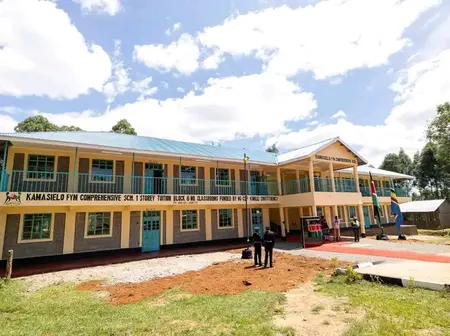
The two developments place roads and education at the centre of the visit. Their impact will ultimately be measured not only by the launch and commissioning ceremonies, but by the quality, accessibility and usefulness of the facilities once they are in service.
What are your views on the KSh503 million road project and the new school block in Kimilili? Share your remarks, views and comments in the comment section.
Speaking and issuing a formal statement on Monday, November 23, 2026, after joining the Head of State at the Nzoia Sugar Company grounds—where growers received KSh195 million in bonus payments—Mudavadi emphasized that domestic self-sufficiency begins with putting fair earnings directly into the pockets of local farmers.
According to the Prime Cabinet Secretary, the government is executing a structured turnaround under the Bottom-Up Economic Transformation Agenda (BETA) designed to make Kenyan sugar mills competitive enough to meet local demand.
Mudavadi explained that for decades, poor factory management and delayed payments discouraged cane cultivation, forcing Kenya to spend scarce foreign exchange importing sugar to bridge persistent local deficits.
To reverse that trend, the administration’s plan rests on several interlocking pillars demonstrated during the Nzoia factory visit.
First, the state is anchoring sector recovery on direct farmer incentives and timely compensation.
By rolling out a KSh1.2 billion national bonus pool—starting with Nzoia before extending next week to Mumias, Chemelil, Muhoroni, and Sony sugar factories—alongside weekly payments upon cane delivery, the government aims to motivate growers to expand acreage under sugarcane.
Second, the strategy relies on private-sector leasing and factory modernization to eliminate chronic operational inefficiencies.
At Nzoia Sugar, leasing management to the Rai Group has already unlocked KSh1.9 billion in immediate upgrades—including irrigation of 3,600 acres—and drastically improved milling efficiency from requiring up to 21 tonnes of cane to produce one tonne of sugar down to just 11 tonnes.
Third, the government has paired management reforms with KSh117 billion in historical debt write-offs and subsidized fertilizer priced at KSh2,000 per 50-kilogram bag to lower farm input costs.
Mudavadi noted that boosting local production while strengthening household incomes in the Western and Nyanza sugar belts ensures that agricultural wealth circulates among ordinary citizens rather than funding foreign sugar exporters.
The Kenya Revenue Authority (KRA) is battling Sh139 billion in disputed tax assessments arising from audits of multinational companies, exposing the scale of revenue claims contested over transactions between Kenyan subsidiaries and their foreign affiliates.
The disputed taxes are at different levels of appeal as the taxman intensifies scrutiny of cross-border transactions suspected of being used to shift profits out of Kenya and reduce corporate tax liabilities.
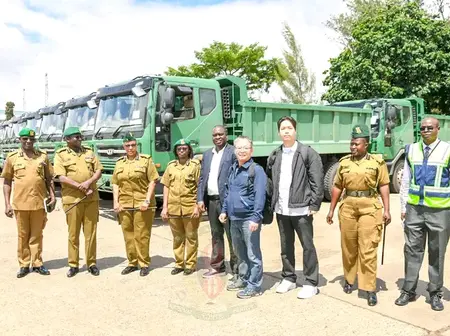
To ensure the new fleet remains in good working condition, NYS has also rolled out a four-week specialised technical training programme for personnel tasked with operating and maintaining the equipment.
The programme was officially launched on Monday, November 23, by Deputy Commandant General Evans T. Yaite at NYS Camp MTB.
Through the partnership, Hyundai Corporation, working alongside its local agent POSCO International, will provide technical support and training to the officers responsible for the trucks.
The sessions will cover essential areas such as servicing, troubleshooting, routine maintenance and repair of the newly acquired machinery.
The initiative is also expected to strengthen NYS's ability to undertake its operational and commercial activities without unnecessary equipment-related interruptions.
The acquisition forms part of a broader strategy to improve the Service's capacity through investments in modern, efficient and fit-for-purpose machinery.
NYS is also implementing eight business models aimed at strengthening its commercial operations and promoting long-term institutional sustainability.
Senior officers present during the training launch included Nairobi Regional Commander Jane Kiogora and NYS Camp MTB Commanding Officer Enock Nyandege, alongside technical trainers from Hyundai.
Have you ever wondered whether ordinary Kenyans can comfortably afford the houses being offered under the government's affordable housing programme?
The idea sounds attractive. After all, owning a decent home is a dream shared by many families. However, the figures involved raise an important question about who can realistically benefit from the programme.
Under the Boma Yangu affordable housing programme, a one-bedroom unit is advertised at approximately KSh 960,000. A buyer is expected to make a 5 per cent deposit of KSh 48,000, followed by monthly payments of about KSh 5,200.
At first glance, these figures may appear manageable. But the reality is different for many low-income households struggling to meet their daily needs.
Consider Otieno, a Kenyan living in a small mabati house where he pays KSh 2,000 in monthly rent. Unfortunately, he has fallen three months behind on his rent.
For someone in Otieno's situation, finding KSh 48,000 for a deposit is already a major challenge. Paying KSh 5,200 every month could be even more difficult, especially when food, school fees, transport and other basic expenses compete for the same limited income.
This is where the debate about affordable housing becomes important.
The programme is not necessarily designed exclusively for the poorest households. However, its success should also be measured by whether low-income earners can access the homes without facing financial difficulties.
A house may be affordable on paper but remain out of reach for someone whose income barely covers basic necessities.
The government has a difficult question to answer: how can ordinary Kenyans, especially those earning little or working in the informal sector, benefit from this housing programme?
After all, affordable housing should not only offer attractive prices. It should also reflect the financial realities of the people it is meant to serve.
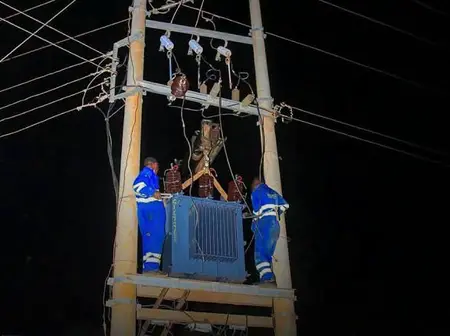
Kenya Power has announced planned electricity interruptions in several parts of the country on Tuesday, November 24, 2026, as technicians have scheduled maintenance works expected to affect customers for several hours.
The utility company has issued a notice informing residents and businesses in the affected areas to prepare for temporary outages, with some locations expected to remain without electricity for up to 10 hours as crews carry out maintenance.
According to the announcement, the interruptions have affected selected areas across Nairobi, Kiambu, Garissa, Kwale and Mombasa counties, with different locations scheduled to experience outages at varying times.
In Nairobi, customers around Garrison and parts of Utawala have been scheduled for an interruption from 8am to 6pm.
The affected areas have included Garrison, Simba Villa, GSU, Astrol Petrol Station, Quickmart, APTC, GSU Training, Dipole, Naivas Utawala, Muthokinju and MK Apartments, alongside neighbouring customers.
Parts of Parklands have also been scheduled for maintenance between 9am and 5pm. The interruption has covered sections of Mithithi, Westlands Road, Chiromo Road, Mpaka Road, ABC Bank and nearby customers.
Residents in parts of Kahawa have similarly been notified of an outage running from 9am to 5pm, affecting Fountain Junior, KiU Police, Booster Area, Kwangete, Kimbo, sections of Githurai 45, Kiuu, New Kahawa and Sukari 7.
The maintenance programme has extended beyond Nairobi, with customers in parts of Kiambu County also expected to experience interruptions.
In Kiambu, Ondiri, Muguga Complex and Kamangu have been listed for maintenance from 9am to 5pm, including Conix Fact, Ondiri, Rumwe, Muguga Complex, Kanyayo and nearby customers.
Parts of Garissa County have also been affected, with Modika C.A.K, Quba, Mwangaza and Sumeya scheduled for an outage from 9am to 5pm. The notice has listed Maua Millers, KPLC Yard, Modika C.A.K, Sumeya, Quba, Bulla Hagar and Duale Farm.
In Kwale, sections of Tiwi and Musufini, including Tiwi water bore holes, have been scheduled for interruption from 9am to 5pm.
Meanwhile, Mombasa customers around Jamhuri Road, parts of Greenwood Drive and Mama Ngina Drive have been notified of a shorter outage running from 9am to 4pm, affecting Nyali and nearby areas during scheduled maintenance works.
The payment was announced on Monday, November 23, during the President's visit to Nzoia Sugar Company in Kanduyi, where he praised efforts to revive the struggling sugar miller and improve farmers' earnings.
Ruto said the bonus was intended to reward farmers for their contribution to the sugar industry and encourage increased cane production to support local manufacturing.
He maintained that the government was committed to strengthening the sugar sector by addressing challenges that had affected farmers and factories for years.
The Head of State also praised Rai Group, which manages Nzoia Sugar Company under a leasing arrangement, for improving the factory's operations and restoring its production capacity.
According to the President, the revival of the miller has created renewed opportunities for farmers who depend on the factory as a market for their sugarcane.
Nzoia Sugar Managing Director Tejveer Rai said the company had paid farmers KSh1.6 billion this year and invested KSh5.7 billion in modernising the factory.
He also reported that the company had remitted KSh688 million in taxes and KSh639 million in lease and concession fees.
Ruto further promised to double bonus payments to Nzoia sugarcane farmers in 2027, urging growers to increase production to sustain the industry's recovery.
The latest payout forms part of broader government efforts to support sugarcane farmers, improve factory operations and strengthen the country's sugar production.