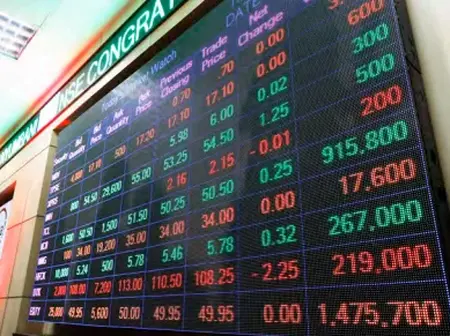
Banking stocks came under pressure at the Nairobi Securities Exchange last week as investors took profits following a strong rally driven by improved third-quarter earnings across the sector.
Absa Bank Kenya, KCB Group and Equity Group were among the biggest losers on Friday shedding 3.2 per cent, 2.8 per cent and 1.8 per cent, respectively, as enthusiasm over strong earnings began to ease.
The pullback follows Equity Group and KCB reporting robust financial performance for the nine months to September, reinforcing the banking sector's profitability even as investors reassess valuations after recent share price gains.
Equity Group reported a 32 per cent increase in net profit to Sh71.5 billion, up from Sh54.1 billion in the corresponding period last year.
Its profit before tax rose 37 per cent to Sh89.8 billion, supported by stronger regional operations, growing non-funded income and improved asset quality.
Total income increased 23 per cent to Sh192 billion, while non-funded income grew 34 per cent to Sh84.3 billion, accounting for 44 per cent of total income. The group's non-performing loan ratio also improved to 9.3 per cent from 12.1 per cent.
KCB Group's net profit attributable to shareholders increased 24.3 per cent to Sh57.2 billion, compared with Sh46 billion a year earlier.
Total operating income rose 12.3 per cent to Sh167.8 billion, while loan-loss provisions declined 9.1 per cent to Sh16.6 billion, reflecting improved credit quality.
The lender's non-performing loan ratio eased to 13.3 per cent from 17.8 per cent, while its cost-to-income ratio improved to 43.7 per cent from 46.2 per cent.
Despite the strong earnings, the latest price movements suggest investors are becoming more cautious about chasing banking stocks after the recent gains, with attention shifting towards whether the improved profitability can be sustained.
The broader market also reflected the subdued sentiment.
According to the Central Bank of Kenya's weekly bulletin, the Nairobi All Share Index declined 0.78 per cent and the NSE 20 Share Index fell 0.16 per cent in the week to November 19, while the NSE 25 gained 0.14 per cent.
Although share volume rose 3.44 per cent, equity turnover fell 18.79 per cent, and market capitalisation declined 0.77 per cent, pointing to weaker trading activity and reduced investor appetite.
The slowdown extended to the fixed-income market, where turnover in the domestic secondary bond market dropped 33.4 per cent, suggesting reduced activity in government securities trading.
However, demand for government borrowing remained strong in the primary market, highlighting investors' continued preference for relatively predictable returns amid fluctuations in equities.
At the Thursday Treasury bill auction, investors submitted bids worth Sh44.1 billion against the advertised Sh28 billion, representing a performance rate of 157.5 per cent.
Similarly, the Wednesday Treasury bond auction attracted Sh85.6 billion in bids against an offer of Sh50 billion, translating to an oversubscription rate of 171.1 per cent. Interest rates on the three Treasury bill tenors also declined marginally.
The strong appetite for government securities, even as equity turnover weakened, points to a market where investors are balancing opportunities for capital gains against the relative certainty of fixed-income returns.
Leave a Reply