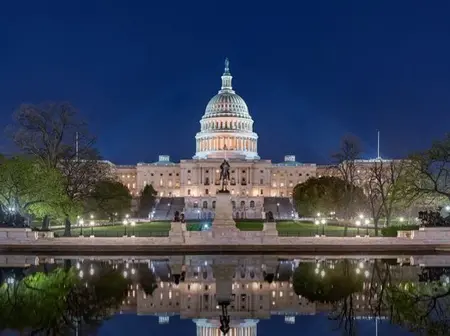
The 2026 United States (US) midterm elections could reshape America’s troubled diplomatic relations with Africa after Democrats won control of both chambers of Congress in a major political setback for President Donald Trump.
The Democratic victories in the House of Representatives and Senate allow the opposition party to scrutinise Trump’s foreign policy, challenge controversial executive decisions and demand greater accountability over America’s engagement with African countries.
Five countries stand out: South Africa, Rwanda, Somalia, Ghana and Nigeria. All have experienced significant tensions with the Trump administration over trade, immigration, security cooperation, development assistance or national sovereignty.
The election result does not automatically reverse Trump’s policies. The president retains substantial executive authority over foreign affairs, immigration and military operations. However, a Democratic-controlled Congress can investigate the administration, scrutinise spending, influence legislation and make it harder for the White House to pursue its agenda without political resistance.
For African governments, the central question is whether the new congressional majority will translate its electoral victory into a more accountable and predictable US foreign policy.
South Africa could find renewed support in Congress following Washington’s latest move against its trade relationship with Pretoria.
On November 2, 2026, US Trade Representative Jamieson Greer announced that President Trump had notified Congress and the South African government of his intention to terminate the country’s African Growth and Opportunity Act (AGOA) eligibility from 1 January 2027. Rwanda received the same notification.
The decision threatens preferential access to the American market for eligible exports, with potential consequences for South African businesses, manufacturing and employment.
A Democratic-controlled Congress could increase pressure on the administration to justify the decision, examine its economic consequences and pursue a more predictable approach to US-Africa trade. Congress also has an important role in AGOA’s legislative framework.
Rwanda faces an additional diplomatic challenge. On October 28, the US Treasury sanctioned Rwanda’s Ministry of Defence and Zigama Credit and Savings Society over claimed support for the M23 armed group in eastern Democratic Republic of Congo.
Washington accused Rwanda of supporting M23 through military equipment, logistics and training. Kigali has disputed allegations concerning its involvement in the conflict and maintains that regional security concerns must also be addressed.
Democratic lawmakers could push for stronger congressional oversight of sanctions and the Washington Accords peace process. However, concerns about instability and human rights abuses in eastern DRC are not exclusive to Republicans. Rwanda should therefore expect scrutiny to continue even under a different congressional leadership.
Somalia could benefit from renewed congressional scrutiny of Trump’s immigration restrictions.
The US State Department confirms that visa issuance to Somali nationals was suspended from 1 January 2026 across immigrant and non-immigrant categories, subject to specified exceptions.
The restrictions have implications for family reunification, education, business travel and the Somali diaspora.
Democrats could challenge the humanitarian consequences of the policy through hearings, legislative proposals and oversight of immigration enforcement. However, congressional opposition alone cannot automatically overturn a presidential entry restriction.
Ghana presents a different test of US-Africa relations: the sovereignty of African countries over their health systems and sensitive medical information.
Ghana rejected a proposed US health assistance compact worth approximately $109 million over five years after raising concerns about access to pathogen information, medical records, counterpart funding and the regulatory authority of its Food and Drugs Authority.
Speaking at the Council on Foreign Relations in September 2026, President John Mahama questioned the proposed access to Ghanaian medical information:
“I mean, who takes another country’s medical records?” The Democratic majority could increase scrutiny of the conditions attached to American development assistance, particularly health-data protection and the autonomy of recipient countries.
For Ghana, the issue goes beyond the value of the rejected agreement. It concerns whether development partnerships respect national institutions and public-interest safeguards.
Nigeria’s relationship with Washington could also come under increased congressional scrutiny, particularly over military cooperation, counterterrorism and religious freedom.
On December 25, 2025, US forces conducted airstrikes against Islamic State-linked targets in Sokoto State. However, Nigeria’s government confirmed that the operation was conducted in coordination with Nigerian authorities and with President Bola Tinubu’s approval.
The distinction matters because President Trump had previously framed US intervention in Nigeria around the alleged persecution of Christians, while Abuja has maintained that terrorism threatens Nigerians across religious communities.
A Democratic-controlled Congress could demand greater transparency about the intelligence behind military operations, civilian protection and the legal framework governing US involvement.
It could also question whether Washington’s approach strengthens Nigeria’s security institutions or creates further diplomatic tensions.
Nevertheless, counterterrorism cooperation is likely to retain bipartisan support. Nigeria should expect greater congressional oversight rather than an automatic end to American military assistance.
Beyond trade, immigration and military relations, the election raises broader questions about democracy, human rights and accountability.
The 2026 CIVICUS State of Civil Society Report offers an important framework for understanding these challenges. Covering developments during 2025 and early 2026, it warns that unaccountable power is on the offensive, with powerful states weakening international institutions and undermining human rights protections.
The CIVICUS Monitor’s current country ratings also reveal significant civic-space challenges across the five countries: South Africa and Ghana both score 60/100 and are classified as having obstructed civic space, while Rwanda scores 25/100, Somalia 28/100 and Nigeria 36/100, with all three classified as having repressed civic space.
These ratings measure the conditions in which civil society organisations, journalists, activists and citizens exercise fundamental freedoms. They are not assessments of US foreign policy or evidence that American pressure will necessarily improve civic space.
Nevertheless, they provide an important lens for evaluating Washington’s engagement with African governments.
A Democratic-controlled Congress could place greater emphasis on human rights reporting, democratic accountability, press freedom and protection of civil society organisations when scrutinising US assistance and diplomatic partnerships.
For African civil society organisations, this could create additional opportunities to engage American lawmakers and raise concerns about government accountability and restrictions on fundamental freedoms.
The Democratic victory in the 2026 US midterm elections presents an opportunity for African governments to reassess their diplomatic engagement with Washington.
South Africa and Rwanda could seek congressional intervention or greater scrutiny over their impending AGOA exclusions. Somalia could find political support for reviewing immigration restrictions, while Ghana may benefit from renewed debate about the conditions attached to American development assistance.
Nigeria, meanwhile, could use congressional oversight to reinforce the importance of sovereignty, transparency and accountable security cooperation.
However, African governments should avoid assuming that Democratic control means a return to the traditional US foreign policy approach. Competition with China, counterterrorism, critical minerals, migration control and American commercial interests are likely to remain central to Washington’s Africa strategy.
The real test will be whether the new Congress can turn electoral change into meaningful policy accountability. For the five countries facing diplomatic difficulties with Washington, the midterm elections offer a new political opening, but not a guaranteed diplomatic reset.
Leave a Reply