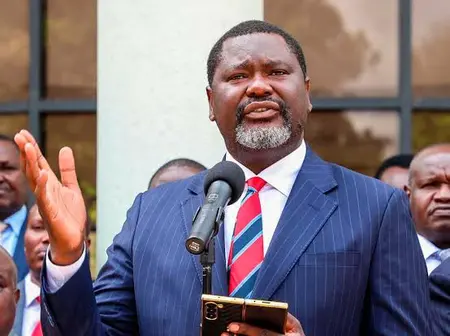
Public Service Cabinet Secretary Geoffrey Ruku has sparked a fierce academic showdown in the Nairobi gubernatorial race by sparing only one rival from scrutiny.
Speaking during a live morning interview on Radio Generation on Tuesday, November 24, 2026, Ruku challenged all politicians eyeing Nairobi's top seat to publicly present their university degree certificates. The former Mbeere North MP, who has declared interest in leading the capital, singled out Embakasi East MP Babu Owino as the only competitor whose academic credentials do not need verification.
"I'm asking all those whom I'm competing with, other than Babu Owino, to give us their degree certificates," Ruku stated during the broadcast. "Babu Owino's certificates are legitimate. And as a Minister of Public Service, who is also in charge of integrity, I will ensure that nobody presents fake certificates to IEBC."
Ruku’s remarks immediately drew sharp reactions across Nairobi's political circles, especially given the history of academic disputes in previous Kenyan elections. While Ruku holds a Bachelor of Commerce and a Master of Business Administration in Finance from the University of Nairobi, he framed his demand as an integrity check meant to protect Nairobi residents from leaders who forge papers to access public funds.
Babu Owino, whose real name is Paul Ongili, has long made his academic record a central pillar of his political brand. The Embakasi East legislator holds a First Class Honours degree in Actuarial Science and a Law degree from the University of Nairobi, and he was admitted as an Advocate of the High Court of Kenya in May 2025. He has frequently used his qualifications to mock rivals whenever election vetting begins.
However, Ruku’s challenge has met pushback from rival camps and legal observers on social media. Critics pointed out that while a university degree is a statutory requirement for governors under the Elections Act, vetting falls strictly under the Independent Electoral and Boundaries Commission (IEBC) and the Commission for University Education—not a sitting Cabinet Secretary who is also an interested aspirant.
Supporters of other Nairobi hopefuls, including incumbent Governor Johnson Sakaja and Environment Chief Officer Geoffrey Mosiria, also weighed in online. Many questioned why Ruku was policing rivals' papers instead of addressing pressing city issues such as garbage collection, traffic congestion, and stalled county projects.
For ordinary Nairobi taxpayers, the debate revives familiar memories of the 2022 election cycle, when prolonged court battles over university degrees dominated headlines while service delivery took a back seat. As early alignments for the 2027 general election take shape, voters are watching closely to see whether aspirants will focus on fixing the capital's daily challenges or spend months trading barbs over academic transcripts.
Do you think vetting university degrees makes Nairobi leaders more accountable, or is it just a distraction from real service delivery?
Leave a Reply