Kenya spends up to Sh25 billion annually to keep people living with HIV on treatment, a bill that may become increasingly difficult to sustain as international donors reduce their support.
Foreign donors finance about 66 per cent of Kenya's HIV programme, while the government and other domestic sources contribute about 34 per cent. The United States, which foots most of the bill, expects Kenya to take over the full cost of its HIV programme by 2030.
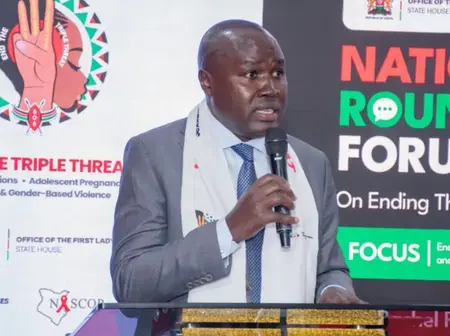
National Syndemic Diseases Control Council (NSDCC) chief executive Douglas Bosire said one way to reduce the long-term financial burden is to prevent new infections, particularly among children, who would otherwise require lifelong treatment.
Kenya recorded 3,396 new HIV infections among children aged below 15 in 2025.
Bosire said 72 per cent of these infections were associated with mothers reporting late for antenatal care or failing to take their HIV medication consistently during pregnancy and breastfeeding.
Bosire urged men to support their pregnant wives in accessing health facilities, including helping them meet transport costs.
“We are not saying too much; we are just saying let her go for four ANC visits. During those four ANC visits, apart from the HIV care, there are some other health benefits that she gets from the process,” he said.
He spoke in Nairobi during the launch of activities to mark World Aids Day 2026, which will be observed on December 1 under the theme, Ending Aids starts with access.
The campaign calls for fair access to HIV prevention, testing, treatment and care, while protecting human rights and ensuring adequate resources to sustain the response.
The financial pressure comes at a time when Kenya is still struggling to ensure children living with HIV receive the same level of care as adults.
The country has about 1.4 million people living with HIV, and 69,330 of those are children.
Bosire said nearly half of the children receiving treatment have not achieved viral suppression, meaning the amount of HIV in their bodies has not been reduced to undetectable levels.
He said while children account for only 4.7 per cent of Kenyans living with HIV they contribute 11.5 per cent of Aids-related deaths.
Bosire said Kenya had made significant progress in reducing new infections and keeping people living with HIV on treatment, but warned against confusing progress with success.
Kenya recorded 13,936 new HIV infections in 2025, down from 32,027 in 2021, representing a 56.5 per cent reduction. However, this still translates to about 38 new infections every day. At least 19,434 people died of HIV-related causes last year.
Of the new infections, adolescents and young people aged 15 to 24 accounted for 4,322.
Children, adolescents and young people together account for 55 per cent of new infections, making them a major priority in the country's HIV response.
Bosire said infections among young people remained particularly worrying because those who acquire HIV must live with the virus and take medication throughout their lives.
“These are children who are in school. These are children who are about to sit for their Grade 9 examinations, children in high school and institutions of higher learning. When a child gets HIV at the age of 15 or 16, that child has to live with the virus for life,” he said.
He called for stronger sexuality education in schools, saying young people needed accurate information to make informed decisions about their sexual health. He also challenged religious leaders to take a more active role in HIV prevention.
The council chief raised concern about the high number of men dying from HIV-related illnesses, despite women making up about 65 per cent of people living with HIV.
He said men were dying disproportionately because many were not getting tested and seeking treatment early enough.
“Men have to get tested. When you look at the statistics, 65 per cent of those living with HIV are women, but the deaths are almost 50-50. This means men are dying disproportionately more than women,” he said.
Bosire also called for more targeted services for key populations, who continue to carry a much higher HIV burden than the general population.
He cited HIV prevalence of 27 per cent among female sex workers, 19 per cent among men who have sex with men, nine per cent among people who inject drugs and 22 per cent among transgender people, compared with about three per cent nationally.
He said declining international funding was forcing Kenya to rethink how it delivers HIV services, including integrating programmes for key populations into ordinary health facilities.
Bosire said about 87 per cent of Kenyans living with HIV were virally suppressed, meaning treatment had reduced the amount of virus in their bodies to undetectable and they cannot transmit it.
He estimated that treating one person costs between Sh15,000 and Sh20,000 annually, translating to between Sh20 billion and Sh25 billion for the country's HIV population.
He said the ultimate goal should be to stop new infections rather than concentrate only on treating those already living with the virus.
“Our desire is that by 2030, we will have zero new HIV infections. We are not saying that by 2030 we will not have people living with HIV. There will still be more than one million Kenyans living with HIV because we have succeeded in keeping people on treatment.”
The World Aids Day activities will begin with a national half marathon at Nyayo National Stadium in Nairobi on November 29.
The event will feature a 21km competitive race, a 10km road race, a 10km wheelchair race, a 5km family and corporate race and a 2km children's fun run.
On December 1, activities will take place across all 47 counties, including community dialogues, public accountability forums, candle-lighting ceremonies, memorial vigils and distribution of dignity packs.
Leave a Reply