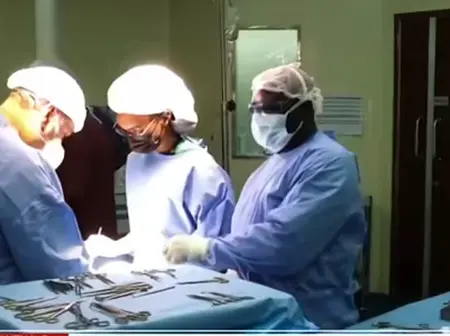
The procedure is being described as the first documented full-arm replantation of its kind in East Africa, highlighting the growing capacity of Kenyan hospitals to handle highly specialised surgical emergencies.
According to the hospital, the patient suffered a severe industrial accident that resulted in the complete amputation of his right arm.
He was rushed to the facility as an emergency case, where doctors first worked to stabilise his vital signs before preparing him for the complicated operation.
Given the severity of the injury, the hospital assembled a multidisciplinary surgical team to carry out the procedure.
The 10-hour operation brought together specialists in plastic and reconstructive surgery, orthopaedic surgery, vascular surgery, anaesthesia and critical care.
The surgeons faced the difficult task of reconnecting several structures that had been completely severed, including bones, muscles, tendons, blood vessels and major nerves.
Restoring blood circulation was particularly important because the survival of the reattached arm depended on establishing an adequate blood supply.
Dr Esther Gathura, the hospital's Section Head and Consultant Plastic, Hand and Reconstructive Surgeon, explained that reattaching an entire arm was considerably more complicated than reconnecting an amputated finger or hand.
She noted that the procedure required exceptional precision, specialised microsurgical skills and close coordination among different medical teams.
The doctors had to balance the need to preserve the patient's life with the challenge of restoring the affected limb and giving it the best possible chance of regaining functionality.
The orthopaedic component was led by Dr Edward Jenner, a Consultant Orthopaedic Surgeon at the hospital.
His team concentrated on restoring and stabilising the arm's skeletal structure, providing the foundation for the reconstruction of the surrounding tissues.
Dr Jenner explained that successful replantation involved much more than simply attaching the amputated body part. The bones had to be properly stabilised, while the damaged tissues needed careful reconstruction to improve the chances of recovery.
Following the lengthy operation, the patient remained under intensive care monitoring before being moved to a lower level of care.
The hospital subsequently reported that his condition was stable and the reattached arm remained viable, with encouraging blood circulation.
He has also started early rehabilitation aimed at supporting the gradual recovery of movement and sensation in the affected limb.
However, the hospital has not indicated how much movement or sensation the patient is expected to regain or how long his rehabilitation will take.
The achievement builds on the hospital's previous experience in complex reconstructive surgery.
Earlier in 2026, its medical team successfully reattached three amputated fingers belonging to a woman who had sustained severe injuries in a separate workplace accident.
The woman reportedly recovered and returned to her normal activities.
For Kenya, the successful procedure represents an important development in the country's ability to manage complicated traumatic injuries without necessarily requiring patients to seek specialised treatment outside the region.
Source
Leave a Reply