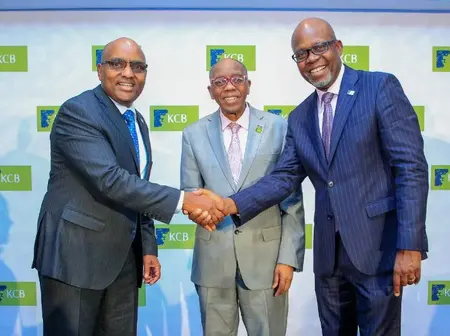
KCB Group's net profit rose 24 per cent to Sh58.6 billion in the nine months to September 2026, driven by stronger regional operations, more digital transactions, and improved asset quality.
This is despite declining interest rates that continue to reshape the banking industry's earnings environment.
Earnings per share rose 24.3 per cent to Sh17.80, underscoring improved shareholder returns.
Total income grew 12.3 per cent to Sh167.8 billion, up from Sh149.4 billion a year earlier, supported by increased lending activity and higher transaction volumes.
This outpaced the 6.1 per cent growth in operating costs, helping improve the cost-to-income ratio to 43.7 per cent from 46.2 per cent.
The results point to the benefits of the group's investments in technology, distribution and regional expansion, which have helped it generate more income without a corresponding increase in operating expenses.
A significant driver was non-funded income, which rose 21.8 per cent to Sh54.9 billion, accounting for nearly a third of total income.
Funded income, largely generated from lending, increased by a slower 8.2 per cent to Sh112.9 billion.
The growth in transaction-based earnings reflects the group's push to diversify revenue sources amid declining interest rates, which have put pressure on traditional lending margins.
KCB's mobile lending business recorded a 26 per cent increase in disbursements to Sh492 billion in the third quarter, equivalent to about Sh1.8 billion daily.
Foreign exchange income also increased 65.1 per cent, supported by higher transaction volumes, particularly through Trust Merchant Bank (TMB) in the Democratic Republic of Congo.
The group has also expanded services on its unified mobile banking application, incorporating money market funds, Pesalink and bill payment solutions to generate additional transaction income.
The strategy comes at a time when banks are experiencing narrowing lending margins.
Latest data by the Central Bank of Kenya (CBK) show the spread between average lending and deposit rates narrowed to 7.46 percentage points in July, its lowest level in 10 months, putting pressure on lenders that depend heavily on interest income.
KCB's regional subsidiaries continued to provide an important growth engine, contributing 33.4 per cent of group net profit.
Profit after tax from businesses outside Kenya increased by 24.3 per cent to Sh19.6 billion, supported by improved performance in Burundi, South Sudan, Uganda and the Democratic Republic of Congo.
The group's total assets expanded 15.4 per cent to Sh2.4 trillion, supported by a 15 per cent increase in customer deposits to Sh1.8 trillion and an 11 per cent rise in gross loans to Sh1.4 trillion.
Its Kenyan banking business remained the largest contributor, with profit after tax increasing 20.7 per cent to Sh40.8 billion and its balance sheet expanding 13 per cent to Sh1.6 trillion.
In September, KCB increased its stake in TMB from 85 per cent to 98 per cent, strengthening its position in the Democratic Republic of Congo, one of the region's major banking markets.
The increased ownership gives the group a greater share of earnings from the subsidiary while reinforcing its regional diversification strategy.
The lender also recorded an improvement in asset quality, with gross non-performing loans falling 17.1 per cent to Sh184.1 billion from Sh222.1 billion a year earlier.
Consequently, the non-performing loan ratio declined to 13.3 per cent from 17.8 per cent, while loan loss provisions fell 9.1 per cent to Sh16.6 billion.
The cost of risk, which measures credit losses relative to the loan book, improved to 1.7 per cent from 2.1 per cent.
According to the banking regulator, industry-wide gross non-performing loans stood at Sh688.2 billion in June 2026, down from Sh728.5 billion a year earlier, as lower borrowing costs eased repayment pressure on some customers.
Commenting on the results, KCB Group chief executive Paul Russo attributed the performance to investments in technology, customer experience and regional capabilities.
The group's operating costs increased by 6.1 per cent, slower than income growth, while return on equity stood at 22.1 per cent and return on assets improved to 3.5 per cent.
Its capital position also remained strong, with core capital to risk-weighted assets at 18 per cent against a statutory minimum of 10.5 per cent. Total capital adequacy stood at 21.1 per cent, above the 14.5 per cent regulatory threshold.
The group also disbursed Sh20.8 billion in green loans during the third quarter and screened projects worth Sh451 billion under its environmental and social due diligence framework in the nine months.
Chairman Joseph Kinyua said strong capital buffers would provide room to absorb economic shocks while supporting future expansion.
Leave a Reply