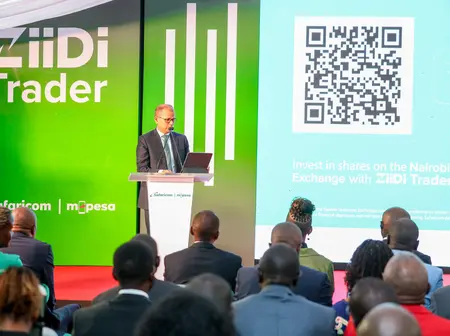
Safaricom’s Ziidi Trader is becoming an important distribution channel for Kenya’s securities market, with the mobile investment platform accounting for approximately 60% of applications in Quickmart’s KSh15 billion initial public offering. The disclosure by Capital Markets Authority Chairman Ugas Mohamed adds to earlier evidence of the platform’s role in bringing retail investors into major share transactions, including the Kenya Pipeline Company (KPC) IPO.
The figures point to a growing role for mobile-based investment services in connecting individual investors with the Nairobi Securities Exchange (NSE). Ziidi’s contribution to Quickmart’s offer follows its involvement in ordinary share trading, where the platform previously accounted for more than half of recorded purchase orders over a reported trading period in February and March 2026.
Between February 5 and March 10, Ziidi Trader processed 268,936 of the 433,498 share-purchase orders recorded by the NSE, according to figures reported by TechTrendsKE. This represented approximately 62.04% of purchase orders during the period. The average purchase value was KSh2,621, providing an indication of the transaction sizes passing through the platform.
The purchase-order figures measure trading activity rather than the value of shares bought. They also offer a different measure of adoption from the proportion of IPO applications submitted through Ziidi. Taken together, however, the figures show that the platform has established a substantial presence in both primary-market applications and secondary-market trading.
The Quickmart transaction follows an earlier demonstration of Ziidi’s reach during the KPC IPO. TechTrendsKE’s reporting on the offer put the number of retail applications submitted through the platform at approximately 36,000, against about 73,000 retail applications in total. This represented roughly 49.3% of applications in that investor category.
The Quickmart figure of approximately 60% suggests Ziidi accounted for a larger proportion of applications in the later offer. The two transactions provide evidence of repeat usage across separate public share offerings, although their investor classifications and application structures are not necessarily identical.
Ziidi’s adoption figures also offer context for its position in the market. Earlier reporting put its registered user base at approximately 511,000, with 84,000 accounts having actively purchased shares. The difference between those figures illustrates why registrations alone provide an incomplete measure of investment activity. Actual share purchases offer a more direct indication of customers using the service to participate in the market.
The platform was introduced in February 2026 through a partnership between Safaricom and the NSE, under the oversight of the Capital Markets Authority. It allows customers to access listed securities through the M-PESA ecosystem, with Kestrel Capital involved in the operating arrangement.
Its entry into the market also coincided with wider efforts to make share ownership accessible to smaller investors. The NSE introduced single-share trading in August 2025, lowering the minimum quantity required to purchase listed equities. In its November 17 reporting, TechTrendsKE noted that the number of junior equity investors had increased from 236 in December 2025 to 497 in September 2026, with their shareholdings valued at approximately KSh120 million.
These developments provide useful context for Ziidi’s growth. Mobile access and lower minimum purchase quantities address different barriers to participation, but both expand the routes through which individuals can enter the securities market.
Quickmart’s listing provides the latest example of the platform’s involvement in public share offerings. The supermarket’s KSh15 billion IPO involved the sale of two billion existing shares at KSh7.50 each, representing 50% of its issued share capital.
The offer attracted applications worth approximately KSh18.4 billion against the available shares, translating into a subscription rate of 122.7%, according to TechTrendsKE’s November 6 reporting. The transaction therefore attracted demand above the amount available for allocation.
The CMA chairman subsequently disclosed that local retail investors contributed approximately KSh2.9 billion to the offer, with Ziidi Trader handling around 60% of applications. His announcement places the platform within a transaction that attracted substantial participation from foreign, institutional and individual investors.
Quickmart’s IPO also provides a useful distinction between application activity and final ownership. Following the allocation, Kenyan and East African retail investors received approximately 199.64 million shares, equivalent to about 5% of the retailer’s issued share capital, according to the November 12 listing report.
The offer was a secondary share sale, meaning the proceeds went to existing shareholders rather than directly to Quickmart. The distinction is relevant when assessing Ziidi’s contribution: the platform facilitated access to an existing investment opportunity, rather than providing a funding channel for the supermarket’s operations.
Quickmart shares opened at KSh10 on their NSE debut, against the KSh7.50 offer price, giving the retailer an implied market capitalisation of approximately KSh40 billion. The listing followed an IPO valuation of KSh30 billion.
Ziidi Trader forms part of Safaricom’s broader effort to extend M-PESA into investment and wealth-management services. The company has developed a portfolio that includes Ziidi Money Market Fund, Ziidi Shari’ah and the share-trading platform, each serving a different investment purpose.
Safaricom’s financial results for the six months ended September 2026 show the scale of this wider business. The company reported 3.4 million active wealth-management customers and assets under management of KSh25.6 billion. Wealth-management revenue reached KSh100 million, representing growth of 69.8% against the comparable reporting period.
Those figures should not be attributed to Ziidi Trader alone. They cover Safaricom’s broader wealth-management activities, including money market and Shari’ah-compliant investment products. The company has not separately disclosed Ziidi Trader’s active customer numbers, trading volumes or transaction value in the results covered by the November reporting.
Safaricom’s wider financial services business also generated KSh7.1 billion in revenue during the six months to September 2026, an increase of 55.3%, according to the company’s results reported by TechTrendsKE. Chief Financial Services Officer Boniface Mungania is overseeing a business that encompasses payments, credit and investment services.
For Safaricom, the expansion into securities distribution adds another use case to its existing mobile customer network. Its partnership with the NSE gives the company a route into share trading and IPO applications without requiring it to operate as a standalone stock exchange.
The commercial opportunity lies in connecting a large existing digital financial services customer base to products that traditionally required engagement with capital-markets intermediaries. The Quickmart and KPC transactions demonstrate the platform’s ability to handle substantial application activity, while the NSE purchase-order figures show that its role also extends into routine trading.
The NSE’s investor base provides a wider measure of the market in which Ziidi operates. TechTrendsKE’s November 6 reporting put the exchange’s investor base at approximately 2.36 million, reflecting participation beyond the customer numbers associated with any single investment platform.
The CMA has also been developing its supervisory approach as participation in capital markets expands across money market funds, exchange-traded funds, real estate investment trusts and digital investment services. Its risk-based supervision approach, digital market surveillance and enforcement against unlicensed investment providers form part of the regulatory framework discussed in the authority’s November 4 reporting.
Greater digital access therefore operates alongside the need for investor protection and oversight. Platforms distributing investment products must operate within the capital-markets framework governing the securities and services they make available, while investors remain exposed to the ordinary risks associated with changes in share prices and market conditions.
For Ziidi, the record across KPC, Quickmart and ordinary NSE trading offers several measures of market adoption. Its reported share of IPO applications has grown between the two transactions, while its share of purchase orders shows that customers are also using the service outside public offers.
The development gives Safaricom a more substantial role in the infrastructure through which Kenyans access listed investments. As the NSE attracts retail applicants through major share offerings and smaller transactions, mobile distribution is becoming an important part of how those investors reach the market.
Leave a Reply