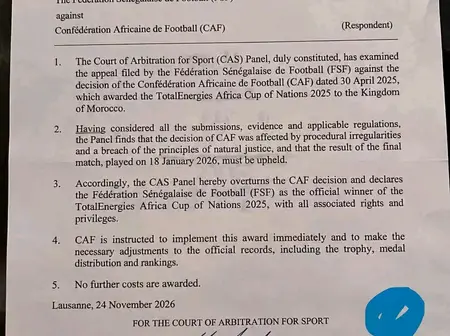
Senegal have officially regained their Africa Cup of Nations title after the Court of Arbitration for Sport (CAS) ruled in their favour in the long-running dispute surrounding the 2025 final against Morocco.
In a landmark decision delivered on Tuesday, 24 November 2026, CAS unanimously upheld the appeal filed by the Senegalese Football Federation against the Confederation of African Football (CAF) and the Royal Moroccan Football Federation. The ruling overturned the CAF Appeal Board's decision to declare Senegal the losers of the final and award Morocco a 3–0 victory. Instead, CAS reinstated the earlier decision of the CAF Disciplinary Board, confirming Senegal's original 1–0 victory after extra time.
The controversy dates back to 18 January 2026, when Senegal faced hosts Morocco in the final in Rabat. The match was heading towards its conclusion when Congolese referee Jean-Jacques Ngambo Ndala awarded Morocco a late penalty following a VAR review. Senegal's players and coaching staff protested the decision and temporarily left the pitch, bringing the match to a lengthy interruption.
After approximately 14 minutes, the Senegalese team returned and the match resumed. Morocco's Brahim Díaz subsequently failed to convert the penalty, while Pape Gueye scored the decisive goal in extra time to give Senegal a 1–0 victory. The result initially stood, but CAF's Appeal Board later ruled that Senegal had forfeited the match because of the team's temporary departure from the field.
That decision was challenged at CAS, which examined whether the referee's decision to restart the match could be reviewed under football's field of play doctrine. The Moroccan federation argued that Senegal had breached Articles 82 and 84 of the AFCON regulations, which address situations where a team refuses to continue or leaves the pitch without the referee's authorisation.
However, the CAS panel concluded that the referee's decision to resume or stop the match fell within his authority. It reasoned that both teams had returned to the pitch and expressed their willingness to continue before the referee restarted play. Consequently, the panel determined that the relevant tournament regulations applied to matches permanently abandoned by the referee, not one that had resumed and reached a sporting conclusion.
CAS therefore found that the referee had not committed an error of law. It also rejected the argument that his decision was arbitrary, acknowledging the extreme tension surrounding the final while finding no evidence that external factors had influenced his judgement.
The ruling does not mean that every disciplinary issue arising from the final has disappeared. CAS noted that the Senegalese federation, head coach Pape Thiaw and certain players had already received separate CAF disciplinary sanctions. Those sanctions were distinct from the dispute over the final's official result.
For Senegal, the verdict restores the title they originally celebrated in January and brings a decisive conclusion to months of uncertainty. For Morocco, it represents a reversal of the title awarded following CAF's earlier appeal decision.
Beyond the two national teams, the case carries significant implications for African football governance. It reinforces the importance of the referee's authority during a match and clarifies the distinction between temporary interruptions and permanent abandonment under tournament regulations.
Senegal are once again the 2025 African champions, not because CAS awarded them a new victory, but because the court restored the 1–0 result achieved on the pitch in Rabat.
Leave a Reply