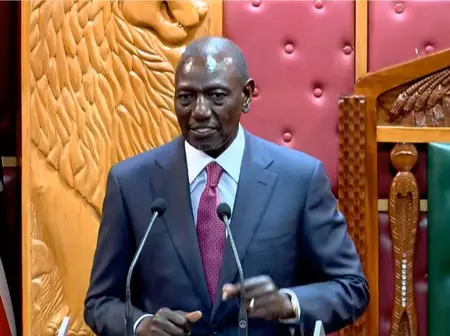
President William Ruto has defended increased government spending on education, saying investments in teachers, classrooms and laboratories are intended to reduce the financial burden on parents and make schooling more affordable.
Speaking during his State of the Nation Address to Parliament on Wednesday, November 18, 2026, Ruto said the government had increased the annual education allocation from Ksh521 billion in the 2022/23 financial year to Ksh784 billion in the current financial year.
The President said the additional funding was part of efforts to shift the responsibility of financing essential education services from households to the government, amid concerns over the cost of schooling.
He said parents had previously been forced to contribute towards hiring teachers, constructing classrooms and providing learning facilities in schools across the country.
Ruto said his administration had made significant progress in addressing the teacher shortage that stood at approximately 116,000 when he took office, noting that the government had recruited 100,000 teachers over the past four years.
He added that another 20,000 teachers were expected to be recruited, a move he said would improve learning conditions and reduce the need for parents to fund teachers hired through school Boards of Management.
“When we assumed office, Kenya faced a teacher shortage estimated at 116,000,” Ruto said.
“In four years, we have employed 100,000 teachers and are preparing to recruit another 20,000.”
The recruitment drive, according to the President, is intended to strengthen teaching capacity in public schools while reducing the financial pressure on households that have been forced to contribute towards staffing costs.
The Head of State also highlighted investments in school infrastructure, saying the government had constructed 23,000 classrooms and was undertaking the construction and equipping of 1,600 laboratories.
He said the infrastructure projects were designed to expand access to learning facilities and ease the financial demands placed on communities to improve schools.
“We have built 23,000 classrooms and are constructing and equipping 1,600 laboratories,” Ruto said.
The President argued that the investments would help reduce the pressure on parents to meet costs associated with essential school infrastructure, while improving the learning environment for pupils and students.
Ruto said the increased education allocation must be properly managed and reach schools on time, warning that parents should not be forced to finance government obligations through unauthorised charges.
He said the objective of increasing public expenditure on education was to make schooling more accessible and affordable while ensuring learners acquire skills that can help them secure employment in the future.
“Our resources must reach schools promptly and be managed responsibly. Parents should not be required to carry public obligations through unauthorised charges,” he said.
The President said education remained a critical investment in household incomes and the country’s economic growth, arguing that keeping children in school and equipping them with practical skills would strengthen families and the nation.
Ruto also addressed the ongoing national examinations, saying 3.6 million learners were sitting the Kenya Primary School Education Assessment (KPSEA), Kenya Junior School Education Assessment (KJSEA) and Kenya Certificate of Secondary Education (KCSE).
He described the cohort as the largest in the country’s history and said the examinations had been conducted in a calm environment without the tension and heavy security deployments witnessed in previous years.
“For the first time in 65 years, examination papers were printed here in Kenya,” he said, adding that the examinations had been conducted in an orderly atmosphere.
Ruto said examinations should be treated as a normal part of learning rather than events that instil fear among candidates, insisting that assessments should measure learners’ progress without threatening their future.
He said the government’s education investments were aimed at lowering the cost of schooling, improving access to facilities and preparing learners for productive employment.
Leave a Reply