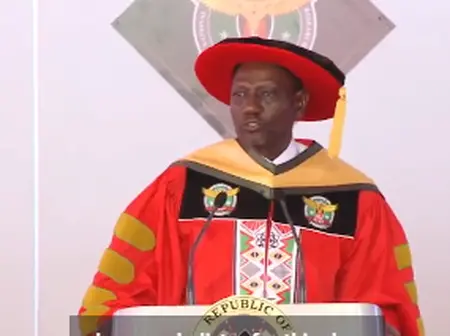
President William Ruto has challenged universities in Kenya to redesign their teaching around real-world problems and strengthen partnerships with employers, saying graduates need practical workplace experience before completing their studies.
The president outlined four commitments he wants universities to adopt, beginning with teaching through practical challenges rather than relying primarily on classroom instruction.
“I therefore challenge International Leadership University and every university in Kenya to make four commitments. First, teach through real challenges and problems,” Ruto said.
He proposed that counties provide students with urban planning challenges, hospitals share service delivery problems, while cooperatives present post-harvest losses for students to investigate and develop solutions.
“Let students apply their knowledge and give us results,” he added.
Ruto pointed to the response to the Government’s internship programme as evidence of the demand among young people for opportunities to gain practical experience.
He announced that the government had opened applications for 50,000 internship opportunities through a digital platform, with 150,000 applications received within 24 hours.
“Yesterday, we did announce, as Government of Kenya in internship opportunities for 50,000 students. The application will be on a digital platform. I am informed that by this morning we had 150,000 applicants within 24 hours,” he said.
The President said the applications reflected a large pool of graduates from technical and vocational institutions, Kenya Medical Training Colleges and universities seeking opportunities to apply their skills in actual workplaces.
“It tells you there is a big pool of graduates from our technical and vocational institutions, from our Kenya Medical Training Centres and from our universities who desire an opportunity to be in a workplace, to be in a real laboratory somewhere and to be in some real factory space to experience their engineering knowledge,” Ruto said.
He asked universities to take a more active role in securing workplace opportunities for their students instead of leaving the responsibility entirely to graduates.
The second commitment calls for employers to become more involved in university teaching and programme development.
“Second, bring employers into the classroom. Design programmes with industry and expand practical attachments so that students encounter the realities of workplace before graduation,” Ruto said.
He disclosed that he had met industry representatives, including the Kenya Private Sector Alliance (KEPSA) and the Kenya Association of Manufacturers, to discuss internship opportunities.
Ruto also announced plans to convene a meeting with university vice-chancellors before the Christmas break to discuss how institutions can expand access to workplace experience.
“And we are going to provide resources as government to pay for students,” he said, signalling plans for government support towards internship placements.
While academic training provides theoretical foundations, workplace attachments and industry partnerships can expose students to the demands of professional environments before graduation.
The challenge to ILU and other universities is therefore to demonstrate how students can use their knowledge to address actual problems in healthcare, agriculture, manufacturing and public service.
Leave a Reply