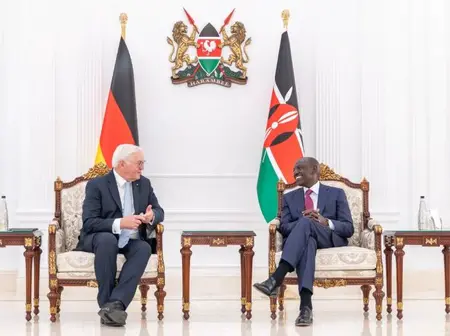

President William Ruto announced the agreement on Wednesday during a joint engagement with German President Frank-Walter Steinmeier at State House in Nairobi. Ruto said the number of Kenyans employed in Germany had risen from 7,170 in March 2024 to 9,500 in March 2026. Over the same period, the number of Kenyan trainees in Germany increased from 820 to 1,260.
The two countries made progress under their Comprehensive Migration and Mobility Partnership, which they signed in September 2024.
Ruto said the governments had discussed measures to simplify visa and recruitment procedures, improve language training, and speed up the recognition of professional qualifications to make it easier for Kenyans to access employment opportunities in Germany.
Kenya and Germany also discussed partnerships between Kenyan technical and vocational education institutions and German industries. The partnerships aim to equip young people with skills that meet the needs of the German economy.
The countries also explored opportunities for Kenyan seafarers through structured training, sea-time placements, and partnerships with German shipping companies. Ruto said the talks covered port modernization, sustainable shipping, and investment in maritime logistics, drawing on Germany’s maritime experience and the strategic locations of the ports of Mombasa and Lamu.
Ruto announced that Germany had committed €52.5 million (KSh7.8 billion) in development cooperation funding for Kenya for 2026–2028. The commitment followed intergovernmental negotiations in Berlin in June 2026.
The funding will build on Germany’s support for Kenya in renewable energy, agriculture, water and sanitation, infrastructure, and technical and vocational education.
“Building on this foundation, we seek to elevate our relationship towards one increasingly driven by trade, investment, technology transfer and private-sector collaboration,” he said.
More than 120 German companies already operate in Kenya. Ruto said the two countries could expand investment and business partnerships, including among micro, small and medium enterprises.
Kenya is seeking greater German investment in manufacturing, agroprocessing, infrastructure, healthcare, renewable energy and digital technology.
The President also pointed to opportunities under the Kenya-European Union Economic Partnership Agreement to grow exports of Kenyan products, including cut flowers, avocados, and fresh vegetables, to Germany and other European markets. The leaders discussed ways to address market access barriers, meet international quality standards, and promote locally processed exports.
“Kenya values Germany as a strategic partner in our pursuit of economic transformation and in advancing global peace and sustainable development. Our responsibility now is to translate the commitments we have made into measurable outcomes that improve the lives of our citizens,” Ruto said.
Leave a Reply