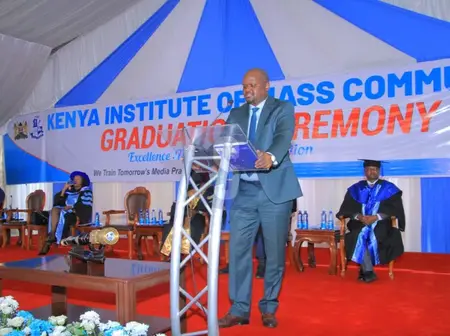
Radio Africa Group Editorial Director Paul Ilado has challenged journalism graduates to take an active role in reshaping the media industry, saying traditional business models have collapsed but journalism itself still has a future.
Ilado said the rapid transformation of the media landscape presented graduates with an opportunity to develop new ways of producing, distributing and commercialising content rather than depend entirely on conventional media houses for employment.
Addressing 498 graduands at the Kenya Institute of Mass Communication (KIMC) on Wednesday, Ilado said the industry needed a new generation of creative practitioners capable of building sustainable media enterprises and responding to technological changes.
"All the business models that have traditionally run media have collapsed, and this is where we need you, the class of 2026. We need you to participate in creating a new order," he said.
He challenged the graduates to use the skills acquired during their training to develop functional and sustainable media houses, arguing that the industry's difficulties should not be mistaken for the death of journalism.
"There is a future in the media, and no one should lie to you. No media is dying. What is happening is transformation," Ilado said.
He warned that graduates who failed to participate in that transformation risked becoming frustrated as the industry continued to evolve.
"You are either part of that transformation or you are not. And if you are, you will be grateful. If you are not, you will be extremely frustrated," he said.
Ilado used the contrasting experiences of English Premier League clubs Arsenal and Manchester United to illustrate the importance of managing transitions and continuously improving.
He recalled how Arsenal underwent a major transition following the departure of long-serving manager Arsene Wenger, while Manchester United struggled to maintain its previous standards after the exit of Alex Ferguson.
He said the experiences demonstrated that organisations could lose their standing when leadership transitions were poorly managed and when they failed to invest in the right talent and ideas.
"The biggest lesson we take from these two teams is that you can be great today, but if you do not continuously improve yourself, you will one day be fighting for your life, let alone your career," he said.
He urged graduates to remain passionate about their profession, develop their talents and embrace innovation rather than assume their qualifications alone would guarantee success.
Ilado said the media industry was undergoing changes that required journalists to think beyond conventional employment arrangements.
He noted that technology had lowered the barriers to establishing media platforms, with individuals now able to create and distribute content using relatively accessible digital tools.
"Today, just with an email, you can open a media house," he said, urging the graduates to participate in shaping the future of the profession.
KIMC Director and Chief Executive Peter Wakoli said the institution had been realigning its curriculum to prepare students for the changing demands of the media industry and the country's digital economy.
He said the institute was conscious of its responsibility to contribute to the digital superhighway and creative economy agenda by producing practitioners equipped for both present and future challenges.
Wakoli described the 2026 graduating class as distinctive, noting that some students had already developed award-winning creative productions before their official graduation.
"Many of these graduates seated here are already airborne, undertaking multimedia storytelling, utilising artificial intelligence in content creation and, more importantly, navigating the complexities of digital and social media journalism by running self-initiated content dissemination platforms," he said.
He added that the graduates had been trained to respond to emerging challenges in content creation and manipulation.
The institute, he said, had also drawn on industry practitioners to mentor students and expose them to the realities of professional media work.
ICT Authority Chief Executive Jessy Maruti welcomed the graduates into the industry, saying their skills would be important in strengthening how stories about the country are told.
"I'm looking forward for these graduates to join us so that they can tell the story the way it's supposed to be told," Maruti said.
The graduation, attended by industry stakeholders and other guests, was held under the theme of excellence, talent, trust and innovation.
Leave a Reply