
Learning how to convert an analog TV to a smart TV is useful if you want to enjoy online entertainment without purchasing a new television. You can upgrade many older televisions by connecting an external streaming device that provides access to internet-based applications such as YouTube, Netflix, and other streaming services.
Blog
-

Uhuru-Era PS Appointed KenGen Chairman
AppointmentKenGen has appointed former Principal Secretary for Infrastructure Prof. Eng. John Kipngetich Mosonik as the new Chairman of its Board of Directors.The Kenya Electricity Generating Company PLC (KenGen) has appointed former Principal Secretary for Infrastructure Prof. Eng. John Kipngetich Mosonik as the new Chairman of its Board of Directors.
-

Beauty mogul Lucy Wambui forks out Ksh2M for two invites to Bahati and Diana’s wedding
Beauty entrepreneur Lucy Wambui, popularly known as Phoina, has offered two cheques worth Ksh2 million for two invitations to Bahati and Diana Marua’s wedding.In a video Diana shared on Instagram on Tuesday, November 3, 2026, Phoina says she wants two invitations and is giving two cheques for the guests.
-

Co-op Bank Gives KECSHA KSh 7 Million for 2026 Annual Conference
Co-operative Bank of Kenya has injected KSh 7 million into the 2026 Kenya Comprehensive Schools Heads Association (KECSHA) Annual General Meeting (AGM) and Annual Conference, reinforcing its support for the education sector.The sponsorship cheque was presented by Co-op Bank Director of Retail and Business Banking, Mr. Samuel Birech, to KECSHA National Chairman, Mr. Faud Ali Abdala.
-

How to Convert an Excel File to Google Sheets
Learning how to convert an Excel file to Google Sheets is useful when you want to access, edit, and share spreadsheets online. Google Sheets allows multiple people to work on the same document, making it suitable for businesses, students, and teams. You can convert an Excel file into a Google Sheets document using Google Drive or the Google Sheets application without manually recreating your spreadsheet.
-

Hackers are using AI to automate cyberattacks targeting educational institutions in Africa
Cybercriminals are increasingly using artificial intelligence to coordinate cyberattacks, with educational institutions in Africa and Latin America being among the targets, according to the new findings by cybersecurity firm Kaspersky.
The attacks involve the use of AI powered penetration testing frameworks known as CyberStrikeAI, which enabled attackers to automate and coordinate several stages of their operations, including network reconnaissance, credential theft, movement across compromised systems and data collection.
Kaspersky Threat Research identified the activity between September and October 2026, documenting incidents in which attackers gained access to highly privileged administrator accounts within affected organisations.
CyberStrikeAI is an open-source framework that combines a command-and-control infrastructure with a large language model (LLM). It allows human operators to set attack objectives while the AI model selects appropriate tools, generates commands and analyses the results to determine subsequent actions.
In one reconstructed case, the attackers first broke into a compromised SQL server and collected information manually before installing the tools they needed for their operation. They sat idle for two weeks, and then used the CyberStrikeAI implant to resume the intrusion.
Following deployment, the attack escalated quickly, with attackers gaining control of domain administrator accounts in three to four days. The final stage, which involved moving between computers, collecting credentials and exporting database information, was completed in less than an hour.
Despite the use of artificial intelligence, the technology did not operate directly on the victims’ computers. Instead, the AI model ran on the attackers’ server, while the implant installed on compromised machines executed commands and transmitted the results back to the command-and-control infrastructure.
Kaspersky said its security solutions detected several malicious activities during the investigations, including credential dumping, the creation of malicious scheduled tasks and suspicious network queries used to map compromised domains.
Its Endpoint Detection and Response Expert solution identified malicious behaviour on affected devices, while its network detection capabilities helped uncover CyberStrikeAI command-and-control communications.
The identified implants were classified as HEUR:HackTool.Win64.CyberStrike.gen and HEUR:HackTool.Linux.CyberStrike.gen.
“The attackers used an AI agent based on CyberStrikeAI to carry out a full attack chain and adapt their next steps within compromised networks. However, the framework still relied on familiar techniques and procedures, including discovery, credential dumping, lateral movement, and collection and exfiltration. AI changes how attackers coordinate intrusions and the speed at which they operate, but well-configured security tools such as Kaspersky EDR can still detect and help stop the techniques they use,” said Nikita Nazarov, head of Threat Exploration at Kaspersky.
Researchers also discovered Chinese-language comments within some of the scripts used during the attacks. However, Kaspersky cautioned that these findings were insufficient to establish the attackers’ identities, geographical location or affiliation with a known cybercriminal group.
The incidents highlight the growing role of artificial intelligence in cybercrime, particularly its potential to help attackers coordinate complex operations and reduce the time needed to move through compromised networks.
Kaspersky recommends that educational institutions and other organizations implement endpoint detection and response solutions to improve defenses, detect suspicious activity, monitor network communications and attempts to access sensitive credentials.
The company also recommends organizations integrate threat intelligence into security investigations, and continue to monitor, especially outside normal working hours. Where internal security teams are not able to provide 24/7 coverage, managed detection and response services can help to detect and respond to threats before they become a problem.
Go to TECHTRENDSKE.co.ke for more tech and business news from the African continent and across the world.
Follow us on WhatsApp, Telegram, Twitter, and Facebook, or subscribe to our weekly newsletter to ensure you don’t miss out on any future updates. Send tips to info@techtrendsmedia.co.ke
-

Betty Bayo’s Daughter Sky Victor Explains Why She Is Not Interested in Dating
Sky Victor has opened up about her decision to remain single, saying she has more pressing priorities than pursuing romantic relationships.
Sky, the daughter of the late gospel singer Betty Bayo and preacher Victor Kanyari, recently reiterated her position on dating, explaining that the demands of her personal life leave little room for a boyfriend.
“There is so much going on in my life for me to start thinking of having a boyfriend. That is the last thing,” she said.
The young content creator also revealed that advice from her late mother continues to influence how she approaches relationships.
Sky recalled that her mother had repeatedly cautioned her about dating, warning that boys could distract her from her goals.
“And even my mum has always been telling me boys will waste your time. And I am listening to her even when she is not here,” she added.
She said she would rather channel her energy into content creation and personal development than focus on finding a romantic partner.
“I will focus on my content,” she stated.
Her latest remarks echo sentiments she shared in June 2026 during a TikTok Live session, when she disclosed that she had never been in a relationship.
Sky said she intended to maintain that position until she turned 20, making it clear that dating was not among her immediate plans.
“Let me tell you, I have never dated in my life, and I will not date until I am 20,” she said.
Her comments have continued to attract attention online, with the young creator maintaining that her current priorities are her work, personal growth and other responsibilities rather than romantic relationships.
-

Simba Arati Urges Fred Matiang’i to Dump United Opposition and Join ODM
Kisii Governor and ODM Deputy Party Leader Simba Arati on Tuesday, November 3, urged Jubilee Leader Fred Matiang'i to ditch the United Opposition and join the Orange Party.Arati argued that Matiang'i had no space in the United Opposition, citing Rigathi Gachagua's claim that he, Wiper's Kalonzo Musyoka and Linda Mwananchi Leader Edwin Sifuna had enough votes to beat President William Ruto on the ballot.
-

Ned Nwoko Breaks Silence on Regina Daniels Death Rumours, Threatens Legal Action Against Bloggers
Nigerian senator Prince Ned Nwoko has strongly condemned the circulation of online rumours claiming that his wife, Nollywood actress Regina Daniels, is dead, warning bloggers and social media users against spreading false reports about her.
In a public statement, Nwoko urged the public to stop exploiting the actress’s health situation for online engagement and give her the privacy and support she needs as she focuses on recovery.
“Regina has been through a lot, more than many people may realise, and right now, what she needs most is love, support and the opportunity to recover,” Nwoko posted.
The senator expressed concern over fabricated reports about Daniels’ health, death and personal circumstances, saying such publications were causing unnecessary distress.
“I am particularly concerned about the circulation of false and disturbing reports about her, including fabricated death announcements, misleading stories and other hurtful content,” Nwoko stated.
“These things are not harmless social media engagement.”
Nwoko warned that those responsible for spreading misleading information about Daniels would be held accountable, revealing that the publications were being documented for possible legal action.
“We are documenting these publications, and anyone found responsible will be held accountable through the appropriate legal channels,” he wrote.
“There is a limit to what should be tolerated, and that limit has been reached.”
His statement comes amid heightened public attention on the couple’s relationship and Daniels’ health.
On October 10, 2026, Daniels marked her 25th birthday by sharing a video in which she appeared in a wheelchair and opened up about her health struggles.
The actress explained that what began as a minor condition had escalated into serious mobility difficulties.
The video came against the backdrop of public speculation about the state of her marriage to Nwoko. Addressing the circumstances, the senator maintained that her well-being remained a priority despite the difficulties the couple had experienced.
“Regardless of the difficulties we have faced, her well-being has always mattered to me,” he noted. “It is, in fact, the very concern that brought much of our private situation into the public domain.”
The senator also appealed to the public to consider the impact that online attacks and fabricated reports could have on Daniels and their children.
“I make this appeal not just for her sake, but also for the sake of the kids, who are very well cared for and deserve to see their mother supported, loved and given every opportunity to get better,” he said.
He urged commentators to avoid judging or vilifying the actress while she deals with her health challenges.
“As someone who knows what she has been through, I can tell you that this is not a time to judge, vilify or add to her burdens.”
Nwoko concluded by insisting that Daniels should be allowed to concentrate on her recovery without being subjected to repeated false reports.
-
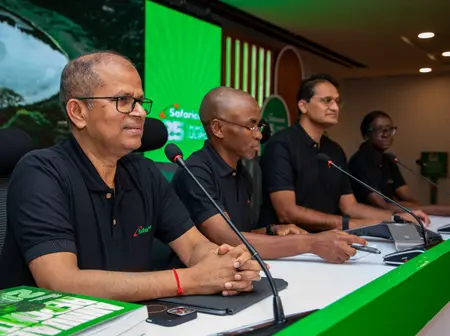
Safaricom HY2027 earnings set for 29% growth as Ethiopia approaches breakeven
Safaricom PLC is expected to report a 28.9% increase in shareholder-attributable profit for the first half of its 2027 financial year, with analysts projecting earnings of KSh55.16 billion as the company’s Ethiopian operation moves closer to operating breakeven. The Safaricom HY2027 results, scheduled for announcement on Thursday, November 5, will come against expectations of double-digit growth in service revenue and a stronger improvement in operating profitability.
Weighted analyst consensus puts group service revenue at KSh222.53 billion for the six months, representing an 11.3% increase from KSh199.87 billion in the corresponding period of the previous financial year. EBITDA is projected to rise 19.8% to KSh121.36 billion, while earnings per share (EPS) are expected to increase from KSh1.07 to KSh1.38.
Four analysts contributing to the forecasts expect shareholder-attributable profit to reach between KSh52 billion and KSh57.2 billion. Gichuki Kahome of Wealth Atlas projects KSh54.90 billion, while Brian Nzioki of Castright Solutions estimates earnings within a KSh52 billion to KSh56 billion range. Robert Ochieng, ACIFA, of Abojani expects KSh55.60 billion, while independent analyst Bildad Joash Barasa has the highest individual estimate at KSh57.20 billion.
The weighted consensus of KSh55.16 billion represents an additional KSh12.38 billion in shareholder earnings compared with the KSh42.78 billion recorded in HY2026. The projected improvement comes alongside expectations of stronger operating earnings, with reported group EBIT forecast to reach KSh86.17 billion from KSh65.21 billion a year earlier. Profit before tax is projected at KSh75.5 billion, compared with KSh55.24 billion in HY2026.
Safaricom Ethiopia is expected to make a substantial contribution to the group’s improved financial performance, with analysts forecasting its EBITDA loss to narrow to KSh1 billion from KSh12.5 billion in HY2026. That represents an improvement of KSh11.5 billion, or approximately 92%, as the operation continues to build its customer base and generate more revenue from telecommunications services.
The forecast builds on the subscriber and revenue growth documented in Safaricom Ethiopia’s earlier operating performance. By June 2026, the business had surpassed 15 million 90-day active subscribers, supported by more than 3,500 network sites covering approximately 60% of Ethiopia’s population. Its FY2026 service revenue reached KSh14.08 billion, with data contributing KSh9.56 billion compared with KSh3.01 billion from voice services.
The difference between the two revenue streams illustrates the importance of mobile data to the Ethiopian operation. Safaricom Ethiopia’s data business has become its principal service revenue contributor as the company expands network coverage and attracts more customers to its telecommunications services.
For HY2027, analysts project Ethiopia service revenue of KSh10.2 billion, up from KSh6.19 billion in the corresponding period. The projected EBITDA loss of KSh1 billion would also bring the operation closer to the EBITDA breakeven target for the financial year ending March 2027.
The improvement is particularly important given the financial burden Ethiopia has placed on the group since its commercial launch. The operation recorded an EBITDA loss of KSh27.9 billion in HY2025 before narrowing it to KSh12.5 billion in HY2026. Its projected HY2027 performance would mark a further substantial reduction in the cost of building and operating the telecommunications business.
However, the Ethiopian operation is still expected to record negative earnings before interest and tax. Analysts project reported EBIT excluding IAS 29 adjustments at a loss of KSh7 billion, compared with an expected EBITDA loss of KSh1 billion. The distinction reflects the additional impact of depreciation and amortisation on a business that has invested heavily in establishing its network infrastructure.
While Ethiopia accounts for a substantial part of the expected improvement in group profitability, Safaricom’s Kenyan business continues to provide the foundation for its revenue generation. M-PESA remains central to that operation, with its payments infrastructure supporting consumer transactions, merchant payments, digital lending and investment products.
Safaricom’s FY2026 operating figures showed that M-PESA processed 46.4 billion transactions worth KSh41.68 trillion during the financial year ended March 2026. Transaction volumes increased by 25.1%, while the merchant network expanded to 3.13 million businesses. The company also increased M-PESA’s processing capacity from 4,500 to 6,000 transactions per second to accommodate growing activity across the platform.
The expansion of M-PESA’s services also extends into wealth management. By March 2026, the platform’s wealth management business had 2.2 million active customers and KSh21.1 billion in assets under management. Safaricom has added investment products including Ziidi MMF, Ziidi Trader and Ziidi Shari’ah to its financial services portfolio, giving customers additional ways to access investment opportunities through M-PESA.
Chief Executive Officer Peter Ndegwa has outlined the company’s ambitions to expand beyond traditional telecommunications, with financial services, merchant solutions and artificial intelligence forming part of its broader growth strategy. The expansion builds on M-PESA’s existing customer and merchant network, which provides Safaricom with an established platform for introducing additional services.
Digital lending is another component of the financial services business. Safaricom’s FY2026 reporting showed that the number of customers eligible for Fuliza borrowing had risen to 18.1 million from seven million, while M-PESA consumer credit customers increased to 17.7 million from 7.9 million. The company has also identified tighter exposure controls and improved behavioural scoring among its priorities for managing digital lending.
These developments provide context for Safaricom’s projected service revenue growth, although the financial results will offer the more direct measure of how its telecommunications and financial services businesses are contributing to earnings.
The forecasts underline the financial importance of Safaricom’s established Kenyan operation as the group continues to invest in Ethiopia. Analysts expect Kenya EBIT to reach KSh97 billion in HY2027, compared with an estimated Ethiopia EBIT loss of KSh7 billion excluding IAS 29 adjustments.
The two figures produce an estimated KSh90 billion in combined operating earnings, matching the consensus forecast for group EBIT excluding IAS 29. Reported group EBIT is projected at KSh86.17 billion after the relevant accounting adjustments.
Kenya’s operating contribution is supported by its established telecommunications infrastructure and M-PESA ecosystem. Mobile data, voice, mobile money, merchant services and enterprise connectivity provide multiple sources of revenue, while the company continues investing in network capacity to accommodate rising demand.
Ndegwa has previously put Safaricom’s annual Kenyan infrastructure investment at approximately US$400 million to US$500 million, with around half directed towards the network. He also reported annual data volume growth of approximately 30%, highlighting the investment requirements associated with maintaining capacity as customers consume more mobile data.
The expansion of the merchant network also creates opportunities for Safaricom to provide services beyond payment processing. The Kenya Revenue Authority has discussed an arrangement with Safaricom to generate electronic tax invoices for businesses receiving payments through M-PESA tills and paybills, extending the platform’s potential role in merchant operations and business administration.
These investments and service developments form part of the company’s wider effort to strengthen its position in Kenya while building another telecommunications and financial services business in Ethiopia.
The HY2027 forecasts come after a decade of substantial growth in Safaricom’s financial performance. Half-year service revenue increased from KSh98.01 billion in HY2017 to KSh199.87 billion in HY2026, representing growth of approximately 104%.
EBITDA followed a similar trajectory, rising from KSh50.81 billion to KSh101.29 billion over the same period, an increase of approximately 99.3%. The figures illustrate how Safaricom has expanded its revenue base and operating earnings while developing M-PESA into a major financial services platform and entering the Ethiopian telecommunications market.
The latest forecasts point to further expansion, with service revenue expected to reach KSh222.53 billion and EBITDA projected at KSh121.36 billion. The anticipated 19.8% EBITDA growth compared with 11.3% service revenue growth suggests an improvement in operating margins as the group converts a larger proportion of its revenue into operating earnings.
For investors, the relationship between revenue growth and profitability will be an important measure of Safaricom’s financial performance. The Ethiopian operation’s narrowing losses could support that improvement, while the Kenyan business remains responsible for the larger share of group operating earnings.
Safaricom’s HY2027 announcement will provide an opportunity to assess the group’s performance against the analysts’ forecasts, particularly its ability to translate revenue growth into higher earnings. The KSh222.53 billion service revenue estimate and KSh121.36 billion EBITDA projection provide two important benchmarks for evaluating the group’s operating performance.
Ethiopia’s financial performance will also attract attention, with the projected KSh1 billion EBITDA loss offering a measure of progress towards the company’s breakeven ambitions. Its service revenue growth will help establish whether the improving operating performance is being supported by a larger telecommunications business.
M-PESA’s contribution will remain another important consideration as Safaricom expands its payments, merchant and investment services. The company’s ability to grow these businesses alongside its traditional telecommunications operations will shape its earnings performance and future revenue opportunities.
The four analysts expect shareholder-attributable profit to reach KSh55.16 billion, with EPS of KSh1.38 for the six months. Their forecasts point to another period of strong earnings growth for Safaricom, supported by its established Kenyan business and a substantial reduction in the losses associated with its Ethiopian expansion.
Go to TECHTRENDSKE.co.ke for more tech and business news from the African continent and across the world.
Follow us on WhatsApp, Telegram, Twitter, and Facebook, or subscribe to our weekly newsletter to ensure you don’t miss out on any future updates. Send tips to info@techtrendsmedia.co.ke