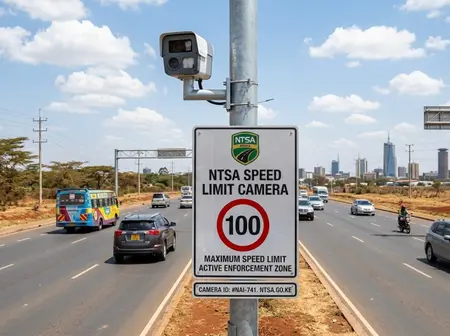
The National Transport and Safety Authority (NTSA) has given an update on the implementation of the instant traffic fines system, saying key legal challenges against the enforcement framework have been dismissed, but a separate court case is still holding back the expansion of the infrastructure required for its full rollout.
NTSA Director General Nashon Kondiwa told the Parliamentary Transport Committee on Tuesday, November 24, 2026, that the authority had successfully defended several cases challenging the instant fines framework and provisions of the Traffic Act.
Kondiwa said the Commission had faced court challenges over the legality of the system and Section 118 of the Traffic Act, which he cited in explaining the legal provisions governing minor traffic offences and instant fines.
He, however, disclosed that one case remained pending, with the court expected to deliver its ruling on Thursday, November 26.
According to the NTSA boss, the outstanding dispute concerns the Public-Private Partnership (PPP) procurement process intended to facilitate the expansion of infrastructure supporting the instant fines programme.
He explained that although the legal framework remained in place, the pending proceedings had prevented the authority from proceeding with the planned expansion of the system’s infrastructure.
Kondiwa maintained that the instant fines laws and enforcement process had not been invalidated by the court cases, distinguishing the legal framework from the contested procurement arrangement.
“We have a court case. And the court case is about the PPP procurement process. And we had other court cases that challenged the Instant Fines and the Section 118 of Traffic Act that gives lives to minor traffic offences and the Instant Fines. And all those cases that were challenging the law and Section 118 of the Traffic Act were thrown out,” he said.
“So the only cases that are pending in court, in fact, it’s one; we have a ruling on 26th November, that’s this week, when we are two days away, is about the procurement process of the PPP that was supposed to expand the infrastructure around Instant Fines. So I want to confirm that the Instant Fines laws and the process are one, except for the court case that is stopping us from expanding the infrastructure.”
The November 26 ruling is therefore expected to provide direction on the disputed PPP component, rather than determine the entire legality of the instant fines framework.
The instant fines programme has faced several legal and operational setbacks since NTSA first attempted to introduce automated traffic penalties in March 2026.
The authority initially rolled out the system on March 9, 2026, announcing that motorists would receive notifications for traffic violations through SMS, with penalties payable within seven days.
However, the rollout was suspended weeks later following public criticism and legal challenges questioning the authority’s powers to impose automated penalties and the procedures through which motorists would be notified and allowed to challenge offences.
On March 12, the High Court issued conservatory orders restricting NTSA and other state agencies from issuing or enforcing penalties generated through automated or algorithm-based systems pending further court proceedings.
NTSA subsequently withdrew its public notice announcing the rollout, saying it needed to improve public understanding of the procedures for handling minor traffic offences.
The authority later reviewed the enforcement framework in collaboration with the Office of the Attorney General, National Police Service, Office of the Director of Public Prosecutions and the Judiciary.
In a public notice published in June, NTSA announced that the government would operationalise a modernised enforcement framework for minor traffic offences under Section 117 of the Traffic Act, effective June 1, 2026.
The revised framework sought to clarify how minor traffic offences would be handled, including the procedures available to motorists who admit an offence and those who wish to contest allegations in court.
A separate legal dispute emerged around the multi-billion-shilling PPP arrangement between NTSA and the Pesa Print Limited consortium.
On May 29, 2026, the High Court issued conservatory orders suspending implementation of the partnership covering the design, supply, delivery, installation and maintenance of smart driving licences, the automated fines system and associated services.
The dispute was subsequently consolidated with other petitions, including one filed by the Consumer Federation of Kenya (COFEK), with interim orders extended as the court considered the challenges.
The Road Safety Association of Kenya also moved to have NTSA and its Director General declared in contempt, alleging that the authority continued implementing aspects of the project despite the court orders.
The association’s application sought sanctions against Kondiwa over the alleged disobedience. The allegations remain claims by the petitioner and should not be treated as a finding of contempt by the court.
The consolidated proceedings have brought together questions surrounding the PPP arrangement and the implementation of the technology supporting the traffic enforcement programme.
The court is expected to issue its ruling on November 26, a decision that could determine the way forward for the disputed procurement arrangement.
The instant fines framework is designed to allow enforcement officers and automated monitoring systems to identify minor traffic violations and notify motorists of the alleged offences.
The revised approach also provides motorists with an opportunity to challenge penalties in court rather than being compelled to accept and pay a fine without contesting the allegation.
The system is expected to rely on traffic cameras, vehicle registration information and digital enforcement platforms to identify violations and facilitate the issuance of notices.
NTSA has previously explained that existing cameras installed by the Kenya National Highways Authority (KeNHA) and Kenya Urban Roads Authority (KURA), alongside a digital application used by traffic police, can support enforcement.
The planned expansion under the PPP arrangement was expected to strengthen the technological infrastructure supporting the programme.
The system has also attracted scrutiny over motorists’ constitutional rights, data protection, transparency in the procurement process and the ability of vehicle owners to challenge penalties.
As the court prepares to issue its ruling, the key question is whether NTSA will receive the legal clearance needed to proceed with the contested infrastructure expansion and move closer to fully introducing the automated instant fines system.
Leave a Reply