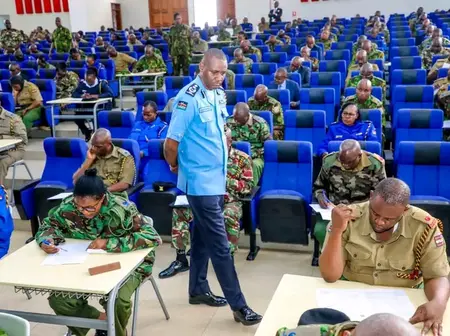
Approximately 310 senior police officers from across Kenya's National Police Service have begun a series of professional examinations at the National Police Leadership Academy (NPLA) in Ngong, as the Service continues to strengthen leadership capacity and improve standards in police administration.
The examinations, which opened on Monday, November 23, 2026, bring together officers drawn from the Kenya Police Service (KPS), Administration Police Service (APS) and the Directorate of Criminal Investigations (DCI).
The candidates, all holding the rank of Assistant Superintendent of Police (ASP), are undertaking the assessments after completing six-month Higher Training and Senior Training Courses at various National Police Service promotional training colleges.
This is the third edition of the Gazetted Officers' Examinations to be conducted at the Ngong-based academy.
The exercise is designed to evaluate the officers' professional knowledge, administrative abilities and readiness to take up greater responsibilities within the country's security institutions.
Speaking during the opening of the examinations, Chief Invigilator Assistant Inspector General of Police Mathiu Kainga highlighted the importance of continuous training in preparing police officers for the increasingly complex demands of modern policing.
Kainga observed that effective leadership requires more than operational experience, noting that senior officers must also demonstrate competence in administration, financial management, legal procedures and organisational planning.
He explained that the examination covers several critical areas, including Service Administration, Financial Accounting, Stores Accounting, Administration of the Law, Appreciation, Organisation and Planning.
According to the chief invigilator, proficiency in these subjects is essential for officers expected to supervise personnel, manage institutional resources, enforce the law and make sound decisions while discharging their duties.
He further noted that the assessment provides an opportunity to establish whether officers have acquired the necessary professional foundation to manage police formations and respond effectively to the country's changing security challenges.
Kainga also linked the examinations to the ongoing transformation of the National Police Leadership Academy as it moves towards attaining university status.
He said the transition represents an important development in police education, creating opportunities for specialised academic programmes designed around the practical requirements of law enforcement, leadership and public security management.
The anticipated advancement is expected to strengthen professional training by giving police officers access to structured learning opportunities that complement their operational experience and prepare them for increasingly demanding assignments.
The examinations are also bringing together officers from the three formations of the National Police Service, providing a common platform for reinforcing institutional cooperation, shared professional values and consistency in leadership standards.
A 16-member team has been deployed to oversee the examination process and ensure that the exercise is conducted in an orderly and professional manner.
The invigilation team includes NPLA Director of Planning Commissioner of Police Geoffrey Kathurima; Senior Officer in charge of Police Operations in the Eastern Region Christopher Mumo; National Police College Kiganjo Campus Chief Instructor Humphrey Abai; and NPLA Dean of Studies Paul Wambugu.
Other members are National Criminal Investigations Academy Chief Instructor Solomon Musai and National Police College, Embakasi 'A' Campus School of Leadership Director Tabitha Ndanu, alongside other senior officers drawn from police training institutions.
The exercise reflects the National Police Service's continued investment in human resource development, with emphasis on building a knowledgeable, disciplined and professionally equipped leadership team.
As security responsibilities continue to evolve, the assessment of senior officers remains an important part of ensuring that those entrusted with command positions have the administrative competence, legal understanding and leadership skills required to deliver effective policing services.
The examinations therefore form part of broader institutional efforts to promote professionalism, accountability and cohesion across the National Police Service.
https://www.facebook.com/100069188350444/posts/1487498240233107/?app=fbl
Leave a Reply