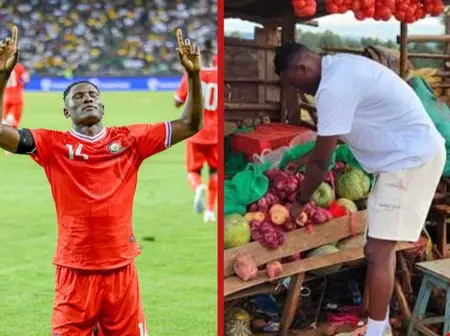
While he enjoys the demands and rewards of professional football in Qatar, the striker still maintains a strong connection to his rural roots in Homa Bay County.
The 32-year-old footballer leads two contrasting lifestyles. In Doha, Qatar, his days revolve around professional training, competitive matches, recovery and family life. Back home in Kenya, he enjoys the quieter surroundings of his village, where farming, family and reconnecting with his community offer a welcome break from the pressure of professional football.
Olunga's connection to his rural home is particularly evident whenever he returns to Othoro village in Kabondo Kasipul, Homa Bay County.
Away from the stadiums and international attention, the striker has previously shared photographs of himself enjoying tea at his village home. He has also given fans glimpses of his farming activities, including tending to his garden and growing maize and other crops.
These moments offer a glimpse into his life beyond football. Despite travelling across several countries and establishing himself as an international striker, he has maintained an attachment to the surroundings that shaped his early years.
His lifestyle in Qatar is considerably different.
Olunga joined Al-Arabi in July 2025 on a two-year contract after spending four and a half successful years at Al-Duhail. His departure marked the end of an outstanding spell during which he scored 130 goals in all competitions, becoming the club's all-time leading goalscorer.
The move presented another opportunity for the Kenyan international to continue his career in the Qatar Stars League.
Speaking to Flashscore at Al-Arabi's training ground, Olunga expressed satisfaction with the living conditions and football environment in Qatar.
"Life in Qatar is great, very good for the family, and the football atmosphere is growing too. Especially since the World Cup. QSL is improving more and more; it's been really amazing," he said.
His remarks highlighted the country's growing football environment and the stability he enjoys while living there with his family.
Another major difference between Olunga's life in Qatar and his national team responsibilities in Kenya concerns finances and football administration.
At Al-Arabi, he operates under a professional club contract. Although the club has not publicly disclosed his salary, his employment is structured around the commercial and professional arrangements of club football.
The situation is different when he represents Harambee Stars.
In November 2026, national team head coach Benni McCarthy raised concerns about the financial and logistical challenges affecting the Kenyan team.
McCarthy disclosed that players had experienced delays in receiving their allowances, with the situation reportedly approaching a training boycott.
He also raised concerns about unpaid salaries for members of his technical team, alongside difficulties involving accommodation, meals and travel arrangements during national team assignments.
The revelations exposed some of the administrative challenges facing Kenyan football compared with the professional structures available to players at their foreign clubs.
Training is another area where the two environments differ.
At Al-Arabi, Olunga operates within a club system built around organised training schedules, professional coaching, medical support and facilities designed for elite athletes.
The Qatar Stars League has also attracted international football talent and investment, particularly following the country's hosting of the 2022 FIFA World Cup.
His experiences across different countries have given him an opportunity to adapt to various football cultures and standards.
Olunga's journey to the international stage, however, began in Kenya.
He developed his football skills at Liberty Sports Academy before playing for Tusker, Thika United and Gor Mahia.
His performances at Gor Mahia helped establish him as one of the country's most promising forwards. During the 2015 season, he scored 19 goals in 27 appearances, attracting attention beyond Kenya.
He subsequently moved abroad, playing in Sweden, China, Spain and Japan before establishing himself in Qatar.
His achievements at Al-Duhail further strengthened his reputation as one of Kenya's most successful football exports.
However, his status in Qatar is different from the responsibility he carries whenever he represents Kenya.
At club level, Olunga is primarily judged by his goals, performances and contribution to his team's success. For Harambee Stars, he is not only a striker but also the national team captain and one of the country's most recognisable sporting figures.
On November 13, 2026, he scored a penalty during Kenya's 2-2 draw against South Africa in a 2027 Africa Cup of Nations qualifier at Orlando Stadium.
The goal took his national team tally to 35, drawing him level with the late William 'Chege' Ouma as Kenya's joint all-time leading goalscorer.
It was another important milestone for a player whose performances have made him an influential figure in Kenyan football.
His position comes with expectations from supporters who look to him for leadership, goals and inspiration whenever the national team takes to the pitch.
Despite the differences between his life in Kenya and Qatar, Olunga's connection to his home country remains an important part of his identity.
In Doha, he is a professional footballer focused on delivering results for Al-Arabi while providing for his family.
For the Harambee Stars captain, the two environments represent different sides of the same life: an international football career built through years of hard work and a lasting connection to the Kenyan home he continues to cherish.
Source
Leave a Reply