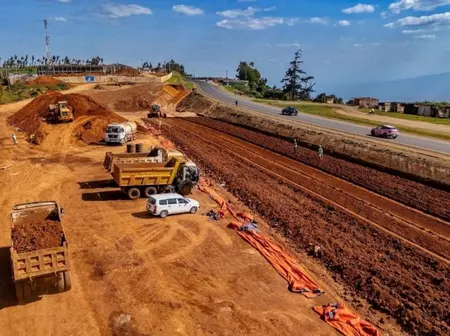
The government is incorporating several safety features into the ongoing expansion project, with physical barriers separating vehicles travelling in opposite directions among the key interventions.
Cornelius Kibet, the Resident Engineer overseeing the Rironi-Gilgil section, explained that the new design would address the persistent danger of head-on collisions, which have contributed to fatal accidents along the route.
Speaking in a documentary released by the Kenya National Highways Authority (KeNHA) on Wednesday, November 25, Kibet said separating traffic would prevent vehicles from accidentally crossing into lanes reserved for oncoming motorists.
He noted that the project was also intended to reduce the time motorists spend travelling along the corridor, which serves thousands of people heading towards Nakuru and western Kenya.
Beyond the physical separation of traffic, the government plans to construct grade-separated interchanges at major junctions to eliminate dangerous interactions between vehicles entering and leaving the highway.
Underpasses will also be provided at selected U-turn points, allowing motorists to change direction without disrupting traffic flowing along the main road.
Pedestrians have also been considered in the new design. According to Kibet, footbridges and underground crossing facilities will be constructed to give people safer alternatives to crossing the busy highway.
The project will further feature service roads that will enable residents and businesses along the corridor to reach their properties without interfering with fast-moving traffic.
The expanded highway will have different lane configurations along its sections. The Rironi-Naivasha stretch is planned as a dual carriageway with two lanes in each direction, while the Naivasha-Nakuru section will have three lanes on either side.
Once completed, the improvements are expected to ease congestion, enhance road safety and facilitate the transportation of passengers and goods between Nairobi, western Kenya and neighbouring countries, including Uganda, Rwanda and South Sudan.
For motorists who regularly use the route, the biggest anticipated benefit is a reduction in dangerous encounters between vehicles travelling in opposite directions.
https://peopledaily.digital/news/how-govt-plans-to-end-deadly-head-on-collisions-on-rironi-mau-summit-highway
Leave a Reply