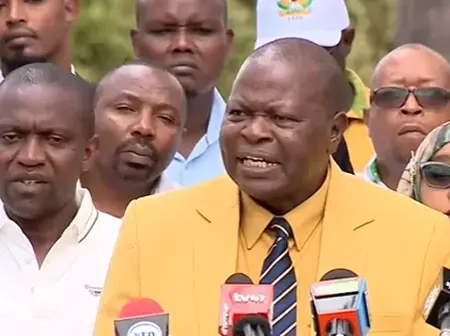
The Kenya Union of Post-Primary Education Teachers (KUPPET) has renewed its demand for administrative autonomy for Junior Secondary Schools (JSS), calling for changes to the comprehensive school model and better working conditions for teachers.
The union says Junior Schools should operate as independent institutions with their own leadership structures rather than remain under the management of primary school headteachers.
Speaking during KUPPET's 28th Annual Delegates Conference in Diani, Kwale County, on Saturday, Secretary General Akelo Misori said delegates had resolved to oppose the comprehensive school arrangement.
Misori said the union would continue pushing for the retention of distinct school categories, arguing that the country's education structure should remain aligned with the constitutional framework.
The union's position comes days after President William Ruto directed the Ministry of Education to work with the Kenya Comprehensive Schools Heads Association (KECSHA) and present proposals within 90 days to amend the Basic Education Act.
The proposed amendments are intended to provide a legal framework for the governance, staffing and financing of comprehensive schools, which bring together pre-primary, primary and Junior School levels under one administration.
KUPPET, however, wants Junior Schools separated from primary schools, arguing that the two levels have different professional and administrative requirements.
The debate dates back to the transition from the 8-4-4 system to the Competency-Based Curriculum (CBC), which began its classroom rollout in 2019.
Under the previous 8-4-4 system, primary education lasted eight years before learners moved to secondary school for four years.
The CBC introduced a new structure, with learners progressing through lower and upper primary, followed by Junior School in Grades 7 to 9 before proceeding to Senior School.
In 2023, the Presidential Working Party on Education Reform recommended that Junior School be domiciled within existing primary school compounds, with pre-primary, primary and Junior School sections managed as one comprehensive institution.
The recommendation was intended to make use of existing infrastructure, reduce the cost of establishing new institutions and ease learners' transition from Grade 6 to Grade 7.
The government subsequently adopted the arrangement, with primary school headteachers serving as heads of comprehensive schools and deputies overseeing the different sections.
The union has maintained that Junior School teachers, many of whom are trained to teach at the secondary school level, require an independent administrative structure that recognises their professional qualifications and responsibilities.
In March, Education Cabinet Secretary Julius Ogamba told the Senate that the decision to place Junior Schools within primary schools was informed by learner welfare, available infrastructure and cost considerations.
Ogamba said the Presidential Working Party had received submissions from education stakeholders, with 93 per cent recommending that Junior Schools be hosted in existing primary schools.
He explained that the government also wanted to maximise the use of available classrooms rather than construct new secondary school facilities to accommodate learners in Grades 7 to 9.
The Cabinet Secretary further clarified that Junior Schools had separate financial accounts because they receive different capitation rates from primary schools, but this did not make them independent institutions.
In April, Junior School teachers staged demonstrations demanding administrative autonomy, permanent and pensionable employment and improved medical cover under the Social Health Authority.
The matter has since featured prominently in public participation forums on the Basic Education Bill, 2026, with KUPPET supporting independent Junior School management while the Kenya National Union of Teachers (KNUT) backs the comprehensive school model.
During the November 12 conference in Mombasa, Ruto asked the Ministry of Education to prepare proposals to anchor comprehensive schools in law within 90 days.
The President said the changes should address governance, staffing and financing, responding to school heads' request for a clear legal framework for institutions operating from pre-primary to Grade 9.
Leave a Reply