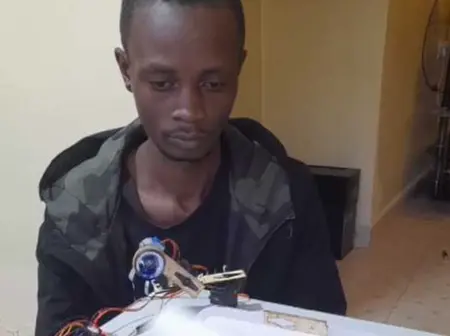
Identified as Cliff Temba, the innovator has designed a bidirectional automatic book page turner that allows readers to flip through the pages of a physical book without manually touching them.
His invention seeks to make reading easier for people who have limited movement in their hands or cannot turn pages without assistance from another person.
Temba's device uses servo motors, electrical wiring and a mechanical arrangement to move book pages automatically. Its bidirectional feature allows users to turn pages both forward and backward, making it possible to navigate through reading materials without relying entirely on a caregiver.
A demonstration video shared on Facebook shows Temba seated at a desk operating the device. The machine is fitted with visible electrical components and appears to have been assembled in a personal workshop.
The invention addresses a challenge that is often overlooked when discussing access to education and reading materials.
Although books remain important learning resources for students and other readers, people with certain physical disabilities can experience difficulties handling them. Even a simple activity such as turning a page may require assistance.
For students, this challenge can affect their ability to study comfortably, complete assignments and access educational materials at their own pace.
Temba's invention could help address some of these difficulties by giving users greater control over their reading experience.
Unlike digital reading applications that allow users to swipe or use audio features, his creation focuses on making conventional printed books more accessible.
The development also highlights the potential of locally developed assistive technology in addressing everyday challenges faced by people with disabilities.
Across Kenya, access to specialised equipment can be difficult for some households, particularly when imported assistive devices are expensive or unavailable.
Locally designed solutions could provide an alternative if they are properly tested, refined and made affordable to the people who need them.
Temba's work has attracted interest online, with his invention presenting an example of how practical engineering ideas can be used to address challenges within communities.
However, details about the machine's production cost, technical specifications, safety testing and possible commercialisation have not been publicly established.
It is also unclear whether Temba plans to manufacture more units, collaborate with disability organisations or make the invention available to schools and institutions.
His innovation adds to a growing list of Kenyan projects demonstrating how locally available materials, technical knowledge and creativity can be combined to develop solutions to everyday problems.
Source
Leave a Reply