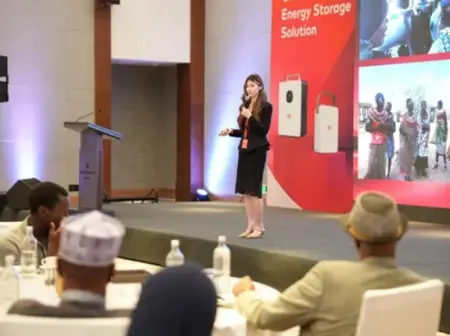
The launch, held at the JW Marriott Hotel in Nairobi on November 22, 2026, marks the company's latest expansion into the African renewable energy market.
The company unveiled two products, the Power Go and Power Tank, designed to provide backup electricity for electronic devices and selected household appliances during power interruptions.
Itel Energy's Kenya Country Manager, Wang Zhuoyu, said the expansion was part of the company's wider strategy to develop renewable energy products and integrated power solutions for emerging markets.
She explained that the company intended to develop products that respond to the specific electricity needs of customers in different markets.
According to Wang, Itel Energy had spent approximately two years establishing itself as a market leader in Nigeria, attributing the achievement to its distribution network, product quality and sustained investment.
The company entered Kenya in October 2026 and says it already operates in more than 20 countries, including 11 African markets.
Its Kenyan expansion is also expected to provide an entry point into neighbouring markets, particularly Somalia and South Sudan.
What the two Itel power stations can do
The newly introduced Power Go is designed for consumers who need portable electricity for smaller electronic devices.
Its 100,000mAh battery is intended to support smartphones, laptops, Wi-Fi routers, LED lights and CCTV cameras.
The device could be particularly useful to students, remote workers and households that want to maintain internet connectivity and keep essential electronics running during electricity interruptions.
However, the actual backup duration will depend on the power consumption of the connected devices and energy losses during operation.
The second product, the Power Tank, targets customers with higher electricity requirements.
It comes with a 1kWh battery capacity and a nominal AC output of 500 watts.
This allows it to power selected household electronics, including televisions, fans, laptops, Wi-Fi routers and LED lighting.
Users can operate several compatible devices simultaneously, provided their combined electricity consumption does not exceed the station's 500W output limit.
However, the Power Tank is not intended for high-power appliances such as electric kettles, microwaves, irons and cooking equipment.
Refrigerators would also require careful assessment because their compressors can draw additional power when starting.
Both products support solar charging, allowing customers with compatible solar panels to recharge their batteries without depending entirely on electricity from the national grid.
The Power Go supports solar input of up to 100W, while the Power Tank can accommodate up to 400W.
This provides an alternative for customers seeking to combine portable battery storage with solar energy, although purchasing compatible solar panels could increase the initial cost.
How Itel's products compare with competitors
Itel Energy is entering a Kenyan market where other manufacturers have already introduced portable battery systems with different storage capacities and power outputs.
EcoFlow's River 2, which has a 256Wh battery and 300W AC output, has been advertised locally at approximately KSh 26,650.
The EcoFlow River 3, with 245Wh of storage and a 300W output, has been listed at about KSh 31,370.
Bluetti's Premium 30 V2, featuring 320Wh of battery storage and a 600W AC output, has been advertised at approximately KSh 34,000.
In the 1kWh category, a comparable YACHU model has been listed at around KSh 45,000, while EcoFlow's E980, which has 980Wh of storage and a 500W output, has been advertised at approximately KSh 62,380.
These comparisons illustrate the range of portable power solutions available to Kenyan consumers, although actual prices may vary depending on the seller, availability and included accessories.
Itel Energy expands its distribution and service network
Beyond the two portable power stations, Itel Energy says it offers a wider range of renewable energy products.
These include hybrid and on-grid inverters, batteries, all-in-one energy systems, energy storage cabinets and photovoltaic modules.
The company says it has established seven official service centres in Nairobi, Mombasa, Kiambu, Nakuru, Meru, Uasin Gishu and Kisumu counties.
It also reports having more than 100 distributors operating in over 20 towns.
The distribution and after-sales network is expected to support customers purchasing the company's products as it establishes itself in the Kenyan market.
Joseph Mwaniki, the company's local service manager, said customers would receive technical assistance and after-sales support.
He encouraged customers experiencing challenges with Itel Energy products to contact the company through 070969888 or visit their nearest Calcare office.
Company outlines plans for commercial solar projects
Itel Energy is also looking beyond individual households, with plans to work alongside local partners to develop solar energy installations in commercial facilities, including shopping malls.
One of its Kenyan partners said the collaboration would combine Itel Energy's technology with local market knowledge, professional installation and technical support.
The partner also identified the initial cost of solar and battery installations as one of the challenges facing businesses interested in adopting renewable energy.
He called for affordable financing arrangements to make the technology accessible to more businesses.
The company further clarified that its intention was not to compete with Kenya Power but to complement existing electricity providers and the national electricity grid.
As Kenya's demand for reliable backup power continues to create opportunities for renewable energy providers, Itel Energy will be seeking to establish its position through its product range, distribution network and local partnerships.
Source
Leave a Reply