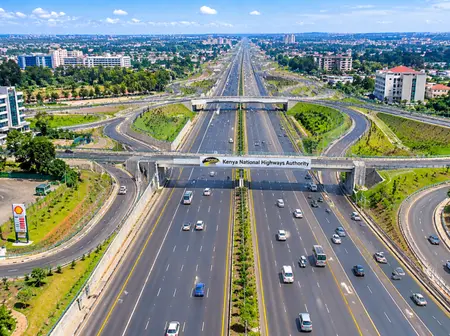
Kenyan motorists could soon pay additional fees to use major highways and bypasses as the government moves to introduce road tolling through Public-Private Partnership (PPP) arrangements.
The plan targets several roads, including Thika Superhighway, Nairobi’s Southern Bypass, Rironi–Nakuru–Mau Summit Highway and sections of the Mombasa road network.
The government intends to attract private investors to finance, expand and maintain highways, with investors recovering their money through toll charges paid by motorists.
However, not all targeted roads have approved tariffs, with some projects still undergoing feasibility studies and procurement.
The National Treasury and Kenya National Highways Authority (KeNHA) have identified several highways for possible tolling.
The Nairobi–Thika–Juja–Kenol–Sagana–Marua highway is proposed for a 30-year concession valued at Ksh100 billion. Nairobi’s Southern Bypass is targeted for a Ksh12.265 billion operation, maintenance and tolling concession lasting 25 years, while the Mombasa Northern Bypass is estimated at Ksh30 billion under a proposed 30-year concession.
Other projects include the approximately Ksh200 billion Rironi–Nakuru–Mau Summit highway, the proposed expansion of the Mau Summit–Eldoret–Malaba highway and the Ksh32 billion Dongo Kundu Bypass.
The proposed Ksh100 billion Thika highway project will extend beyond Thika to Juja, Kenol, Sagana and Marua.
Under a proposed 30-year concession, a private investor will finance and maintain the road before recovering the investment through toll collections.
Meanwhile, Nairobi’s Southern Bypass could be subjected to a Ksh12.265 billion concession covering its operation, maintenance and tolling for 25 years.
Motorists using the existing highway, which connects Mombasa Road, Lang’ata Road and Kikuyu, could therefore face additional charges. However, neither project has published final toll rates.
The Mombasa Northern Bypass is earmarked for a Ksh30 billion project under a proposed 30-year concession.
The Ksh32 billion Dongo Kundu Bypass is also being considered for PPP tolling. The road is particularly important because it connects sections of Mombasa’s transport network while reducing dependence on the congested Likoni ferry crossing.
Specific charges for both roads are yet to be announced.
The Rironi–Nakuru–Mau Summit highway is among the projects with published kilometre-based toll rates.
KeNHA has indicated charges of Ksh8 per kilometre for the Rironi–Gilgil section and Ksh8.50 per kilometre for Gilgil–Nakuru–Mau Summit.
The 81-kilometre Rironi–Gilgil section would cost approximately Ksh648, while the 94-kilometre Gilgil–Mau Summit section would cost about Ksh799.
A motorist travelling the entire 175-kilometre stretch could therefore pay approximately Ksh1,447, subject to vehicle classification and applicable tariffs.
The project is being implemented under a PPP arrangement involving Chinese companies and Kenya’s National Social Security Fund.
The government is exploring tolling the approximately 243-kilometre highway through a proposed expansion from a two-lane road into a four-lane access-controlled highway.
A pre-feasibility study is underway, but specific toll charges have not been announced.
The government’s draft National Road Tolling Policy proposes payments through cash, bank cards and prepaid electronic systems.
Charges will depend on the distance travelled, vehicle category and the cost of constructing and maintaining the roads.
The policy also proposes exemptions for military, police, ambulance and fire service vehicles, subject to identification requirements.
One of the biggest concerns is whether motorists will have alternative routes without toll charges.
Under the draft policy, the government is not automatically required to provide dedicated toll-free alternatives.
However, proposed measures include discounts for residents, high-occupancy vehicles and energy-efficient vehicles.
The government argues that tolling will attract private investment into road infrastructure while reducing pressure on public finances.
Investors will finance construction, expansion and maintenance before recovering their money through toll collections over agreed concession periods.
However, the charges could increase transport costs, with public transport operators potentially transferring some expenses to passengers.
Road tolling will not begin simultaneously across all targeted highways. Each project must undergo the necessary approvals, procurement and contractual processes before collections start.
Some concessions are targeting financial closure in the 2028/29 financial year.
For now, motorists should distinguish between proposed toll roads and projects with published tariffs. The outstanding issues include final charges, toll collection points, exemptions and the availability of affordable alternative routes.
Leave a Reply