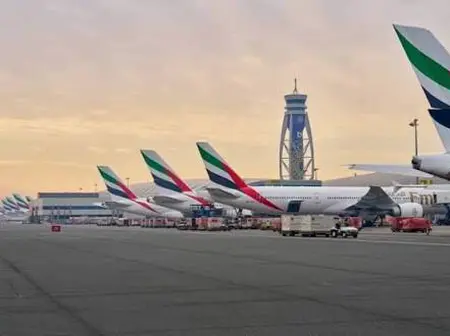
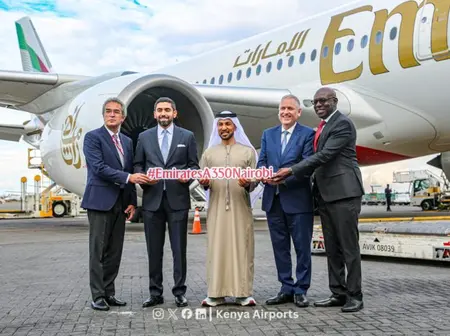
The aircraft was unveiled at Jomo Kenyatta International Airport on Wednesday, November 11, 2026, marking another development in the airline’s operations in Kenya.
According to a People Daily report, the aircraft will serve the Dubai–Nairobi route alongside Emirates’ existing services.
The A350 has been deployed on flights EK717 and EK718, connecting Dubai with Nairobi.
The introduction is particularly significant for passengers seeking more comfort without paying for Business Class. Emirates’ Premium Economy cabin offers an additional travel option between Economy and Business Class.
The airline previously announced that the A350 would operate on the route from October 25, 2026. Nairobi also became the 32nd destination in its network to receive the aircraft.
Emirates’ A350 accommodates up to 298 passengers across three cabin classes: Business, Premium Economy and Economy.
The airline says the aircraft features spacious cabins, improved technology and enhanced passenger entertainment. Its Premium Economy product is making its debut in the Kenyan market through the Nairobi service.
The deployment follows Emirates’ expansion of its Nairobi schedule in July 2026. The airline introduced a third daily flight between Dubai and Nairobi, increasing its operations to 21 flights weekly.
The additional services provide passengers with more travel options and connections through Dubai to destinations in Europe and other international markets.
The arrival of the A350 strengthens Emirates’ offering in Kenya while giving travellers another cabin option on one of the airline’s important African routes.
The Kenya National Highways Authority (KeNHA) issued a safety advisory on Wednesday, November 11, asking drivers to exercise extra caution, particularly when approaching sections where road expansion works are underway.
The authority advised motorists to ensure their vehicles are in good condition before beginning long journeys, with particular attention to braking systems and indicator lights.
Drivers were also reminded to observe traffic regulations and remain alert around construction zones where heavy machinery, diversions and changing road arrangements could pose additional risks.
The warning comes as thousands of Kenyans prepare to travel to different parts of the country for the festive season, traditionally one of the busiest periods on the Nairobi-Nakuru corridor.
The highway serves travellers heading towards Nakuru, Western Kenya, the Rift Valley and neighbouring countries, making it particularly vulnerable to congestion during peak holiday travel.
KeNHA's advisory follows an inspection of ongoing construction by Roads and Transport Cabinet Secretary Davis Chirchir, during which contractors laid the first layer of tarmac at Lari near the Ngarariga Interchange.
The government is targeting the opening of the Rironi-Naivasha section before the end of 2026, with some portions expected to become accessible to motorists before Christmas.
However, construction will continue on other sections of the 233-kilometre Rironi-Mau Summit highway expansion project, including areas towards Gilgil, Nakuru and Mau Summit.
More than 1,000 pieces of heavy machinery have reportedly been deployed to accelerate the project, meaning drivers will need to remain cautious when navigating active work zones.
Meanwhile, the National Transport and Safety Authority (NTSA) has stepped up festive-season road safety enforcement under its Msimu Bila Ajali, Usalama Barabarani campaign.
The operation targets speeding, drunk driving, overloading and vehicles operating with mechanical defects. Police Inspector General Douglas Kanja has similarly directed officers to intensify traffic checks and take action against dangerous driving as holiday traffic increases.
According to a report published by People Daily on Wednesday, November 11, 2026, Roads and Transport Cabinet Secretary Davis Chirchir announced the proposed changes during an inspection of the ongoing Rironi–Mau Summit Road project.
The ambitious plan seeks to make the iconic viewpoint more attractive to local and international tourists while creating additional business opportunities along the busy highway.
Cable Cars Among Major Attractions
One of the most notable proposals involves introducing cable cars connecting the A8 highway corridor to the A8 South escarpment corridor.
Chirchir said the development would give visitors a different experience of the Great Rift Valley while creating a major tourism attraction.
He described the proposed facility as a magnificent destination that would showcase the natural beauty of the region.
The cable cars are expected to become a major attraction for travellers using the Nairobi–Nakuru highway.
Modern Curio Shops and Hotels Planned
The government also intends to redesign the shopping facilities at the viewpoint to encourage tourists to stop and spend more time at the location.
Chirchir revealed that plans include developing modern curio shops where traders can sell locally made products and souvenirs to visitors.
He also indicated that the government hopes to attract private investors interested in establishing hotels around the area.
The proposed investments could create business opportunities for local traders and other tourism-related enterprises.
Government Raises Safety Concerns
Apart from introducing new attractions, the government has identified visitor safety as another important issue requiring attention.
Chirchir acknowledged that the existing viewpoint has shortcomings in its design and safety arrangements.
He said the proposed redevelopment would address these concerns through improved facilities and a more suitable design.
The government wants the location to become more than a roadside stop where motorists briefly admire the landscape before continuing their journeys.
Instead, the ambition is to establish a destination where visitors can spend more time enjoying the surrounding scenery and available attractions.
The proposed transformation forms part of the wider Rironi–Mau Summit Road development, which is expected to improve transport connectivity between Nairobi and western Kenya.
However, the government has not yet provided a detailed implementation timeline, project cost or confirmed construction arrangements for the proposed tourism facilities.
Speaking on Wednesday, November 11, Duale said Kenya would not detain passengers travelling through the country simply because their destinations require them to undergo quarantine or provide evidence of being free from Ebola.
The CS maintained that the Ministry of Health would not issue travel clearance documents or Ebola-free certificates to passengers seeking to satisfy entry conditions imposed by foreign governments.
He argued that such requirements should not be transferred to Kenya, insisting that travellers must not be forced to remain in the country to meet another jurisdiction's public health regulations.
"Kenya will not serve as a quarantine centre for any jurisdiction. Travellers from other countries will not be held in Kenya to meet another country's entry requirements," Duale stated.
The Health CS also criticised foreign jurisdictions that have introduced travel and visa restrictions affecting Kenyan citizens and passengers passing through the country.
He questioned the justification for imposing blanket restrictions despite Kenya's decision to openly communicate developments surrounding the Ebola outbreak.
Duale urged the affected countries to reconsider their decisions, arguing that Kenya had made significant progress in containing the disease.
He disclosed that the country had no Ebola patient undergoing treatment, no contacts remaining in quarantine and no evidence of community transmission.
The CS further assured Kenyans and international visitors that normal activities would continue, noting that the government had not introduced restrictions on domestic movement, public gatherings, tourism or business operations.
His remarks came after the Ministry of Health discharged the final Ebola patient from isolation, marking a major step towards ending the outbreak.
According to Duale, November 12 will mark the beginning of the mandatory 42-day countdown before Kenya can officially declare the outbreak over, provided no new infections are reported.
The government has maintained that the outbreak will only be declared officially ended after completing the required monitoring period without recording another case.
The preacher shared details of her travel experience on social media, offering fans a look at the aircraft that flew her to the neighbouring country for the high-profile celebration.
Kiuna appeared excited about the journey, and her update gave followers an opportunity to see part of the arrangements behind her trip.
Her choice of private air travel quickly became a talking point, with social media users showing interest in the aircraft and the experience.
Unlike commercial flights, private aircraft offer passengers a more personalised travel arrangement, often allowing greater flexibility and privacy. However, Kiuna’s post did not provide details about the aircraft’s owner, model or the cost of the journey.
The trip attracted additional attention because of the event she was attending. Charlene Ruto’s wedding brought together guests from different backgrounds, including public figures and personalities whose updates from the occasion attracted interest online.
Photographs and videos shared by attendees gave Kenyans glimpses of the celebration, with many following the event through social media.
Kiuna’s latest update added to those conversations by shifting attention to how she travelled to Tanzania.
The preacher is known for her church leadership and public engagements, but this time her followers were interested in a different aspect of her activities: the private flight experience.
Her post has offered a glimpse into her wedding trip, although further details about the aircraft and the travel arrangements were not provided.
Emirates has introduced its modern Airbus A350 aircraft on the Dubai-Nairobi route, bringing a new level of comfort, technology and luxury to passengers travelling between Kenya and the United Arab Emirates.
The aircraft, which began operating on the route on October 25, 2026, makes Nairobi the 32nd destination in the airline's A350 network.
Its arrival also marks the first time Emirates has introduced its highly anticipated Premium Economy cabin to the Kenyan market.
The Airbus A350-900 has a capacity of 298 passengers distributed across Business Class, Premium Economy and Economy Class.
One of its biggest attractions is the Premium Economy cabin, which features spacious leather reclining seats, adjustable headrests, additional legroom and individual charging points.
Passengers also enjoy 13.3-inch entertainment screens and improved onboard services.
Business Class offers another impressive experience through its 1-2-1 seating arrangement, ensuring every passenger has direct access to the aisle.
The seats can transform into fully flat beds and include personal minibars and wireless charging facilities.
Economy Class has also received significant improvements, including redesigned seats, leather headrests and upgraded entertainment systems featuring 13.3-inch adjustable 4K screens.
Another notable feature is the aircraft's advanced entertainment platform, known as Emirates ICE.
It provides passengers with a wide selection of movies, television programmes, music and other entertainment throughout their journey.
The aircraft also incorporates improved onboard connectivity, Bluetooth headphone compatibility and modern USB-C charging facilities, allowing travellers to remain connected and charge their electronic devices.
Additionally, the A350 features larger overhead storage compartments, wider aisles and higher ceilings, creating a more spacious cabin environment.
Its advanced cabin lighting system is designed to improve passenger comfort, while enhanced noise-reduction technology helps create a quieter flying experience.
The aircraft also incorporates modern engineering designed to improve fuel efficiency and support long-distance operations.
The introduction of the A350 comes as Emirates continues expanding its Kenyan operations.
The airline increased its Dubai-Nairobi services to three daily flights in July, bringing the total to 21 weekly flights.
With the new aircraft, Kenyan travellers now have access to improved seating options, upgraded entertainment and greater comfort when flying through Dubai to international destinations.
Emirates has introduced its Airbus A350 on the Dubai–Nairobi route, bringing a new generation of aircraft technology, redesigned passenger cabins and its Premium Economy product to Kenya for the first time.
The aircraft, which operates flights EK717 and EK718 between Dubai and Jomo Kenyatta International Airport (JKIA), accommodates 298 passengers across Business Class, Premium Economy and Economy Class.
Its arrival marks an important addition to Emirates’ Kenyan operations, but what exactly makes the Airbus A350 different, and what can passengers expect when flying on the aircraft?
Here are 10 key features of the Emirates Airbus A350:
The Emirates A350 features three passenger cabins: Business Class, Premium Economy and Economy Class. Its 298-seat configuration provides travellers with different levels of comfort and service, including the introduction of Premium Economy on the Nairobi route.
One of the biggest highlights for Kenyan travellers is Premium Economy. The cabin features leather reclining seats, adjustable headrests, additional legroom, leg and footrests, in-seat charging and 13.3-inch entertainment screens.
Passengers also receive enhanced onboard amenities, including larger pillows and blankets and complimentary amenity kits on selected routes, including Nairobi.
Business Class with direct aisle access
Business Class is arranged in a 1-2-1 configuration, ensuring every passenger has direct access to the aisle. The seats convert into fully lie-flat beds and feature personal minibars and wireless charging facilities.
Economy Class features a redesigned interior with sky-blue, bronze and cream finishes. Passengers benefit from adjustable leather headrests, generous seat pitch and individual entertainment screens.
The aircraft features Emirates’ upgraded in-flight entertainment system. Economy passengers have 13.3-inch adjustable 4K screens, providing access to a wide selection of entertainment content.
Passengers can charge compatible electronic devices using 60-watt USB-C charging points available throughout all three cabin classes.
The entertainment system supports Bluetooth headphone pairing, allowing passengers to connect their personal wireless headphones.
The A350 features Emirates’ aerBlade electronic window blinds. Passengers can adjust the blinds at the touch of a button, with the Ghaf tree motif appearing when they are closed.
The onboard entertainment system includes five external aircraft camera views, allowing passengers to follow different perspectives of the aircraft during their journey.
The Airbus A350 uses advanced aerodynamics, lightweight materials and next-generation engines. The aircraft family is designed to deliver improved fuel efficiency and reduced emissions compared with previous-generation aircraft.
For Nairobi, the introduction of the A350 follows Emirates’ addition of a third daily Dubai flight in July, bringing its operations at JKIA to 21 flights per week.
The aircraft’s arrival was marked by an unveiling and tour attended by Kenya Airports Authority Managing Director Moses Wekesa, UAE Ambassador to Kenya Salim Al Naqbi, and Emirates representatives Rashid Alardha and Christophe Leloup.
With its combination of redesigned cabins, passenger technology and additional travel options, the Emirates A350 brings a new onboard experience to the Dubai–Nairobi route.
Emirates has brought its Airbus A350 aircraft to Jomo Kenyatta International Airport (JKIA), introducing its Premium Economy cabin to the Kenyan market for the first time and marking another development in the airline’s expansion of its Nairobi operations.
The aircraft arrived in Nairobi on Wednesday, November 11, 2026, operating flight EK717 from Dubai. It will serve the Dubai–Nairobi route alongside Emirates’ existing services, with the A350 deployed on flights EK717 and EK718.
According to the Kenya Airports Authority (KAA), the introduction of the aircraft gives passengers travelling between Nairobi and Dubai access to three cabin classes: Premium Economy, Business Class and Economy Class.
The arrival is particularly significant for Kenyan travellers because it marks the first introduction of Emirates’ Premium Economy product on flights serving the country. The cabin provides an additional option between Economy and Business Class, expanding the range of travel products available on the route.
The aircraft deployment builds on Emirates’ expansion of its Nairobi schedule in July, when the airline introduced a third daily Dubai–Nairobi service. The additional frequency increased its operations at JKIA to 21 passenger flights per week, equivalent to three daily return services.
The aircraft’s arrival was marked by an unveiling ceremony and a tour at JKIA attended by Kenya Airports Authority Managing Director Moses Wekesa, United Arab Emirates Ambassador to Kenya H.E. Dr. Salim Al Naqbi, and Emirates representatives Rashid Alardha and Christophe Leloup.
Their participation highlighted the aviation and diplomatic ties underpinning connectivity between Kenya and the UAE.
For Emirates, the A350 deployment adds a newer aircraft type and another cabin product to its Nairobi operations. For passengers, Premium Economy provides an additional booking choice on a route connecting Kenya to Dubai, one of the airline’s major international hubs.
The Dubai connection is important for Kenyan passengers travelling beyond the UAE, particularly those connecting to destinations across Emirates’ international network. The increased flight frequency also gives travellers more departure options between the two cities.
JKIA remains Kenya’s principal international aviation gateway, handling passenger traffic linking the country with major global markets. Emirates’ 21 weekly flights and introduction of the A350 further reinforce the importance of the Nairobi–Dubai corridor.
The latest development combines increased flight frequency with an expanded onboard product offering, strengthening Emirates’ presence in Kenya’s competitive international aviation market.
With the A350 operating EK717 and EK718, Nairobi becomes part of Emirates’ growing A350 network, while Kenyan travellers gain access to the airline’s Premium Economy cabin for the first time.
Listen to articleThe decision, announced on Wednesday, November 11, allows Ugandans to apply for visas to travel to the UAE, although they will be required to have spent at least 21 days outside Uganda before entering the Gulf country.The United Arab Emirates has lifted its suspension on issuing new visas to Ugandan nationals, ending months of restrictions imposed following an Ebola outbreak in the East African country.
Health Cabinet Secretary Aden Duale has warned foreign governments against using Kenya as a quarantine destination for passengers transiting through the country amid the Ebola outbreak.Speaking during an update on the Ebola situation in Kenya on Wednesday, November 11, Duale said the government would not allow foreign nationals travelling through Kenya to be detained locally to satisfy the entry requirements of their destination countries.