
Kenyans stepping out this Thursday, November 19, 2026, should carry an umbrella as wet conditions persist in various regions. The Kenya Meteorological Department notes in the Daily Weather Forecast that rainfall is expected across several counties throughout the day.If you are in Kitui, prepare for light to moderate rains over a few places this morning.
Category: Society
-

Woman dies after son allegedly hacks her with axe in Kiambu village
A 67-year-old woman died after she was allegedly attacked with an axe by her son following a domestic dispute over stolen building materials in Gatundu South, Kiambu County.The victim, identified as Margaret Wanjiru Kibunga, was allegedly hacked on the head by her son at Gitwe area on November 17.
-

Moyale fighting leaves truck drivers stranded in Ethiopia as some risk deadly escape into Kenya
Long-distance truck drivers have been stranded on both sides of the Kenya-Ethiopia border as fighting between Oromo and Somali communities in Ethiopia’s Moyale region enters its fourth week, forcing some to risk their lives to escape into Kenya.
Some of the drivers have since crossed back into Kenya, leaving their trucks and cargo behind as insecurity intensifies on the Ethiopian side.
The drivers say returning to Ethiopia has become increasingly dangerous, with gunfire and explosions reported in areas where they had been parked.
“Even if we were to return there, there are vehicles ahead of us and the drivers themselves are here,” one of the stranded truck drivers said.
Another driver described the insecurity, saying: “Bombs are being fired.”
Those who have managed to cross into Kenya say the situation remains dangerous, leaving them uncertain about when they will be able to return to their vehicles and resume their journeys.
“We are also drivers whose vehicles have been stranded there,” another driver said.
The prolonged insecurity has disrupted transport and commercial activities along the Moyale corridor, a key route connecting Kenya and Ethiopia.
Trucks carrying goods remain stranded, while drivers who have escaped into Kenya face uncertainty over their livelihoods, accommodation and the safety of colleagues still on the Ethiopian side.
The disruption comes as the Kenya-Ethiopia border remains closed amid efforts to contain the security situation.
The crisis has also affected thousands of civilians fleeing the violence into Kenya, placing additional pressure on host communities and humanitarian services in Moyale, Marsabit County.
Humanitarian agencies identified food, water, shelter, healthcare and sanitation among the most urgent needs facing displaced families.
The fighting, which erupted in October, is linked to longstanding territorial tensions between Ethiopia’s Oromia and Somali regional administrations.
For the stranded truck drivers, however, the immediate concern remains their safety and the fate of the vehicles and cargo they left behind.
With no clear indication of when normal movement will resume, they face an indefinite wait as insecurity continues to disrupt life and trade along the border.
-

Public participation must shape affordable housing agenda
Whenever I reflect on Kenya’s housing question, my mind travels back to 1997–1998, when devastating El Niño rains swept across East Africa. Among the families affected was ours in Mathare 4A Valley, Nairobi, where I grew up and spent my childhood and early youth.
One evening, my two older brothers and I were having dinner, sharing a plate of boiled maize and beans, popularly known as nyoyo in Dholuo or githeri in Kikuyu. Suddenly, water began trickling beneath the door of our mud-walled, iron-sheet-roofed house. Within minutes, the trickle became a torrent. Our shoes were soaked, and the door could no longer open.
In our youthful innocence, we decided to finish our dinner before dealing with the water. We raised our feet and climbed onto the table, determined to complete our meal. But the water kept rising, threatening even our makeshift refuge.
Then a neighbour shouted instructions: we needed to make an opening through our mud wall to allow the water to flow into the neighbouring house. We acted immediately. Other neighbours did the same, creating passages through which the floodwaters could drain towards the river.
Our homes had temporarily become a communal drainage system. Our walls, which ordinarily separated us, became pathways to collective survival.
Today, Kenya's weather conversations have taken a different turn. We have heard predictions of El Niño rains that have not materialised as expected. Yet, whether the rains come in excess or fail altogether, the vulnerability of families living in inadequate housing remains.
My childhood experience reminds me that housing is about much more than bricks, mortar and roofing materials. It is about dignity, safety, security, culture, community and the right to belong.
It is also why public participation must occupy a central place in Kenya’s affordable housing conversation.
The question is not simply how many houses we build.
Kenya’s housing challenge has deep historical roots. During colonial rule, urban planning systematically excluded much of the African population. Nairobi’s 1948 master plan largely reflected the interests of privileged communities, leaving African settlements marginalised.
These inequalities did not disappear at independence. They evolved into the informal settlements and inadequate housing conditions that continue to characterise many Kenyan towns and cities.
Successive governments have attempted to address this challenge. The Kibaki administration initiated the Kenya Slum Upgrading Programme in 2004, in partnership with UN-Habitat. Kenya Vision 2030 subsequently placed housing within its social pillar.
The Uhuru Kenyatta administration elevated affordable housing under the Big Four Agenda, targeting 500,000 units. The current administration, under President William Ruto's Bottom-Up Economic Transformation Agenda, has taken the programme into an ambitious implementation phase.
These initiatives deserve recognition for keeping housing on the national development agenda. The current programme has demonstrated a determination to move beyond policy declarations towards actual construction, while creating opportunities for employment and economic activity.
However, the central question remains: Are we building houses that the people who need them can actually afford, access and regard as home?
Who defines an affordable house?
Public participation provides an important lens through which to examine this question.
First, who defines what constitutes a house? For a family in an informal settlement, a home may be a modest structure within an established community, close to work, schools and social support networks.
For a rural household, it may be a homestead accommodating extended family, livestock and agricultural activities. A modern apartment may satisfy technical construction standards but fail to accommodate the social and economic realities of its intended occupants.
Second, who determines affordability? A house may fall within government pricing categories but remain beyond the reach of a casual labourer, single parent, person living with a disability or family without regular income.
Affordability must consider not only the purchase price but also deposits, repayments, service charges, transport and access to essential services.
Third, what happens to community and belonging when people are relocated? Neighbours provide childcare, informal employment, security and emotional support. Housing programmes should not destroy these social networks in the name of modernisation.
Finally, what happens to those who cannot qualify under conventional eligibility criteria? Street families, homeless persons and other vulnerable groups risk being excluded from programmes ostensibly designed to realise the right to housing. Their absence from formal consultations does not make their housing needs disappear.
Participation is a constitutional obligation
Article 43(1)(b) of the Constitution of Kenya 2010 guarantees every person the right to accessible and adequate housing and reasonable standards of sanitation. Article 10 identifies participation of the people as a national value and principle of governance, while Article 1 locates sovereign power in the people.
Public participation is therefore not an administrative formality or public relations exercise. It is a constitutional expectation.
For affordable housing, participation should begin before architectural designs are finalised or financing models adopted. It should inform policy formulation, identification of beneficiaries, site selection, financing, construction, allocation and evaluation.
People should not simply be invited to endorse decisions already made. They must have a genuine opportunity to influence them. A public meeting, newspaper notice or collection of signatures does not automatically amount to meaningful participation.
Bringing people into the decision-making room
American scholar Sherry Arnstein, through her Ladder of Citizen Participation, distinguishes tokenistic consultation from genuine citizen power. Participation becomes meaningful when people can influence decisions affecting their lives.
Gayatri Chakravorty Spivak, in her influential essay Can the Subaltern Speak?, challenges the exclusion of marginalised populations from dominant systems of representation. Her insights are particularly relevant to street families and other vulnerable groups whose needs are discussed without their voices being heard.
Architects N J Habraken and John F C Turner similarly offer valuable lessons on people's capacity to shape their own housing solutions. Governments and professionals should facilitate and support communities rather than assume that they alone know what people need.
Affordable housing must therefore be understood not simply as a construction project but as a people-centred development process.
Beyond the politics of housing
Kenya needs affordable housing. The housing deficit is real, and the economic opportunities associated with construction should not be dismissed. Equally, the debate should not be reduced to political support or opposition to the current administration.
The more important question is whether the programme can progressively realise the constitutional right to housing for all Kenyans, including those whose economic and social circumstances exclude them from conventional financing and allocation models.
Perhaps the greatest lesson from my childhood experience in Mathare is that communities possess knowledge, resilience and the capacity to solve problems collectively. During the El Niño floods, no government blueprint instructed our neighbours to open passages through their walls. They understood their circumstances, recognised their shared vulnerability and acted together.
That spirit of collective problem-solving should inform our national housing agenda
Ultimately, success should not be measured only by the number of units constructed or the money invested. It should also be measured by whether ordinary Kenyans can access decent homes without sacrificing their livelihoods, dignity, culture and sense of belonging.
The question is simple: Are we building houses for people, or expecting people to fit into houses designed without them?
The right to housing must not end at the construction site. It must begin with the people.
Sustainable Development PhD scholar at the Institute for Social Transformation, Tangaza University
-

The crisis of money laundering, terrorism financing: DCI among the more than 500 delegates from over 23 countries meeting in Kampala
The Directorate of Criminal Investigations (DCI), through its Financial Investigations Unit (FIU), took part in the Africa Financial Intelligence Summit 2026, held in Kampala, Uganda, from 9th to 13th November 2026.The summit brought together more than 500 delegates from over 23 African countries, including key stakeholders committed to combating money laundering, terrorism financing and proliferation financing.
-

How Colleagues Uncovered Alleged Killing of Newborn by Eldoret Security Guard
Sharon Chepkurui, a security guard at a private learning institution in Uasin Gishu County, appeared before Eldoret Chief Magistrate Peter Ndwiga. She was not represented by a lawyer.
Inspector Dorothy Matete, the investigating officer from the Directorate of Criminal Investigations (DCI) Ainabtich Police Station in Moiben Sub-County, told the court that investigators still needed to record statements from Chepkurui and other witnesses.
The magistrate granted the request for additional time and ordered that Chepkurui be held at Eldoret Central Police Station while investigations continue. The case is scheduled for mention on November 23, 2026.
Chepkurui, who is from Narok County, gave birth to a boy at Mama Rachel Hospital about two weeks ago, according to the information presented in court.
After leaving the hospital, she allegedly told her estranged boyfriend about the baby. He reportedly refused to take parental responsibility and cut off contact with her.
Investigators allege that Chepkurui later locked herself in her home, strangled the infant, and hid the body in a carrier bag in her bedroom. She reportedly returned to work the following day.
When colleagues asked where the baby was, Chepkurui allegedly avoided answering. They reported their concerns to Ainabtich Police Station, prompting officers led by Matete to go to the school and take her to her home.
Police say Chepkurui confessed to killing the baby. Investigators are continuing their inquiries before the case proceeds.
-
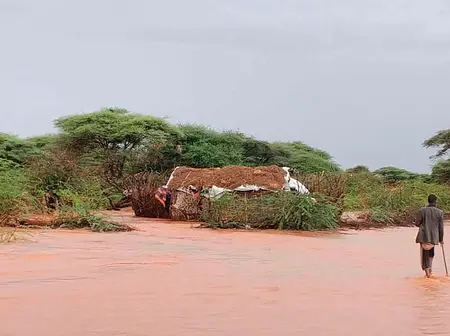
Floods displace hundreds as six people die across the country
Six people have been killed and hundreds of households displaced by floods across the country, with Tana River and Taita-Taveta among the hardest-hit counties as the short rains intensify.A Kenya Red Cross situational report shows that 1,141 households have been affected nationally, with rising water levels destroying homes, submerging farmland, disrupting transport and threatening communities living along rivers and in low-lying areas.
-

Which Is the Latest Number Plate in Kenya?
KEA is the latest confirmed seriesAs of mid-November 2026, the latest standard vehicle registration number plate series in Kenya is KEA.Previous series was KD, which has been exhausted.New plate Kenya: KEA.Example: KEA 000A.Issuing authority: National Transport and Safety Authority (NTSA).
-

Promotion to Glory: Charles Maina Ngare of California
Promotion to Glory: Charles Maina Ngare of San Jacinto, CaliforniaThe Kenyan diaspora community in California is mourning the passing of Mr. Charles Maina Ngare, affectionately known as King Charles, of San Jacinto, California, USA.Charles went to be with the Lord on Friday, November 13, 2026, at Loma Linda University Hospital in California, following a short illness.
-

155 Arrested as Kirinyaga Crackdown Uncovers Thousands of Bhang Rolls and Illegal Alcohol
The operation, conducted between August and October 2026 under the Government’s Rapid Results Initiative, targeted drug dealers and illegal alcohol businesses across all five sub-counties as security agencies intensified efforts to protect residents.
Presenting the operation’s report on Tuesday, November 17, County Commissioner Shufaa Omar Mwijuma revealed that authorities had destroyed 384 litres of makabo, 60 litres of chang’aa and 51 litres of muratina during the crackdown.
Officers also intercepted 16 litres of ethanol before it reached consumers, with Mwijuma warning that the substance posed serious health risks and could have caused fatalities if consumed.
Authorities further seized 13 crates of Jumbo Ice, four crates of Santa Ice, 12 crates of bottle caps and 87 boxes of Trigger Portable Spirits. Another operation recovered 185 crates of assorted alcoholic drinks suspected of being uncertified.
The crackdown also led to the recovery of 15 kilogrammes of bhang, 1,373 rolls, 7,485 grammes and 10 brooms of the narcotic substance. Out of the 155 arrests, 73 cases reached court, with 58 successful prosecutions.
The operation comes amid renewed national debate over alcohol regulation following the introduction of the Alcoholic Drinks and Drugs Control Laws (Amendment) Bill, 2026, by National Assembly Majority Leader Kimani Ichung’wah, proposing to raise the legal drinking age from 18 to 21.
Mwijuma also urged young people to avoid drugs and excessive alcohol consumption, encouraging them to explore agriculture, entrepreneurship and government empowerment programmes, including the Youth Fund and Uwezo Fund, to establish sustainable sources of income.
The campaign forms part of the Kirinyaga We Want initiative, spearheaded by Dennis Itumbi, which links the fight against substance abuse to youth empowerment, security and economic development. Mwijuma assured residents that enforcement operations would continue.