Investigations have been launched following the shocking murder of a woman whose body was discovered in a bush in Mwala, Machakos County, under circumstances that have left residents worried.
The victim, identified as Stacy, operated a salon at Ikalaasa Market.
Her body was discovered in Katheka B village, Ngungi Sub-location, after a resident reportedly spotted a motionless person lying in a thicket.
Photo Source
The resident immediately raised the alarm, attracting the attention of other villagers and prompting police officers to respond to the scene.
Upon arrival, officers examined the area and noticed visible injuries on the woman's body, suggesting that she may have been assaulted before her death.
According to information surrounding the incident, Stacy had not been seen during the morning hours before her body was discovered.
Mwala Sub-County Police Commander Catherine Kagwiria confirmed the incident, saying investigations were underway to establish what happened.
She stated that the motive behind the killing remained unknown and that no arrests had been made by the time of reporting.
Detectives from the Directorate of Criminal Investigations visited the scene, collected evidence and documented important details that could help establish how the woman died.
Meanwhile, her body was transferred to the mortuary, where it is being preserved pending a postmortem examination to determine the exact cause of death.
Investigators are working to trace the woman’s last movements, identify people she may have met, and determine whether the attack was linked to a personal dispute, robbery, or another criminal act.
The murder has sparked fear among residents, who claim that bushes in the area provide hiding places for criminals. They have urged authorities to increase security patrols and clear dangerous thickets.
Police have appealed to anyone with information that could help identify those responsible to report to the nearest station.
A labourer identified as Paul Samuel has revealed the last painful words that his workmate told him when he knew no one could save him from the collapsed Riverside building.
While making his revelation, Paul indicated that he had worked at the site for two months, but what he saw on the morning of Saturday, November 14, 2026, will never leave his mind.
Paul stated that on the fateful day the building collapsed, it started like any other hard morning at the Riverside building site. No one would have imagined about the tragedy that was about to strike.
He indicated that he woke up tired and went to work and his colleagues too were very tired because they had poured concrete the day before. Some of them said they did not want to go inside the building that was still under construction but in the end, they all went in.
As per his remarks, Paul claimed that there was no water at the site and as a result he and six other workers decided to carry heavy cement with their hands to the back of the site.
However, at around 11:30 in the morning when Paul had just turned to go and take another load, everything went wrong after he heard a loud scream before he saw people running past him.
He claimed that a few seconds later, a big pile of big stones and iron sheets fell down to the ground with a loud crash. As per his remarks, there was dust everywhere and people who were at the scene were all running for their lives.
As that was happening, Paul stated that he saw one of his workmates stuck under a very big stone before he rushed and tried to save him.
Paul claimed that he pulled the stone with all his strength trying to lift it and save his colleague but all his effort was in vain. As per his remarks, the stone did not move at all as it was too heavy and no one was near to help him lift it.
That is when the stuck colleague knew no one could save him and it was his final moments. He indicated that stuck worker looked at him and said his last final words “Paul, I am going.”
Kisii music producer Steve Mansamu is counting heavy losses after a fire destroyed, the recording studio he had spent years building from scratch.
Mansamu was at home when he received a phone call at around 10pm informing him about the incident. He rushed to the studio, hoping to establish what had happened, but arrived to find flames consuming his business.
The producer said the sight left him devastated as he watched years of sacrifice and investment go up in smoke.
"I stood helplessly, watching years of hard work, sacrifices, sleepless nights, and financial investment disappear," he told TUKO.co.ke.
He recalled breaking down as the fire continued to destroy the facility, struggling to come to terms with how quickly everything he had worked for had been lost.
"I broke down. I stood helplessly, watching years of hard work, sacrifices, sleepless nights, and financial investment disappear before my eyes," he recounted.
For Mansamu, the studio was more than a place where musicians recorded their songs. He described it as a personal dream that he had pursued from scratch while trying to establish himself as a young entrepreneur.
Building the facility had taken considerable effort, with every piece of equipment and improvement representing progress made over the years.
The producer said the loss was particularly painful because of the time and resources he had committed to growing the business.
He also expressed concern about the young creatives who depended on the studio. According to Mansamu, the facility had provided them with a place to develop their talents and work on their music projects.
Its destruction therefore affected more than his personal investment, disrupting a space that had supported upcoming artists.
The fire has left the producer facing the difficult task of rebuilding what he spent years creating. His account has also drawn attention to the challenges faced by small creative businesses when unexpected disasters destroy their equipment and livelihoods.
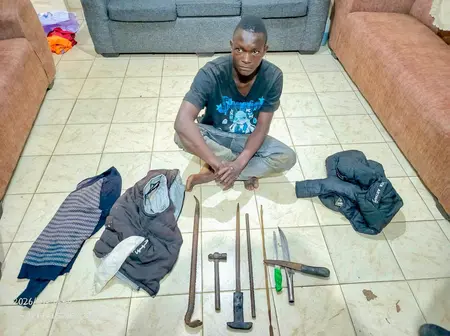
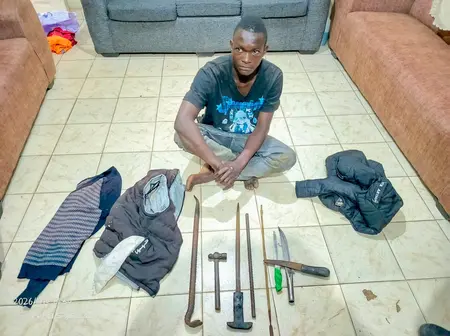
A 19-year-old suspect has been arrested in connection with a violent robbery in which a lorry driver and his salesman were attacked while spending the night in their vehicle in Kisumu County.The suspect was arrested during a multi-agency police operation in Nyawita following investigations into the incident that occurred in the early hours of November 4, 2026, in the Lolwe area.
Listen to articleThe attackers used crude weapons to smash the vehicle’s door windows before assaulting and robbing the occupants.A 19-year-old suspect has been arrested in connection with a robbery in the Lolwe area of Kisumu County, where three armed men attacked a lorry driver and his salesman, smashed their vehicle’s windows and stole from them.
Kenya’s ambitious Rironi–Mau Summit Highway project is raising an important question about the future of road infrastructure financing: how much should motorists pay to use roads built through public-private partnerships?
With the government proposing a toll charge of Ksh8 per kilometre, the approximately 210-kilometre highway is set to introduce a new financial consideration for motorists travelling between Nairobi, the Rift Valley and western Kenya.
The charge means that using the entire highway could cost a motorist approximately Ksh1,680 for a one-way journey, before considering any applicable adjustments or exemptions.
For motorists who regularly travel along the corridor, the cost could become a significant part of their transport expenditure.
The debate is therefore bigger than the construction of another highway.
It touches on affordability, infrastructure financing, public investment and the right of motorists to access alternative roads.
The Rironi–Mau Summit project represents a shift towards using private-sector participation to finance major infrastructure developments.
Under the public-private partnership model, private investors participate in financing, construction and maintenance, with their investment recovered through an agreed concession arrangement.
The Rironi–Mau Summit project has an estimated cost of approximately Ksh184 billion, making it one of the country’s major ongoing road infrastructure investments.Instead of relying entirely on direct government financing, the partnership arrangement provides an alternative mechanism for mobilising capital.
However, the model transfers part of the financial responsibility to road users through toll charges.
This creates an important public policy question: how can Kenya finance modern transport infrastructure without making mobility increasingly expensive for ordinary citizens?
The proposed Ksh8-per-kilometre charge is intended to support the financing and operation of the toll road.
But motorists will ultimately judge the arrangement by the quality of the service they receive.
A toll road is expected to offer more than additional lanes. Its value should be reflected in reduced travel time, improved road safety, reliable maintenance and better traffic management.
For businesses transporting goods between Nairobi and western Kenya, these improvements could translate into more predictable delivery schedules and lower vehicle operating costs. For individual motorists, shorter journeys could mean reduced fuel consumption, less time spent in traffic and improved convenience.
However, these benefits must be weighed against the direct cost of using the highway.
A motorist who pays a toll but experiences persistent congestion, poorly maintained sections or inadequate safety infrastructure may question whether the charge represents value for money.
One of the most important issues in the tolling debate is whether motorists will have meaningful alternatives.
Roads and Transport Cabinet Secretary Davis Chirchir has said alternative routes have been designed for motorists who do not wish to pay toll charges.
This is an important consideration because tolling should not leave road users with no practical option of travelling between destinations without paying.
The availability, condition and convenience of alternative roads will therefore influence how motorists respond to the new arrangement.
If alternative routes are significantly slower, poorly maintained or more expensive to use, motorists may feel compelled to pay even when the toll charge strains their budgets.
The government must consequently ensure that non-toll routes remain usable and that motorists understand their options before the system becomes operational. When can motorists use the road without paying?
Chirchir has also explained that toll exemptions may apply under particular circumstances, including when sections are opened or expanded to ease congestion and maintain the required service levels.
The arrangements are linked to service-level agreements established by the Kenya National Highways Authority.
These agreements are intended to define the standards expected from the road operator, including maintenance and traffic management.
The principle is important because motorists should not continue paying for a service that fails to meet the agreed standards.
However, the specific conditions governing exemptions, their duration and how motorists will be informed need clear communication.
The success of the Rironi–Mau Summit Highway will not be measured exclusively by whether contractors meet the June 2027 completion deadline.
It will also depend on whether the completed road delivers measurable benefits to motorists and businesses.
The government will have to demonstrate that the toll charges are justified by the quality, reliability and efficiency of the infrastructure.
It must also establish transparent mechanisms for toll collection, public accountability, maintenance standards and handling complaints.
For Kenya, the project presents an important test of whether public-private partnerships can deliver modern infrastructure while balancing investor interests with the financial realities of citizens.Ultimately, the question is not simply whether Kenyans are willing to pay Ksh8 per kilometre.
It is whether the time saved, safety improvements and reliability gained will justify the additional cost of travelling.
Police have launched investigations after the body of an unidentified middle-aged man was found floating in River Riana in Ochol Village, Kobita Sub-location, Homa Bay County.The body was discovered on Saturday, November 14, 2026, by children who had gone to fetch water from the river.
Police in Kisii County launched a manhunt for a suspect who allegedly stabbed a 25-year-old woman to death inside a bar at Nyakoe Market in Kitutu Central Sub-County.The victim, identified as Diana Aguko, was found lying in a pool of blood inside one of the rooms at Kundi’s Lounge Bar on Saturday night, November 14, 2026.
Police in Dagoretti, Nairobi, are hunting for a suspect who allegedly stabbed a 25-year-old man to death following a midnight quarrel at Muthinthia area.The victim, identified as David Lamwenya, died while receiving treatment at a hospital after sustaining a stab wound to the chest in the attack reported in the early hours of Sunday, November 15, 2026.
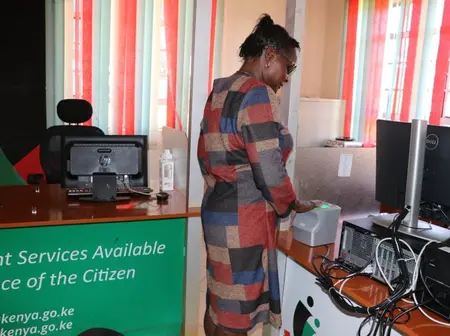
Applicants seeking Certificates of Good Conduct can now have their fingerprints captured and police clearance processed within minutes at selected centres following the introduction of a new biometric identification system.
However, Kenyans must complete an online application and carry specific documents before visiting the designated desks.
The process of obtaining a Certificate of Good Conduct in Kenya is undergoing a major technological transformation, with the Directorate of Criminal Investigations (DCI) introducing a modern biometric system designed to reduce the time applicants spend waiting for police clearance.
The new system, known as the Multi-Biometric Identification System (MBIS), is replacing traditional ink-based fingerprint recording and paper-based processing with digital biometric capture.
The development marks a major shift from the previous processing timeline, which required applicants to wait for at least 14 working days before receiving their documents.
In a statement issued on Tuesday, November 10, 2026, the DCI said the latest installations were part of its efforts to decentralise Police Clearance Certificate services and make them more accessible to members of the public.
“The Directorate of Criminal Investigations (DCI) has today stepped up the rollout of its new Multi-Biometric Identification System, a transformative initiative aimed at enhancing efficiency and improving service delivery in North Eastern and North Rift, which will enable members of the public to apply for and obtain their Police Clearance Certificates in less than five minutes, compared to the previous Service Charter timeline of at least 14 working days,” the DCI stated.
Some Huduma Centres have reported completing the process in approximately two to five minutes, although the speed depends on the availability of the upgraded system and successful processing of an applicant’s records.
The important thing, however, is that applicants cannot simply walk into a biometric desk and expect to receive the service without completing the necessary preparations.
The MBIS is an upgraded identification technology that captures and analyses multiple biometric identifiers, including:
Unlike the traditional system, which relied heavily on ink-based fingerprint recording, the new technology captures biometric information digitally and compares it against records held in the DCI database.
The system was launched at DCI headquarters in Nairobi on July 23, 2026, by Interior Cabinet Secretary Kipchumba Murkomen.
According to the DCI, the upgrade is expected to reduce Police Clearance Certificate processing from approximately 14 days to same-day issuance at connected centres.
It has also increased the system’s record-handling capacity from two million to 10 million records, while daily fingerprint searches have increased from approximately 4,500 to 20,000. Directorate of Criminal Investigations+1
The technology is therefore not simply intended to make fingerprint collection faster. It is also designed to improve the accuracy of identity verification and strengthen the DCI’s ability to identify individuals during criminal investigations.
The Directorate announced that it had installed the Multi-Biometric Identification System (MBIS) at Lodwar Huduma Centre in Turkana County and Kapenguria Huduma Centre in West Pokot County.
Before visiting a designated biometric centre, applicants must first complete their applications through the government’s eCitizen platform.
According to the DCI, the following are the essential requirements for Kenyan adults applying for a Certificate of Good Conduct.
1. Original National Identity Card
Applicants must carry their original national identity cards for identification and verification.
The details on the ID should correspond with the information submitted during the online application.
2. Two copies of the payment invoice
After completing the application and payment, applicants should download and print two copies of their payment invoice.
These documents serve as proof that the application fee has been paid.
3. Form C24
Applicants must download and print Form C24, the prescribed fingerprint recording form.
The form should be printed on both sides of an A4 sheet, as directed by the DCI.
4. Personal appearance
The applicant must physically visit the selected biometric centre.
This is because the system requires the applicant’s fingerprints, palm prints and facial image to be captured.
Applicants cannot send another person to undergo biometric registration on their behalf.
These requirements are outlined in the DCI’s official Police Clearance Certificate application guidelines. Directorate of Criminal Investigations+2
The five-minute biometric service does not eliminate the online application process.
Kenyans must first submit their applications through the DCI eCitizen portal before proceeding to the fingerprinting centre.
Here is the process:
Step 1: Access the eCitizen portal
Visit DCI eCitizen portal and log into your account.
Applicants without an account must first register.
Step 2: Select Police Clearance Certificate
Navigate to the Police Clearance Certificate service and select the appropriate application category.
Adult applicants should select the adult application option.
Step 3: Fill in your details
Provide the required personal information and carefully check that the details match those on your identification documents.
Incorrect information could complicate the processing of your application.
Step 4: Select a fingerprinting centre
Choose your preferred fingerprinting location from the available options on the platform.
This is an important step because applicants should visit the centre indicated in their application rather than assume that every DCI office or Huduma Centre has the upgraded biometric equipment.
Step 5: Pay the application fee
Complete the payment through the available eCitizen payment options.
The prescribed Police Clearance Certificate application fee is Ksh1,050.
Step 6: Download and print your documents
After payment, download two copies of the invoice and one copy of Form C24.
Print the C24 form on both sides of an A4 sheet.
Step 7: Visit the selected biometric centre
Present yourself with your original national ID, two payment invoices and the printed C24 form.
Your biometric details will then be captured electronically.
Once the certificate is ready, you will receive an SMS notification directing you to download it through your eCitizen account.
Rono is a digital journalist with a proven track record in newsroom leadership and content creation. Currently a Digital Writer for People Daily Digital, Emmanuel’s career is rooted in a lifelong passion for storytelling. Let's talk here: or