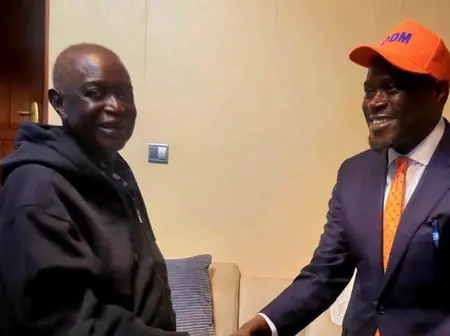
MeetingNairobi Governor Johnson Sakaja has detailed his meeting with ODM Leader Senator Oburu Oginga, following his move to join the party.Nairobi Governor Johnson Sakaja has detailed his meeting with ODM Party Leader Senator Oburu Oginga, following his move to join the party.In an update on Monday, November 2, Sakaja said he visited Oburu at his home where he was formally welcomed into the ODM Party.
Category: Politics
-
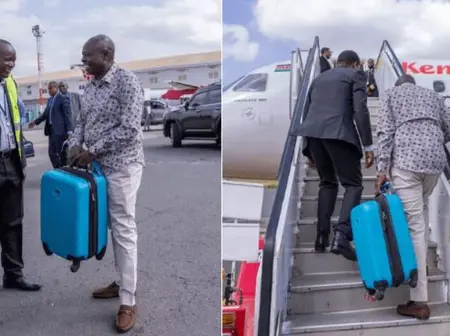
Gachagua Says He Will Flee to US If Ruto Wins 2027 Election

Speaking during a wide-ranging interview with a vernacular television station on Sunday, the DCP founder and leader confirmed he has a home in America. He said he would move there if divisions within the Mt Kenya region contributed to the opposition’s defeat in the presidential contest.
Nonetheless, Gachagua expressed confidence that the Opposition can beat Ruto.
“I am convinced that the Opposition will win if it does not allow itself to be divided,” he said.
“If our people allow themselves to be divided, I will just board a plane and go to the US. I have a home there,” he said.
Gachagua quipped that he would not wait until after the election to flee Kenya, particularly if Mt Kenya had been misled by its own leaders.
“If I see that our people have been misled and divided through their own leaders, because I will be woke, I will not be here in Kenya,” he added.
The former DP argued that he had done his best to unite the region, and therefore, he would not be answerable to anyone if he relocated to the U.S. with his family.
“I have tried to unite the region, so no one will ask me any question. No one will ask me the reason for fleeing. I will just go to America with my people because I have a home there,” he said.

Gachagua at the same time recounted the warm reception he received from Kenyans in the US during his two-month tour in the country.
According to Gachagua, he was treated like royalty, as Kenyans in the diaspora provided accommodation in private homes instead of hotels, food, transport, and personal items for him and his wife, Dorcas Gachagua.
“I want to thank our people in the US. I was accorded an unforgettable affection. They treated me like their king…like a young child. They came for me at the airport with flowers and they sang for me,” he said.
Gachagua described how his hosts brought food, did his laundry, and ironed his clothes, while others took him shopping.
“I was not staying in a hotel. Those with big houses were instructed by the community to relocate. We were given the space with Mama Gachagua to live until it was enough for us,” he said.
“They would take me to shops and ask me to pick what I want and don’t spend even a cent,” he said.
The DCP described the tour as a wholesome experience that was both socially and spiritually fulfilling.
“I have never been accorded such affection in my life,” he said.
Gachagua estimated that the U.S. tour cost about Ksh150 million, and he never spent a coin out of his pocket thanks to contributions and logistical support from Kenyans living in the US.
“My two-month trip cost Sh150 million, and I did not spend even a shilling. That money came from our people,” he said.
Gachagua also used the tour for self-reflection, spending part of his time in prayer and solitude.
“I had a moment of self-reflection in thoughts, prayers, and fasting, reflecting about our people and our country, as our people are not in a good situation,” he said.
Gachagua said the reflections strengthened his resolve to reach out to other Kenyan communities and build political alliances before the 2027 general election. He said he put the strategy into action as soon as he returned to Kenya, beginning with meetings at his home in Wamunyoro, Nyeri County.
“From that love, I decided to do all I can to defend our people at all cost,” he said.
-

Ichung’wah Slams Gachagua Over Threat to Move to US if Ruto Wins 2027
Speaking to residents in Kiambaa, Ichung’wah warned that Gachagua’s rhetoric threatens to isolate the Mount Kenya region from the rest of Kenya. He urged voters to reject divisive politics, questioning where ordinary citizens without overseas property would go if political outcomes fail to suit individual leaders.
“He is trying to sell us hatred. I have heard others saying that if Ruto returns to office, he will relocate to America. You have a house there, but what of the Kiambu people who don’t? Where will they go? Let us not buy hatred. We cannot stand ourselves in this country alone; we need other Kenyans,” Ichung’wah said.
Ichung’wah also pushed back against the assumption that the region’s seven million registered voters will automatically rally behind a Kikuyu candidate. Highlighting the cosmopolitan nature of the region, he noted that out of Kiambu County’s 1.3 million registered voters, nearly 400,000 come from communities outside Mount Kenya.
The criticism follows similar reactions from other prominent political figures. Prof. Makau Mutua, head of the Panel on Compensation of Human Rights Violations and Protest Victims, called Gachagua’s bluff, urging him to pack his bags for the US immediately while asserting that Ruto’s re-election remains inevitable.
“I welcome Wamunyoro to flee to the US now because the die is cast for Tutam! He should save himself the trouble,” he said.
-

‘Who Does He Think He Is?’ Kibagendi Questions Gachagua’s Power-Sharing Demand
In a public statement on social media, Kibagendi questioned Gachagua’s authority to dictate terms to the broader opposition and accused him of attempting to dominate power-sharing talks ahead of the 2027 General Election. The discussions at the Nyeri residence involved Nairobi Senator Edwin Sifuna alongside other key opposition figures.
“When he invited Linda Mwananchi to Wamunyoro, I am informed that he demanded half of the government. Who does he think he is?” Kibagendi asked.
The lawmaker argued that several leaders had already built the opposition movement and challenged the Kenya Kwanza administration long before Gachagua joined their ranks following his impeachment. He raised concerns over whether Gachagua intends to control a future administration by installing leaders accountable directly to him.
Recalling a 2023 development meeting with Gusii lawmakers, Kibagendi alleged that Gachagua questioned why opposition MPs expected national government funding while opposing the administration.
According to Kibagendi, Gachagua told him to seek infrastructure and road development for Kitutu Chache South from the late former Prime Minister Raila Odinga. Kibagendi walked out of the meeting despite attempts by fellow MPs, including Silvanus Osoro, to persuade him to stay.
The incident, he noted, cemented his decision to challenge the Kenya Kwanza administration over policies such as the housing levy and regional development imbalances.
Kibagendi also accused Gachagua of trying to isolate prominent opposition figures who hold independent political positions, citing former Interior Cabinet Secretary Fred Matiang’i, former CS Peter Munya, former Meru Governor Kawira Mwangaza, and Kiharu MP Ndindi Nyoro.
Addressing Gachagua’s recent media interview on Inooro FM, Kibagendi rejected the former deputy president’s suggestion that he could form a government exclusively alongside Sifuna and Wiper leader Kalonzo Musyoka. He warned that excluding key stakeholders undermines efforts to present a cohesive opposition front against President William Ruto.
Emphasizing that no individual holds exclusive ownership over the United Opposition, Kibagendi called for mutual respect across all member parties.
“I am not in any way demanding that Matiang’i or Sifuna or Kalonzo must be the opposition flag bearers, but there must be unity in the opposition; there has to be respect for everyone, and that unity should be on getting this oppressive regime out and making Kenya better,” Kibagendi said.
He warned that continued infighting and individual power plays will erode the opposition’s momentum and weaken its challenge to President Ruto in 2027.
-
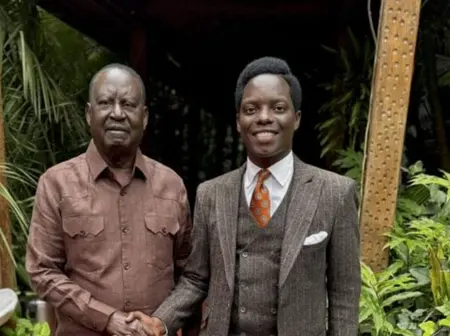
McOure Shifts Loyalty From Raila to Ruto, Makes 2027 Election Pledge
McOure revealed that he has formally shifted the political allegiance he previously held for the late former Prime Minister Raila Odinga directly to President Ruto. Moving forward, he pledged to align exclusively with individuals committed to securing a second term for the Head of State.
Addressing the personal toll of his decision, McOure noted that he has paid a heavy price for his political stance and will not permit individual agendas to derail Ruto’s campaign.
“President William Ruto’s decisive victory in 2027 will be my only ideological vindication. I have paid too dear a price to allow a few individuals to impose their selfish interests and potentially sabotage it,” he said.
He insisted that his endorsement of the Head of State remains non-negotiable and independent of third-party interests.
“The unwavering loyalty I once had for H.E. Raila Odinga has now been transferred to President William Ruto. Support for President Ruto must be unconditional. I consider it a matter of principle,” he added.
McOure’s stance comes amidst intense internal debate within the Orange Democratic Movement (ODM) regarding the terms of engagement with President Ruto ahead of 2027. While McOure offers direct endorsement, several ODM party leaders continue pushing for structured negotiations.
Prominent figures in the party, including National Assembly Minority Leader Junet Mohamed, Homa Bay Governor Gladys Wanga, and Secretary General Catherine Omanyo, advocate for a formal broad-based alliance that explicitly guarantees ODM a 50 percent share of government positions and power.
-
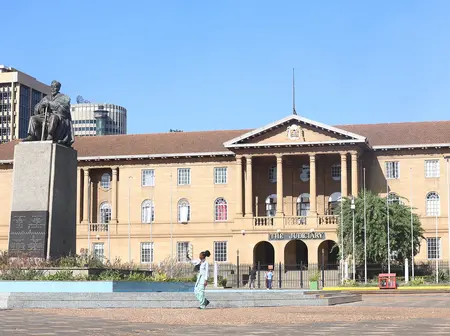
Mwakideu Questions Why Waititu Faces Long Sentence as Other Corruption Cases Stall
Radio host Alex Mwakideu has raised questions about the consistency of Kenya’s corruption accountability, pointing to the case of former Kiambu Governor Ferdinand Waititu.
In remarks on Tuesday, November 3, 2026, Mwakideu noted that Waititu appears to be facing a lengthy prison sentence, yet other leaders implicated in corruption have not attracted similar scrutiny or penalties.
The former governor’s case also involves his wife, Susan Wangari Ndung’u, who has been mentioned in connection with the matter. Mwakideu observed that others linked to the case were given different sentences, and said Waititu had wanted his wife, children and other friends involved to remain free.
He argued that corruption should be addressed beyond individual prosecutions, asking whether other Kenyan leaders facing corruption allegations would face the same level of scrutiny and legal consequences.
The report did not specify the exact length of Waititu’s sentence, the precise charges against him, or the names of the other leaders and individuals referenced. It also did not detail the outcomes of the different sentences handed to those involved in the case.
Mwakideu’s comments add to ongoing public discussion about how corruption cases involving high-profile figures are handled in Kenya.
-

350 Kenyan workers denied entry to Saudi Arabia after latest travel ban
More than 350 Kenyan workers who travelled to Saudi Arabia for employment have been forced to return home after authorities denied them entry over concerns linked to Ebola cases in Kenya.
The workers, who had travelled with valid work visas, spent four days stranded at Sharjah Airport in the United Arab Emirates before boarding a flight back to Kenya. The plane landed at Jomo Kenyatta International Airport at about 1.30 pm Kenyan time on Monday, November 2, 2026.
The returnees have asked the Kenyan government to intervene through diplomatic channels, warning that the disruption could affect their employment plans and leave them with expiring visas.
Saudi Arabia introduced an indefinite travel ban on arrivals from Kenya following an assessment of the Ebola situation. The measures, announced on October 30, 2026, through the Saudi Press Agency, include suspending travel by Saudi citizens to Kenya and halting the issuance of all visa categories for people travelling from the country.
The restrictions also bar entry to travellers who have stayed in Kenya or another country experiencing an active Ebola outbreak within the 21 days before their arrival. The rule applies even where travellers pass through a third country.
The measures build on health protocols first introduced in 2019 and strengthened in May 2026.
One of the affected workers, Mary Njau, described the experience at Sharjah Airport as frustrating and said the group had travelled with expectations of starting work.
“Tumerudi and it is very frustrating. We were stuck and stranded at Sharjah. Tulienda na matarajio lakini tukifika pale we were treated bad,” she said.
She appealed to the Kenyan government to address the matter before the workers’ visas expire. Other returnees reported limited meals and spending nights on airport floors.
The Association of Skilled Migrant Agencies of Kenya (ASMAK) has called for urgent diplomatic engagement between Nairobi and Riyadh.
Assistant Secretary General Elab Muridi said more than 350 workers were returning, while about 150 others were still in transit. He added that documents for approximately 2,200 workers had already been processed, with the applicants expected to travel.
“Already, more than 350 workers are on their way back, and most of them are here. We estimate that about 150 are still in transit,” Elab Muridi, Assistant Secretary General of the Association of Skilled Migrant Agencies of Kenya (ASMAK) said.
ASMAK Chair Francis Wahome said recruitment partners in Gulf Cooperation Council countries were also surprised by the restrictions. He said agencies had not received formal communication from the Kenyan government.
“Even our partners in Saudi Arabia, Kuwait and other Gulf Cooperation Council countries were shocked. They have been calling us to ask what is happening. Everyone in the recruitment sector is seeking answers from colleagues and the government because we have not received any formal communication from the government,” Francis Wahome, Chair of ASMAK, said.
Secretary General Monica Mwema said the decision had disrupted confirmed bookings and scheduled departures, leaving recruiters seeking clarification on the 21-day restriction.
“We have people who are coming back because they were not allowed to enter Saudi Arabia. Others have confirmed tickets, with some scheduled to leave tonight and others tomorrow. We have been caught off guard and are seeking clarity on the 21-day restriction. What does it mean?” Monica Mwema, Secretary General of ASMAK, stated.
The agencies want the Ministry of Foreign Affairs to engage Saudi authorities and establish how the restrictions will affect workers whose travel arrangements are already in place.
The restrictions come as Kenya responds to nine confirmed cases of Bundibugyo-strain Ebola and two deaths. The cases have been linked to one cluster originating from an imported case involving a Kenyan man who travelled from the Democratic Republic of Congo through Uganda before arriving in Nairobi on October 3, 2026.
The Ministry of Health reported that Kenya had gone 10 days without recording a new infection as of October 30, 2026. It has also started releasing contacts who completed the required 21-day monitoring period.
Principal Secretary for Public Health Mary Muthoni said the release of people under monitoring was being carried out progressively, with full clearance targeted around mid-November.
Kenyan workers and recruitment agencies have warned that prolonged restrictions could affect employment opportunities, trade and tourism. They want the two governments to reach an agreement that will allow affected workers to travel once the necessary health requirements are met.
-

Martha Karua calls for Tundu Lissu’s release after brother’s death
Kenyan lawyer and politician Martha Karua has called for the release of Tanzanian opposition leader Tundu Lissu following the death of his elder brother, Alute Lissu Mughwai.
Karua said Lissu should be allowed to leave prison and join his family in mourning Alute, who died on November 1, 2026, after a prolonged illness.
In a statement posted on X on November 2, 2026, Karua expressed her condolences to Lissu and the entire family, recalling that she had met the deceased during a visit to Tanzania in April 2025.
Alute, who was also a lawyer, had appeared at Kisutu Court to represent his younger brother.
“This personal encounter makes his passing particularly close to my heart,” she wrote.
The former Justice Minister said it was painful that Lissu had to receive news of his brother’s death while in detention and could not stand with his family during the mourning period.
She also highlighted his role in advocating for freedom, justice and democracy in the region.
“Tundu Lissu has been at the forefront of this struggle—standing firmly for the rights of his people and the democratic future of our region,” Karua said.
She described the circumstances surrounding his brother’s death as particularly difficult, noting that the family had postponed the burial arrangements.
“It is profoundly painful that a man who has given so much to the struggle for freedom must now face such a personal loss without the freedom to grieve as he should,” she stated.
“We will continue to stand with Tundu and to demand his release. He ought to be free to mourn his brother, to stand with his family in this hour of grief, and to continue the struggle for a more just, free and democratic East Africa.”
Alute died in Arusha in the early hours of November 1, 2026, after being unwell for a long time. His younger brother, Vincent Lissu, described him as a father figure and role model, particularly to Tundu.
The family has postponed the burial, which is expected to take place at Mahambe Village in Ikungi District, Singida Region, to allow relatives to attend the judgment in Tundu Lissu’s treason case.
The High Court in Dar es Salaam is scheduled to deliver its judgment on November 6, 2026. The family has said it will communicate further funeral arrangements after the court proceedings.
Lissu, the national chairman of the opposition party CHADEMA, has been in detention since his arrest on April 9, 2025. He faces a treason charge linked to remarks he made during the campaign for electoral reforms ahead of Tanzania’s 2025 General Election.
Karua’s appeal follows her previous involvement in Lissu’s case. In May 2025, she and two other Kenyan lawyers were detained and deported from Julius Nyerere International Airport while travelling to observe court proceedings.
-

Kenya: Journalists Face Rising Attacks Ahead of 2027 Election, Media Council Warns
Nairobi recorded the highest number of violations with 13 casesThe Media Council of Kenya has raised the alarm over a sharp rise in press freedom violations, warning that attacks on journalists are increasing as the country approaches the 2027 General Election.According to data from the Media Council of Kenya (MCK), 47 cases of press freedom violations were documented between July and September 2026, a significant increase from 17 cases recorded during the same period in 2025 and 24 cases in 2024.
-
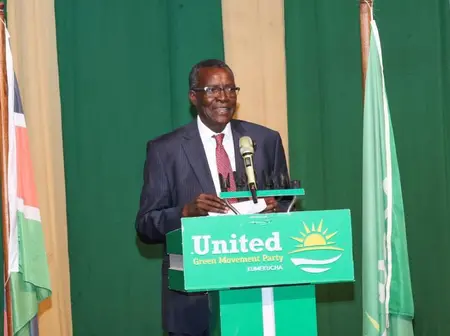
Maraga explains why Kenyans are poor
Former Chief Justice David Maraga has blamed Kenya’s persistent poverty on an extractive system that prioritises people in power over ordinary citizens, arguing that the country’s economic challenges go beyond a lack of money.
In a statement posted on X on November 2, 2026, Maraga, who is seeking the presidency in 2027, said the country could take a different direction through leadership guided by integrity, discipline, respect for the rule of law and prudent management of public resources.
“We are not poor because we lack money. We are poor because we have embraced an extractive system that is designed to serve those in power before it serves citizens,” Maraga stated.
Maraga also linked the country’s economic difficulties to corruption and wastage of public resources. In a separate post, he wrote: “We are not a poor country!!! But bad leadership, mega corruption scandals like these two and wastage of resources has pushed Kenyans to their knees.”
The former Chief Justice’s remarks come as he continues to criticise President William Ruto over the failure to reconstitute the Cabinet in line with the constitutional two-thirds gender rule.
The High Court had given the President 120 days to ensure that at least nine women were appointed to the 25-member Cabinet, with the deadline expiring on October 28, 2026.
Maraga questioned the failure to meet the deadline, saying compliance with court orders and the Constitution should guide decisions made by the government.
“Compliance with the Constitution is not optional; it is the ultimate metric of a functioning democracy,” he stated.
He also criticised Attorney General Dorcas Oduor for seeking a stay of the judgment shortly before the deadline. The Court of Appeal declined to treat the application as urgent.
“A court order remains fully active, alive, and binding unless and until a higher court explicitly stays it,” Maraga emphasised.
He warned that government decisions, policies and expenditure made after the deadline could face legal challenges, including possible contempt proceedings against the Attorney General.
Maraga further linked the Cabinet dispute to what he described as wider concerns about adherence to constitutional procedures.
He cited a separate High Court ruling that declared the President’s roadside announcements on affordable housing allocations unconstitutional. He also questioned plans to spend more than Ksh1 billion on the opening of the Raila Odinga International Stadium without parliamentary approval.
The former Chief Justice questioned why the President would appeal a ruling requiring the inclusion of women in the Cabinet, arguing that Kenya has qualified women who can serve in government.
Maraga, who served as Chief Justice between 2016 and 2021, is the co-party leader of the United Green Movement (UGM).
He has called on Ruto to reconstitute the Cabinet in line with the court directive or resign if he cannot comply.