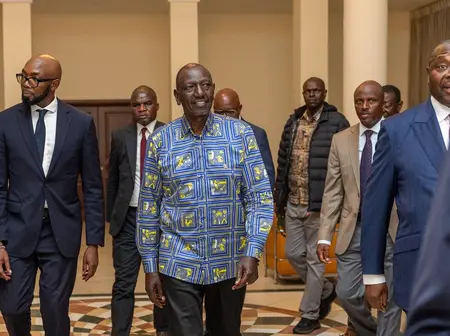
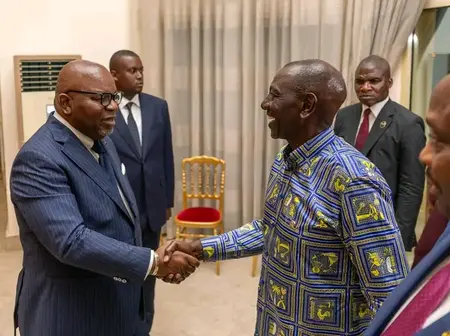
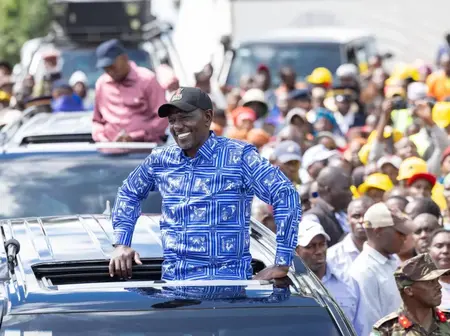
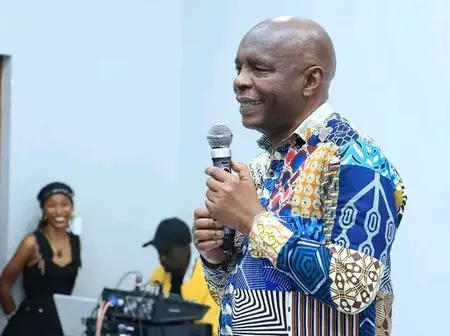
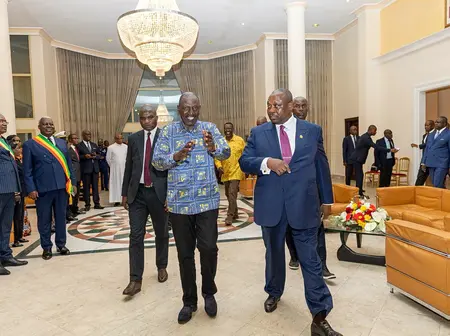
President Ruto has finally addressed his unexpected trip to the Republic of Congo, breaking his silence hours after leaving Kenya and cutting short his ongoing engagements in the Western region.
The Head of State has confirmed his arrival in Oyo, Congo, where he has attended a Quadripartite Summit bringing together Kenya, the Republic of Congo, the Democratic Republic of Congo and Togo.
In a statement shared on his official social media accounts, Ruto has explained that the meeting has focused on strengthening diplomatic ties, deepening regional integration, advancing peace and security, and expanding cooperation among the participating countries.
The President has maintained that the discussions have been aimed at promoting shared prosperity while strengthening relationships between the four nations.
His announcement has followed reports that he had departed Kenya through Kisumu International Airport aboard a military aircraft, sparking widespread interest in his destination after his Western region engagements were interrupted.
The latest communication has now shed light on the reason behind his trip, confirming that he has travelled to participate in the regional diplomatic gathering convened in Congo.
Ruto has further indicated that the participating leaders have remained committed to dialogue, partnerships and African-led solutions to challenges facing the continent.
The summit has provided an opportunity for the leaders to engage on matters of mutual interest, particularly regional stability, economic cooperation and diplomatic relations at a time when several African countries have continued to navigate political and security challenges.
His presence at the meeting has also highlighted Kenya's involvement in regional initiatives aimed at strengthening cooperation with neighbouring countries and promoting peaceful engagement.
Although the President has not provided a detailed account of the discussions or disclosed specific agreements reached during the meeting, his statement has indicated the broad objectives of the summit.
The diplomatic engagement has attracted attention back home, particularly among Kenyans who have been following his political activities and public appearances across Western Kenya.
Ruto's latest update has consequently clarified his sudden departure, with the President having confirmed that his Congo visit has been part of a regional effort to strengthen relations, promote peace and pursue cooperation among African nations.
Ruto announced his arrival on Sunday, November 22, through a social media update, revealing that he was in the Central African country for the Quadripartite Summit involving Kenya, the Republic of the Congo, the Democratic Republic of the Congo (DRC) and Togo.
The meeting brings together the four nations to discuss issues affecting the continent and explore opportunities for stronger diplomatic and economic relations.
According to the President, discussions will centre on strengthening diplomatic ties, promoting regional integration and expanding cooperation among the participating countries.
Peace and security are also expected to feature prominently in the deliberations, particularly as African nations continue to seek lasting solutions to conflicts and other challenges affecting stability across the continent.
Ruto emphasised the importance of partnerships and dialogue in addressing Africa's problems, maintaining that African countries must take the lead in developing solutions that respond to their unique circumstances.
He further expressed his administration's commitment to working with other governments to promote shared prosperity through closer cooperation and stronger regional relationships.
The summit comes at a time when African countries are increasingly seeking to strengthen economic partnerships, improve cross-border relations and establish common approaches to security challenges.
Kenya's participation also provides an opportunity for Nairobi to reinforce its diplomatic engagement with countries in Central and West Africa.
The four-nation meeting is expected to provide a platform for the leaders to exchange ideas, identify areas of mutual interest and explore practical ways of advancing cooperation.
Ruto's visit further underscores Kenya's continued involvement in continental diplomacy and efforts to promote African-led initiatives in addressing political, economic and security challenges.
The concerns were raised during a diaspora meeting in New Jersey on Saturday, November 21, where supporters had gathered to meet Sifuna. The woman questioned the movement's organisation, communication and handling of contributions from Kenyans living abroad.
Wafula Nabiliaka, a Kenyan from Webuye, took the floor during a question-and-answer session and complained that supporters had waited for hours without receiving clear information about Sifuna's whereabouts.
She said some attendees had arrived early and were left confused after receiving conflicting updates about his location, including claims that he was in New York while a Facebook livestream showed him at a church.
Nabiliaka said she had worked an 18-hour shift before attending the gathering and was disappointed by the lack of timely communication.
She called on the movement's leadership to improve its organisation and ensure supporters are treated with respect, insisting that transparency and accountability should be central to its operations.
Woman questions multiple fundraising WhatsApp groups
Beyond the delays, Nabiliaka raised concerns about the numerous diaspora WhatsApp groups associated with Linda Mwananchi, saying she had been added to approximately 15 groups.
She warned that having several groups soliciting contributions could confuse supporters and make it difficult to establish which fundraising initiatives were legitimate.
With fraudsters increasingly exploiting people through online platforms and mobile money transactions, she called for a centralised communication and fundraising system that supporters could easily verify before sending money.
Her concerns placed the movement's fundraising arrangements under scrutiny, particularly as it seeks to attract financial and political backing from Kenyans living abroad.
Sifuna apologises and directs supporters to official platform
Sifuna acknowledged the complaints about lateness and apologised to the attendees before responding to questions about fundraising.
He directed supporters to the movement's website, lindamwananchi.com, where he said they could access the official contribution channels rather than send money through individuals or unverified groups.
According to Sifuna, the website provides several payment options, including M-Pesa, card payments and PayPal.
He said the movement did not want supporters to feel they were being conned or that fundraising was being conducted dishonestly.
Sifuna also urged members to reconsider making contributions directly to individual leaders, encouraging them instead to support the movement as an institution.
He argued that institutional contributions would be easier to track, audit and account for, helping build confidence among supporters.
Sifuna recalls past donation complaints
During the meeting, Sifuna also referenced complaints from people who claimed to have donated tablets to the Orange Democratic Movement (ODM) but never received acknowledgement.
He said he had no record of some of the donations reportedly sent to the party's national headquarters during his time as secretary general, raising questions about how contributions were received and documented.
He used the experience to emphasise the importance of having a formal system for collecting and recording donations, rather than relying on informal arrangements or individual intermediaries.
The exchange highlighted the expectations among diaspora supporters, who want clearer communication, reliable fundraising channels and greater accountability as political mobilisation gathers momentum.
President William Ruto is relying on two parallel networks of allies to rebuild his support in Mt Kenya, a region that has drifted away from him politically since the impeachment of former Deputy President Rigathi Gachagua in October 2024.
The networks, led by Public Health PS Mary Muriuki and National Assembly Majority Leader Kimani Ichung’wah, are pursuing a common objective through different approaches: promoting the administration’s development record and mobilising political leaders behind Ruto’s 2027 re-election bid.
The strategy comes as the President limits his physical presence in a region that overwhelmingly backed him in 2022. Instead of frequent presidential visits, State House is relying on senior officials and elected leaders with local roots to reach communities, defend government policies and challenge Gachagua’s influence.
Muthoni heads the technocratic side, bringing together Principal Secretaries from the region. The team uses government outreach forums, particularly Jamii Imara Mashinani, to explain public programmes and highlight projects in health, roads, housing and education.
The network includes Energy PS Alex Kamau Wachira, East African Community Affairs PS Dr Caroline Wanjiru Karugu and Gender and Affirmative Action PS Anne Wang’ombe, all from Nyeri.
Meru is represented by Cooperatives PS Patrick Kilemi, Forestry PS Gitonga Mugambi and Diaspora Affairs PS Roseline Njogu.
Other members are Muthoni, from Kirinyaga; Roads PS Joseph Mbugua, from Nyandarua; TVET PS Dr Esther Muoria, from Embu; Defence PS Dr Patrick Mariru, from Laikipia; Housing PS Charles Hinga, associated with Kiambu and Murang’a; and Irrigation PS Ephantus Kimotho.
Muthoni, who also serves as Deputy Dean of Principal Secretaries, has led delegations of senior officials to several counties under Jamii Imara Mashinani.
In Kirinyaga, forums have been held at Karucho Primary School and Kiamutugu Boys’ High School in Gichugu. In September, she led officials to a forum at Nyeri National Polytechnic, where she cited road investments worth more than Sh46 billion and Social Health Authority registration drives.
Defending the President’s relationship with the region, Muthoni said there is still mutual affection.
She urged residents to give Ruto an opportunity to complete his term, dismissing what she described as political propaganda targeting the administration.
The team has also taken its message to Nyandarua, Murang’a, Laikipia, Meru and Kiambu. Forums have focused on service delivery, social health insurance, community health promoters, development planning and disability inclusion.
The second network, led by Ichung’wah, is more overtly political. It brings together MPs and local leaders who campaign for Ruto, defend his record and contest Gachagua’s calls for a united Mt Kenya political front with other regions.
Its ranks include Laikipia East MP and The Service Party leader Mwangi Kiunjuri, Nyandarua Woman Representative Faith Gitau and Ndia MP George Kariuki.
During campaigns in Laikipia West in November, Kiunjuri urged Mt Kenya voters to support Ruto, pointing to affordable housing, modern markets, water infrastructure and universal health coverage.
He also argued that the region needed political alliances with other parts of the country to strengthen its national influence.
“Please elect the President due to his strong development agenda in the region and in the entire country,” Kiunjuri said.
Ichung’wah has similarly challenged former Deputy President Rigathi Gachagua’s political strategy, particularly his proposed alliance linking Mt Kenya, Ukambani and Western Kenya.
Speaking in Kiambaa in November, he argued that Mt Kenya could not win the 2027 General Election alone, warning against ethnic-based mobilisation.
He dismissed Gachagua’s proposed regional coalition, saying, “Gachagua is trying to become the Raila of Mt Kenya.”
The Kikuyu MP has also mobilised leaders in Gatundu North and Kikuyu, where he has highlighted infrastructure projects as evidence of the administration’s commitment to the region.
In Tigania West, Meru county, he led MPs in challenging Gachagua’s regional unity message, accusing him of pursuing personal political interests.
The political network has also found a focal point in Kirinyaga, where Ndia MP Kariuki has opened his Gacharu home to political delegations for a three-month consultation process ahead of the 2027 election.
According to political analysts, the President’s new approach is intended to ease the anger that appears to have developed towards his administration in the region following Gachagua’s impeachment.
Speaking to the Star, political analyst Martin Andati said relying on loyalists was the best way for Ruto to reach the masses through a more conciliatory approach.
“The President is aware that there is a great anger towards his administration. He has directly minimised his physical presence, relying on his technocratic and political lieutenants to woo the masses on the development agenda against the backdrop of anti-Ruto politics advanced by the opposition, especially Gachagua. It may be quite a difficult task, but the leaders are realistic about this,” Andati said.
An insider in the Ichung’wah-led caucus said the group intended to secure at least 40 per cent of the votes in the larger Mt Kenya region for Ruto.
“We know how the ground is. However, our aim is to at least recapture 40 per cent of the support that the President got,” he said.
Trans Nzoia Governor George Natembeya has announced his intention to contest in the 2027 General Election using the Linda Mwananchi political platform, signalling his continued association with the movement ahead of the highly anticipated polls.
Natembeya made the declaration while discussing his political future, indicating that he intends to pursue his ambitions through the movement associated with Nairobi Senator Edwin Sifuna and other opposition leaders.
“I am going to vie on a Linda Mwananchi ticket,” Natembeya declared.
The announcement is likely to generate fresh political discussions, particularly in Western Kenya, where Natembeya has established a political base and continues to play a prominent role in regional politics.
His declaration also comes at a time when opposition leaders are intensifying consultations and political mobilisation ahead of the 2027 elections.
Linda Mwananchi has increasingly attracted politicians from different political backgrounds who are seeking to work together under a common political arrangement.
The movement, associated with Sifuna, has been holding political rallies and engaging supporters in different parts of the country as leaders explore ways of building a broader political platform.
Natembeya's latest remarks further demonstrate his willingness to work with the group as political alignments continue to take shape.
The governor has previously been vocal about the need for political unity and a wider national political movement capable of bringing together leaders beyond their traditional regional strongholds.
His relationship with Linda Mwananchi leaders has also attracted attention, with Natembeya participating in engagements involving prominent figures associated with the movement.
As the country moves closer to the 2027 General Election, his declaration is expected to raise questions about the political seat he intends to pursue and the role he could play within the movement.
However, Natembeya's latest statement has made his preferred political platform clear, adding another significant development to the ongoing political realignments ahead of the next General Election.
A fresh debate has erupted in Kilifi County after Watamu Ward MCA Ibrahim Matumbo gave cash to over 250 deaf residents.
The Kilifi County Assembly Majority Leader hosted the beneficiaries at Watamu Social Hall. He handed each participant five thousand shillings to launch small businesses.
Supporters of the move praised Matumbo for remembering a marginalized group. Many noted that persons with disabilities are often overlooked during routine county empowerment drives.
Attendees explained that rising living costs in coastal towns make survival difficult. Traditional bank loans also remain out of reach for most unemployed youth and residents with disabilities.
During the event, Matumbo insisted that ward representatives must spearhead grassroots financial support . He argued that local leaders understand community needs better than distant county officials.
However, critics and governance observers have raised fresh questions about the long-term impact of cash distributions. They warn that money handed out at political rallies rarely builds lasting enterprises.
Community analysts also pointed out that capital alone cannot guarantee business success. Without mentorship and market access, small grants risk becoming temporary relief rather than real empowerment.
Matumbo has previously clashed with rival leaders over who should control local empowerment funds in Kilifi. He maintains that Members of County Assembly sit closest to struggling traders.
Across Kenya, direct cash handouts by elected leaders continue to divide public opinion. Tough economic times have left many families desperate for immediate capital ahead of the next election cycle.
Beneficiaries in Watamu welcomed the boost to start small retail kiosks and service ventures. Still, skeptics insist that county assemblies should prioritize inclusive laws and proper budget oversight.
Do direct cash grants from politicians truly help vulnerable Kenyans build lasting businesses, or do they simply create temporary political dependency?
The National Liberal Party led by Dr August Muli has officially withdrawn from the Azimio la Umoja One Kenya Coalition. The party cited unresolved concerns and a lack of benefits from its membership.
It announced the decision after a National Executive Committee meeting on Saturday. The meeting reviewed its position in the coalition and resolved to pursue an independent political direction ahead of the 2027 General Election.
Muli said the party had gained nothing from its association with Azimio. He said it had raised several concerns and sought clarity on pending matters but received no satisfactory answers.
He added that the party has several issues pending at the Office of the Registrar of Political Parties. It had written to the coalition for clarifications but is yet to get new answers.
With only a few months left before the election Muli said the party could no longer stay in a coalition that has not addressed its concerns. The withdrawal took effect immediately after consultations with national officials and county chairpersons and delegates and grassroots members.
The party said it joined Azimio in good faith hoping to build a united and democratic and people-centred coalition. It has now concluded that the coalition no longer reflects its values.
NLP named liberty and accountability and devolution and economic dignity as the principles guiding its decision. It plans to unveil its presidential candidate at a National Delegates Convention. The date will be announced in the coming days.
The party also intends to field candidates for governor and senator and member of parliament and women representative and member of the county assembly.
It said it is leaving without hostility. It added that it parts ways with respect. It also pledged to keep representing farmers and youth and women and persons with disabilities and small traders and marginalised communities.
Its exit adds to the political realignments ahead of 2027.
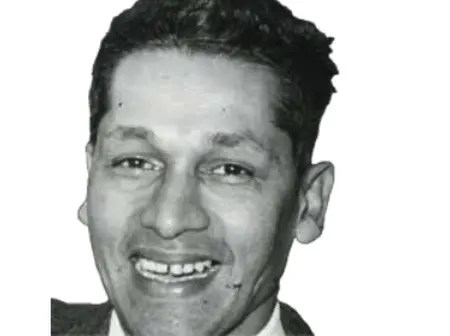
Pio Gama Pinto, one of Kenya's early post-independence politicians, was assassinated outside his Nairobi home in February 1965 following a period of growing political tension involving the country's founding president, Jomo Kenyatta.
Details of the events leading to his death were later documented in Forward to Independence, a memoir written by Fitz de Souza, who served as Kenyatta's lawyer and was also Parliament's Deputy Speaker.
According to de Souza, Pinto strongly disagreed with Kenyatta over the distribution of land belonging to British settlers who left Kenya after independence. He believed that the arrangements favoured influential individuals instead of benefiting ordinary Kenyans.
Their disagreement eventually resulted in a heated confrontation at Parliament Buildings in February 1965. De Souza recalled witnessing the two men exchanging angry words over the controversial land issue.
The memoir also contains an account of Pinto allegedly referring to Kenyatta as a "bastard" during their disagreement. De Souza later expressed concern about the possible consequences of such a confrontation, particularly given the political influence Kenyatta held at the time.
Pinto reportedly received warnings about threats to his safety and travelled to Mombasa for a short period. However, he eventually returned to Nairobi after receiving assurances from his friend Joseph Murumbi.
On February 25, 1965, Pinto was shot dead outside his home in Nairobi while seated in his car. His assassination shocked the country and became one of the most significant political killings in Kenya's early independence history.
Although the circumstances surrounding his death have attracted considerable historical attention, the account in de Souza's memoir does not establish that the alleged insult was the cause of his assassination.
Kivutha Kibwana has questioned attacks directed at Wiper Party leader Kalonzo Musyoka and Embakasi East MP Babu Owino raising concerns about tension across the political landscape among people associated with Kenya’s opposition.
In a statement dated November 22, 2026, Kibwana asked why Edwin Sifuna whom he described as influential would use his influence to belittle Kalonzo whom he called a father figure.
He also questioned attacks against Babu Owino by bloggers associated with the Linda Mwananchi movement. Kibwana wondered whether such exchanges were the right way to achieve unity among opposition leaders and their supporters.
With the clout Sifuna has why invest in belittling a father figure like Kalonzo he asked. He also questioned the repeated criticism directed at Babu Owino.
Kibwana described the exchanges as not friendly but lethal fire expressing concern over the tone of the debate. His remarks have drawn attention to disagreements involving opposition figures and their supporters.
The statement comes amid public discussions about cooperation among opposition leaders. Kibwana’s questions place focus on whether personal attacks and online criticism can help build a united political front.
President William Ruto has arrived in Oyo, Republic of the Congo, to attend a high-level Quadripartite Summit bringing together leaders from Kenya, the Republic of the Congo, the Democratic Republic of the Congo and Togo.
The summit is expected to provide an important platform for the four African nations to strengthen diplomatic relations, explore areas of mutual cooperation and discuss strategies for addressing challenges affecting the continent.
In a statement announcing his arrival, President Ruto said the discussions would focus on strengthening diplomatic ties, deepening regional integration, advancing peace and security, and expanding cooperation for the shared prosperity of the participating countries.
The Kenyan Head of State emphasised the importance of dialogue and partnership in addressing Africa's challenges, reaffirming his commitment to supporting solutions driven by African countries.
"Our discussions will focus on strengthening diplomatic ties, deepening regional integration, advancing peace and security, and expanding cooperation for the shared prosperity of our nations," Ruto stated.
The meeting comes at a time when African countries continue to explore ways of strengthening economic partnerships, improving regional security and enhancing cooperation in addressing political and economic challenges.
With the Democratic Republic of the Congo facing longstanding security concerns in its eastern region, discussions on peace and stability are expected to remain an important aspect of the engagement.
The summit also presents an opportunity for Kenya to strengthen its diplomatic influence and expand partnerships with other African nations in areas of economic development, trade and regional integration.
Ruto further stressed the importance of African-led solutions, arguing that cooperation and constructive engagement remain essential in securing a prosperous future for the continent.
The four-nation gathering is expected to reinforce the participating countries' commitment to working together through diplomatic engagement and strategic partnerships.
Kenya's participation reflects its continued efforts to strengthen relationships across Africa and promote regional cooperation as a foundation for sustainable development and lasting peace.