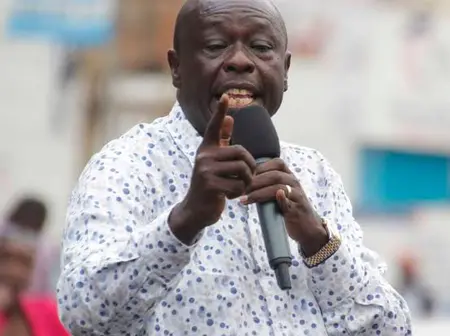
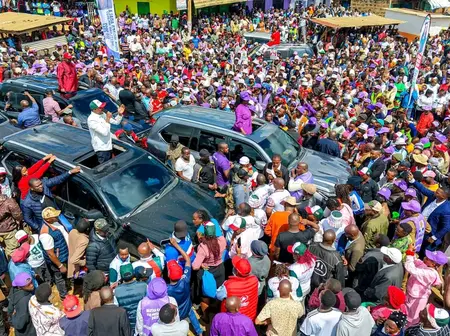
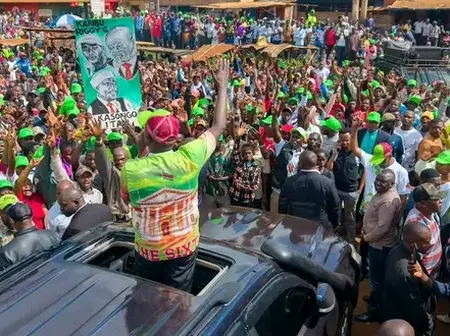
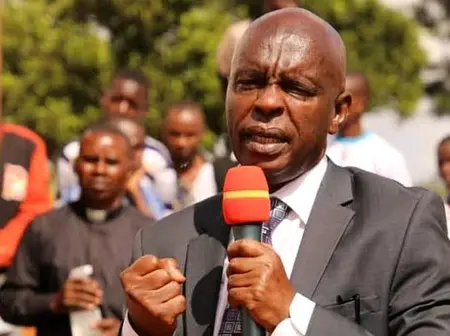
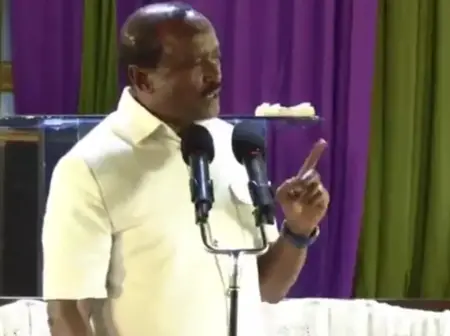
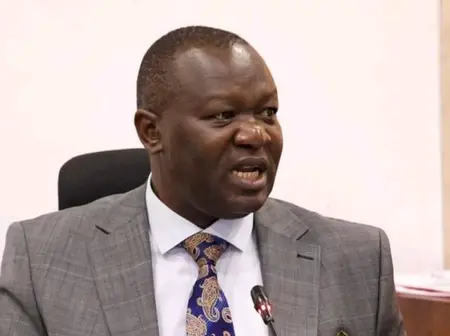
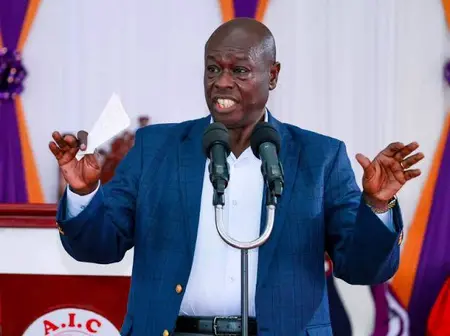
Speaking during a meeting with DCP supporters and party delegates from Narok County in Nyeri on Saturday, November 21, 2026, Gachagua accused the electoral commission of working alongside the Ministry of Interior in what he alleged was a coordinated effort to compromise the 2027 General Election. Without providing documentary evidence, Gachagua claimed that targeted registration and mobilization exercises were underway in parts of North Eastern, Nyanza, and the Rift Valley, alleging that Interior Principal Secretary Raymond Omollo was involved in planning the activities.
"They have offices in every county across Kenya. We will visit them and tell them what we disagree with. We will do this across the country," Gachagua told delegates. He added that the opposition would not accept what he described as a compromised electoral body and insisted that contentious issues surrounding voter registration and vote tallying be resolved well before polling day.
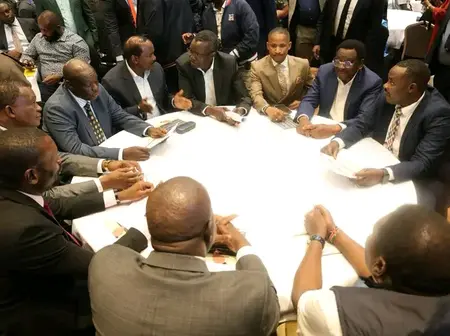
Gachagua's remarks follow a contentious consultative meeting earlier in the week between opposition leaders and the IEBC, from which Gachagua, Wiper Party leader Kalonzo Musyoka, and Nairobi Senator Edwin Sifuna staged a walkout. Following that walkout, Gachagua warned that public frustration over electoral credibility could trigger demonstrations larger than the June 2024 Finance Bill protests if the commission failed to engage political stakeholders meaningfully.
President William Ruto also dismissed the opposition’s allegations, urging rival leaders to focus on presenting their policy agendas and selecting their presidential candidate rather than putting pressure on the electoral agency. Ruto maintained that the IEBC’s constitutional role is to administer and count votes rather than determine election outcomes, calling on political leaders to allow the commission to carry out its mandate without interference.
Opposition leaders have received an enthusiastic response in Kirinyaga after Fred Matiang’i mentioned Nairobi Senator Edwin Sifuna during a rally in Kutus, with the crowd breaking into cheers.
The reaction has added to attention around Sifuna’s place in the opposition’s political plans ahead of the 2027 General Election. A.M Media has reported that supporters have cheered loudly when Matiang’i has mentioned the senator’s name.
Matiang’i has been accompanied by leaders including Nyoro and Martha Karua, as well as other opposition figures.
The team has continued to present a united front while seeking support across the country.
During the rally, Matiang’i has spoken about the need for opposition leaders to work together, bringing together figures with different political backgrounds and party affiliations.
He has named Sifuna among those expected to be part of the effort, prompting an enthusiastic response from the crowd.
The former Interior Cabinet Secretary has also thanked residents of Kimunye in Kirinyaga County for the warm reception and support they have given the visiting leaders.
In a message shared on his social media account, he has expressed confidence that working together can help build a better Kenya.
The reception has come at a time when Sifuna’s political standing has attracted public attention. His recent political activities and outspoken position within the Linda Mwananchi have kept him in the national conversation, with supporters showing interest in his next political move.
The opposition has been seeking to strengthen cooperation among its leaders as preparations for the next general election have taken shape.
Bringing together influential figures from different regions has remained central to efforts to build a political alternative.
Although the cheers have not, on their own, amounted to a formal political endorsement, they have demonstrated the enthusiasm that Sifuna’s name has generated among rally attendees.
The moment has also underlined the importance opposition leaders have attached to presenting a united team.
Matiang’i’s remarks have added another moment to the unfolding political realignments, as opposition leaders have continued to engage supporters and discuss a possible joint path towards the 2027 contest.
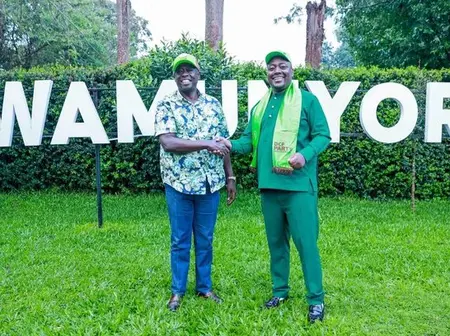
Victor Kanyari shared details regarding Rigathi Gachagua’s Wamunyoro estate in Nyeri County, the location he visited before aligning with the Democracy for the Citizens Party. Kanyari noted that guests were prohibited from bringing their cell phones inside, effectively preventing them from filming or photographing any private activities within the property.
Although the rule was in place, he said the reception felt friendly, noting that they were received kindly and allowed time to unwind and spend time with Gachagua’s relatives.
Kanyari recalled sitting side by side, eating together, and chatting with Gachagua’s spouse. His version of events suggested a laid-back visit, not a stiff political event filled with speeches and cameras.
Kanyari’s move to link himself with Gachagua’s political group drew notice, as he gears up to run for the Kasarani constituency in the 2027 general election.
Gachagua has invited the preacher to join DCP, though he noted that the individual would still need to vie with other candidates during the party's selection process.
Kanyari’s most recent narrative provides the public with a look at the hospitality he received in Wamunyoro, focusing especially on events that occurred out of the spotlight and away from public eyes.
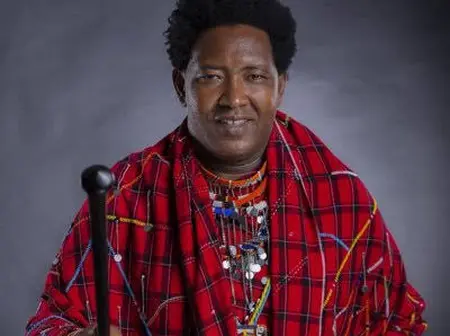
The handheld footage, which surfaced online on Saturday, November 21, 2026, shows Olekina locked in a heated outdoor argument with a group of men near a parked truck. During the altercation, the lawmaker is heard warning one of the men in Kiswahili, "Nitakupiga risasi" ("I will shoot you"), before adding in English that he would shoot him in the head. The clip drew swift condemnation across social media, with citizens and commentators questioning the temperament of a sitting legislator and calling for accountability over the threat of gun violence.
In a statement issued on Saturday night, Olekina did not deny making the remarks recorded in the clip. However, he strongly rejected initial online reports claiming that auctioneers had arrived to repossess his personal vehicle over an unpaid car loan. Instead, the senator explained that the men had trespassed onto the premises of a private company in which he holds shares and confiscated the keys to a delivery truck.
According to Olekina, the individuals later stated they were executing court orders to recover KSh365,000 awarded to a former employee attached to his Narok Senate office over an unfair termination claim. Olekina faulted the targeting of private corporate property over an institutional employment matter, arguing that staff assigned to senators' offices are hired and remunerated by the Parliamentary Service Commission rather than individual lawmakers.
"Let me be clear: the Senate of the Republic of Kenya is a constitutional institution, not Ledama Olekina's private estate," he stated. "Staff salaries and employment obligations are funded by the public purse through the Parliamentary Service Commission, not from an individual senator's pocket."
The confrontation has reignited national debate over firearm discipline among political leaders, the legal boundaries of debt collection, and the proper enforcement of Labour Court awards involving public offices.
DCP leader Rigathi Gachagua has told President William Ruto to stop crying early and save his tears for 2027, as he took his campaign to Karurumo in Runyenjes Constituency, Embu County.
"Ruto, wacha kulia mapema," Gachagua said in Kiswahili, meaning "Ruto, stop crying early," before adding: "Keep those tears for 2027."
It was not immediately clear what prompted the remark, but tears have become a recurring theme in Gachagua's attacks on the President.
In September, he mocked Ruto's emotional moment with a young girl in Bomet, saying such tears would no longer move Kenyans into voting for the wrong person.
In March, he described Ruto as "crying like a rat in a trap," and in an interview he claimed Ruto wept at his home while seeking his support ahead of the 2022 election.
The Embu appearance followed a church service in Runyenjes earlier on Sunday, where Gachagua gave the IEBC until January to address opposition concerns or face fresh protests.
Ruto recently likened Gachagua to the biblical King Herod in Kisii, accusing him of intimidating young politicians and urging veteran leaders to make way for a new generation.
Gachagua separately accused Ruto of hypocrisy on X over his remarks on young leaders, listing young Kenyans who died during or after police encounters.
Gachagua's DCP has been attracting UDA defectors: three lawmakers joined on November 17, and he predicts its MPs could rise from 25 to 60.
Embu, with 334,684 registered voters, sits in Mount Kenya East, where Public Service CS Geoffrey Ruku has led calls for the region to chart a path separate from the West.
He has insisted the opposition wants change through the ballot on August 10, 2027.
Elsewhere, Gachagua has vowed to win the Nairobi governorship for DCP, accusing Kasarani MP Ronald Karauri of being positioned by Ruto to divide the Mount Kenya vote.
Former Makueni Governor Kivutha Kibwana has ignited an intriguing political conversation after offering advice on the kind of international engagements Nairobi Senator Edwin Sifuna's ongoing United States tour could inspire among Kenya's emerging political leaders.
Kibwana suggested that if Embakasi East MP Babu Owino, who is 37 years old, ever travelled to the United States, he should prioritise securing a one-on-one mentorship engagement with 35-year-old New York City Mayor Zohran Kwame Mamdani.
He further proposed that a meeting with former United States President Barack Obama would provide an impressive addition to such an ambitious diplomatic and political itinerary.
The former governor's remarks come at a particularly interesting moment, with Sifuna currently undertaking his American tour, attracting attention from political observers who are closely monitoring his international engagements and growing national profile.
The comparison has inevitably opened another conversation about the importance of international exposure, political mentorship and leadership development among Kenya's younger generation.
However, Kibwana's intervention has not escaped criticism, with some social media users questioning the political undertones behind his commentary.
Critics argued that his repeated references to Babu whenever Sifuna's political activities arise could reflect an apparent political preference rather than impartial political analysis.
Others questioned whether Babu would necessarily secure an audience with Mamdani or Obama, while some defended the freedom to support individual politicians without being accused of hypocrisy.
The debate has consequently expanded beyond the proposed mentorship meetings, exposing the growing rivalry surrounding the political ambitions of Kenya's emerging leaders.
As Sifuna continues his American engagements, Kibwana's remarks have added another dimension to the increasingly heated conversation about generational leadership and the future of Kenya's opposition politics.
Kalonzo made the announcement on Sunday while addressing congregants at AIC Mbaikini in Wamunyu Ward, Mwala Constituency, Machakos County, where he attended a church service alongside several political leaders.
The former Vice President said upgrading the busy highway would be among his immediate priorities upon taking over the country's leadership, placing infrastructure development at the centre of his presidential ambitions.
The Mombasa-Nairobi highway is a critical transport corridor linking the Port of Mombasa to the capital. It serves thousands of motorists and commercial transporters daily, making it an important route for the movement of goods and passengers.
Its expansion into a dual carriageway has remained a major infrastructure issue as traffic volumes continue to increase along the busy route.
Kalonzo's declaration comes as political leaders begin positioning themselves ahead of the 2027 presidential contest, with infrastructure, economic development and public service delivery expected to feature prominently in campaigns.
During Sunday's service, Kalonzo also urged Kenyans to remain prayerful and seek God's guidance as the country navigates its challenges.
He was accompanied by Democratic Party leader Justin Muturi, Wiper Patriotic Front National Chairman Jamleck Kamau, Machakos Deputy Governor Francis Mwangangi, Women Representative Joyce Kamene and Senator Agnes Kavindu.
Others present included MPs Julius Mawathe and Makali Mulu, as well as Wiper spokesperson Ndegwa Njiru and other leaders.
Kalonzo shared a message drawn from Psalm 33:12, calling for national unity, peace and wisdom among those entrusted with leadership.
Nairobi Senator Edwin Sifuna has become the most talked-about opposition leader in Kenya today. From his Linda Mwananchi tour, his US diaspora tour and the KSh 100 million pledge he received from a Kenyan in America, it is clear that Sifuna is no longer just a Senator. He wants to be President.
But wanting is not enough. To become the Opposition flag bearer in 2027, Sifuna must get these seven things in order. If he fails on any one of them, then his dream will die.
1. Unite the Opposition and don't divide it
Right now, the Opposition is divided. Gachagua has DCP, Kalonzo has Wiper, Matiang'i has Jubilee, Karua has PLP, Babu Owino has Mwananchi Party and Eugene has his own ambitions.
Sifuna cannot become flag bearer by fighting all of them. He must become the bridge. He must sit down with Gachagua, Kalonzo, Matiang'i and Karua, then convince them that he is the best candidate to beat Ruto. If he appears arrogant, then they will gang up against him.
The flag bearer will not be chosen on TikTok, Facebook or any social media. He will be chosen in a boardroom.
2. Prove he can win Mt. Kenya, nyanza and coastal
Sifuna is strong in Nairobi and Western. That is not enough to be President. He must build serious structures in Mt. Kenya, where Gachagua is currently the king. He must also build in Rift Valley, where Ruto is strong. If he cannot show numbers from those regions, then the Opposition Boardroom will not trust him with the ticket.
3. Turn crowds into structures
Babu Owino proved yesterday in Nairobi that crowds are easy. Sifuna also pulls crowds. But crowds do not vote. Structures vote. Sifuna needs polling station agents in all 47 counties. He needs county coordinators, constituency coordinators and ward coordinators. He needs a real party machine and not just WhatsApp groups. The recent complaint from a diaspora Kenyan about too many WhatsApp groups shows his movement is still disorganized.
4. Present a clear economic plan
Kenyans are tired of slogans. "Linda Mwananchi", "WANTAM" and "Mimi ndio sifuna" are good slogans but what do they mean?
Sifuna must answer how he will reduce unga prices, create 1 million jobs, reduce taxes, handle SHA and payslip deductions.
If he cannot answer those questions clearly, then voters will say he is just another politician with sweet words.
5. Manage Babu Owino and Natembeya carefully
This is his biggest headache right now. Babu Owino launched his own tour alone. Natembeya today said "We would not accept Sifuna's deal with Babu Owino."
He must find a way to keep both men in the same camp and give them clear roles. A good leader does not choose between his generals. He unites them.
6. Secure funding and prove transparency
The KSh 100 million pledge from the US is a good start. But 2027 will cost billions. Sifuna needs serious funding from business people, diaspora and well-wishers.
More importantly, he must prove that the money is used well. Kenyans have lost trust in politicians who collect money and disappear. He must show accountability for every shilling.
7. Show he can handle Ruto
Ruto is not a weak opponent. He has state machinery, money and experience. He has survived many political battles.
Sifuna must show he is not afraid of Ruto. He must debate him on policy, not insults. He must show Kenyans that he can sit with world leaders, handle the economy and command the military. That is what a President looks like.
Edwin Sifuna has the energy. He has the youth. He has the momentum. But momentum without strategy is just noise.
If he unites the Opposition, builds structures, presents a clear plan and manages his team well, then he can become the flag bearer.
What do you think? Is Sifuna ready to be the Opposition flag bearer or should the Opposition pick Gachagua, Kalonzo or Matiang'i? Tell us in the comments.
On Saturday, November 21, Ojienda held a consultative meeting with business representatives from Akupae, Fish Market, Jubilee Market and Ahero Mowuok to discuss challenges affecting small-scale traders.
During the engagement, the senator addressed concerns about insecurity around the Kisumu Buspark area, particularly theft and the difficulties traders face when operating at night.
He revealed that six floodlights had been installed in the area to improve visibility, protect businesses and allow traders to continue operating with greater confidence.
Ojienda maintained that protecting traders and their investments would be a priority in his leadership agenda, arguing that insecurity directly affects the livelihoods of small business owners.
The senior counsel also used the meeting to outline his plans for Kisumu County should he win the gubernatorial contest in 2027.
He pledged to introduce reforms in the county's revenue collection system, promising greater transparency and accountability in the management of public funds.
According to Ojienda, improving revenue administration would help eliminate financial leakages and ensure collections translate into better services and development projects across all parts of Kisumu.
The senator urged traders to support his political ambitions, presenting improved service delivery and economic transformation as key priorities of his proposed administration.
His latest engagement is part of an expanding grassroots campaign that has also taken him to Kondele, Migosi and the Kisumu Central Business District.
Ojienda has declared interest in succeeding Governor Anyang' Nyong'o when his term ends, setting the stage for a competitive gubernatorial race in the lakeside county.
Security, business-friendly policies and accountability in county revenue collection are expected to feature prominently as aspirants seek support from Kisumu residents ahead of the August 2027 elections.
Former Deputy President Rigathi Gachagua has launched a sharp verbal attack against President William Ruto over statutory payslip deductions and national equity. Speaking in Embu County on Sunday, November 22, 2026, the Democracy for the Citizens Party (DCP) leader dismissed the administration's economic record as political alignments intensify ahead of the 2027 General Election.
According to a video broadcast by Citizen TV Kenya on November 22, 2026, Gachagua addressed congregants and residents at Wonders of God Church in Karurumo, Runyenjes Constituency. During his address, he mocked the President's slogan on national equality, claiming the only uniform experience among citizens was the heavy deductions taken from workers' salaries.
The remarks come amid a deepening political rivalry in the Mount Kenya region following Gachagua's October 2024 impeachment and his subsequent formation of DCP. Just days earlier on November 17, Gachagua hosted several defectors from Ruto's United Democratic Alliance (UDA) at his Wamunyoro residence in Nyeri, including Gatundu South MP Gabriel Kagombe, Laikipia West MP Wachira Karani, and Nyeri Woman Representative Rahab Mukami.
Meanwhile, President Ruto has maintained a firm defence of his administration's tax policies and development agenda across the country. Speaking during a conference in Nyali, Mombasa, on November 12, 2026, Ruto challenged opposition critics over the payslip debate while defending his legislative proposal to raise the tax-free Pay As You Earn (PAYE) threshold to Sh32,000.
Beyond taxation, the battle for Mount Kenya's voting bloc has increasingly shaped recent political tours and legislative exchanges. While Ruto has recently toured Western Kenya and Gusii to highlight infrastructure and teacher absorption pledges, Gachagua has focused on consolidating regional grassroots support and challenging the Independent Electoral and Boundaries Commission (IEBC) over voter register audits.
As both leaders sharpen their economic messaging ahead of 2027, do you think payslip relief proposals or calls to scrap statutory levies will carry more weight with Kenyan voters?