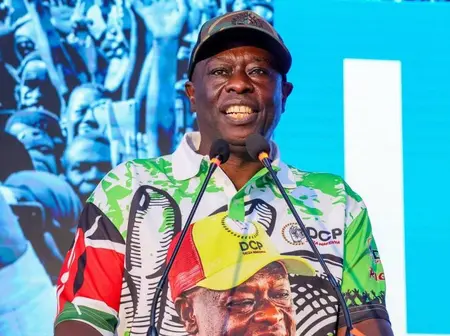
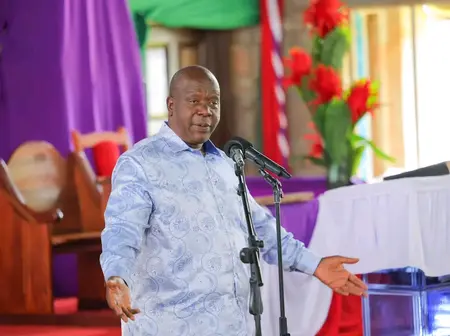
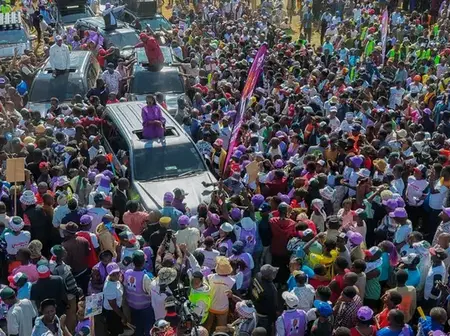
Speaking during a church service at Wonders of God in Karurumo, Runyenjes Constituency, Embu County, on Sunday, November 22, 2026, Gachagua stated that he will outline his political proposals on December 22 or 23 before giving families and communities between December 23 and Boxing Day to deliberate.
He explained that as residents working in Nairobi and other towns return to their rural homes for the holidays, family discussions will evaluate performance and agree on preferred candidates from the presidency down to governors, senators, woman representatives, MPs, and MCAs before delivering a regional verdict around December 27 or 28.
Gachagua also used the Runyenjes address to issue a Christmas deadline to lawmakers and aspirants still allied to President William Ruto’s United Democratic Alliance.
Urging anyone harbouring 2027 political ambitions to be physically present in their constituencies over the holidays, Gachagua argued that the proposals reflect views gathered during public consultations and warned undecided leaders that the region’s position will be settled before the new year.
His remarks follow a series of recent defections into DCP, including Runyenjes MP Eric Muchangi Karemba and Laikipia West MP Stephen Wachira Karani, as Gachagua works to consolidate Mt. Kenya behind his party.
On the other hand, President William Ruto and leaders allied to the ruling administration have pushed back against efforts to frame Mt. Kenya as an exclusive regional voting bloc.
Addressing political gatherings earlier in the week, President Ruto emphasized that leaders entrusted with government should be judged on their development commitments and delivery records rather than regional mobilization.
Ultimately, Gachagua’s Christmas timeline underscores how deeply cultural homecoming periods and local social networks are woven into political mobilization in Mt. Kenya roughly eight months before the ballot.
While holiday family gatherings offer a powerful forum for grassroots consensus-building, turning festive discussions into disciplined electoral outcomes will still depend on party nominations, candidate quality, and voter turnout in August 2027.
How both DCP and the ruling coalition engage residents during the December recess will offer an early test of political momentum heading into the new year.
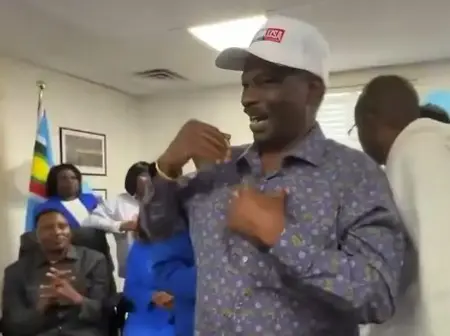
A Kenyan man living in North Carolina drove nine hours to attend Nairobi Senator Edwin Sifuna's diaspora rally in New Jersey on Saturday, November 21, where he pledged that Kenyans in the United States could raise KSh 100 million for the Linda Mwananchi Movement leader's 2027 presidential ambitions.
George Njue, originally from Runyenjes in Embu County, made the promise during Sifuna's US tour, which coincided with the opening of the movement's first diaspora office in Hackettstown, New Jersey.
He then turned to fellow Kenyans in the hall and asked them to pool their money through Linda Mwananchi, the mobilisation and fundraising vehicle linked to Sifuna's campaign.
Njue told them there was no need to look for funds elsewhere, and he asked diaspora officials, especially doctors, to design a formal structure for channelling contributions, adding that the community could put together KSh 100 million.
Beyond campaign financing, Njue proposed that diaspora Kenyans partner with a future Sifuna administration on development projects through a private-public partnership.
He said investors abroad expect returns on their efforts, which they want to see in their pockets as well, and gave the construction of dams as an example of ventures they would be willing to finance.
The pledge comes as Sifuna's US visit becomes a major push to consolidate diaspora support ahead of the 2027 General Election. The Hackettstown office will serve as the movement's first formal base outside Kenya.
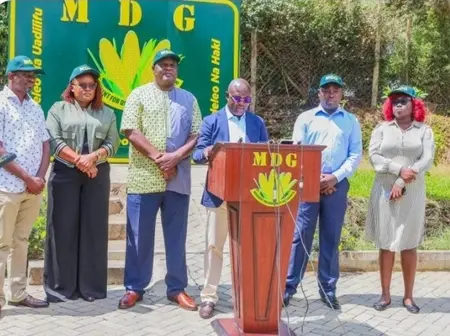
The Movement for Democracy and Growth party has hit back at former Deputy President Rigathi Gachagua, dismissing his allegations and ruling out any possibility of joining his opposition camp ahead of the 2027 General Election.
MDG leader and Ugenya Member of Parliament David Ochieng' strongly defended his party following claims that it was receiving financial support from President William Ruto's administration to weaken the Orange Democratic Movement in the Nyanza region.
Ochieng' dismissed the allegations, maintaining that MDG was an independent political organisation that had existed for approximately 10 years.
He argued that the party had established its political identity long before Gachagua became Deputy President.
The legislator further rejected suggestions that MDG was being sponsored by State House to attract politicians and supporters from ODM, insisting that his party had its own political ambitions and structures.
In a major political declaration, Ochieng' made it clear that MDG would not join Gachagua's Democracy for the Citizens Party or participate in the opposition coalition being assembled ahead of the 2027 elections.
Instead, he declared that the party would remain aligned with President Ruto's Kenya Kwanza administration and the broad-based government arrangement.
"MDG will be in Kenya Kwanza and broad-based to stay," Ochieng' declared, sending a strong message to political leaders seeking to bring different opposition parties together.
The Ugenya MP also revealed his party's position regarding the 2027 presidential contest, expressing support for Deputy President Kithure Kindiki as Ruto's potential running mate.
His remarks come amid increasing political activity as leaders across the country position themselves ahead of the next General Election.
Ochieng' also dismissed claims that MDG was demanding money from politicians seeking political opportunities through the party, maintaining that its focus was on strengthening its structures and preparing candidates for the upcoming elections.
The latest confrontation exposes growing divisions among political players as the battle for influence in Nyanza and other regions intensifies.
With MDG firmly declaring its political direction, Gachagua's efforts to build a united opposition could face additional challenges as the 2027 elections approach.
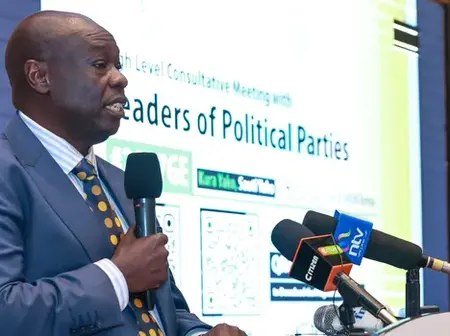
Gachagua warned that failure by the commission to respond to the questions could force opposition leaders to mobilise Kenyans across the country to demand answers directly from the electoral body.
Speaking on Sunday, November 22, during a church service at Wonders of God Church in Runyenjes Constituency, Embu County, the Democracy for the Citizens Party (DCP) leader accused IEBC of failing to provide satisfactory explanations on issues surrounding election preparedness.
He said opposition leaders wanted to engage IEBC Chairperson Erastus Edung Ethekon and other commissioners directly, insisting that their concerns should not be dismissed as political attacks.
One of the key issues Gachagua wants addressed is the state of the national voters' register. He called for an independent audit to establish whether the register contains names of deceased persons, duplicate entries or individuals who may have been registered unlawfully.
The former Deputy President also questioned claims that foreign nationals from neighbouring countries, including Uganda and Somalia, had been included in the register.
He demanded investigations into the allegations and urged the commission to establish a clear timeline for conducting the audit. However, he did not provide evidence to support the claims about foreign nationals being registered as voters.
Gachagua also raised concerns about the election technology expected to support the 2027 polls, particularly the contract involving Smartmatic, which he claimed was due to expire on November 24, 2026.
He questioned how the commission would manage future voter registration activities if the existing arrangement ended before a replacement system was secured.
His concerns come as IEBC faces legal and procurement challenges surrounding the acquisition of election technology and ballot papers.
On Sunday, the commission's Director of Voter Registration and Electoral Operations, Salome Nderitu, reportedly indicated that ongoing court proceedings had affected some procurement activities. She said the commission had advertised relevant tenders but was awaiting court decisions before taking further steps.
Beyond technology and the voters' register, Gachagua accused Interior Principal Secretary Raymond Omollo of allegedly influencing voter registration activities in certain parts of the country.
He claimed that some regions were receiving preferential treatment in voter registration and the processing of national identity cards, while young people in other areas experienced lengthy delays.
The DCP leader did not provide documentary evidence to substantiate the accusations against the Interior PS.
He further challenged IEBC's proposed approach to presidential election results, rejecting the use of Bomas of Kenya as the national tallying centre.
Gachagua argued that presidential election results should be announced at constituency level, with political parties independently adding up the figures from across the country.
He maintained that the opposition would not support an arrangement it believes could create opportunities for electoral manipulation.
However, the constitutional framework requires IEBC to tally and verify presidential election results before declaring the winner, while the Elections Act provides for the transmission of results to the national tallying centre.
The warning comes against the backdrop of growing disagreements between opposition leaders and the electoral commission.
On Thursday, November 19, a group of opposition politicians, including Wiper Party leader Kalonzo Musyoka and former Chief Justice David Maraga, walked out of a consultative meeting with IEBC after raising concerns about the preparations for the next General Election.
The commission subsequently defended its handling of the meeting, saying the leaders had presented their initial concerns before leaving, without allowing the scheduled discussions to proceed.
IEBC also maintained that it remained open to receiving formal proposals from political parties on electoral reforms and pledged to conduct credible, transparent and peaceful elections on August 10, 2027.
Despite the commission's position, Gachagua insisted that opposition leaders would not abandon their demands.
He specifically directed his message to IEBC chairperson Ethekon, saying the commission had until January to engage political leaders and respond to the outstanding questions.
He warned that if the deadline passed without meaningful engagement, the opposition would turn to the public to press for answers.
Invoking the 2024 Gen Z demonstrations against the Finance Bill, Gachagua suggested that the public reaction to concerns over the next election could be significant if Kenyans lost confidence in the electoral process.
He maintained that his demands were aimed at ensuring all eligible citizens had an equal opportunity to register and participate in the 2027 General Election.
The latest remarks add pressure on IEBC as political leaders intensify scrutiny of election preparations, with the dispute over electoral reforms emerging as an increasingly important issue ahead of the August 2027 polls.
Former Interior Cabinet Secretary Dr Fred Matiang’i has hinted at the possibility of returning to the Interior Ministry if the opposition forms the next government after the 2027 General Election.
Speaking during a political outreach tour in Kirinyaga County on Sunday, Matiang’i vowed to deal with criminal gangs and restore public order, saying such groups would have no place in the country under an administration led by his political team.
Drawing on his experience as Interior Cabinet Secretary, he emphasised the importance of security and stability in creating an environment where Kenyans can pursue economic and social development.
His remarks have drawn attention to the question of what role he could take in a future opposition government, despite his involvement in the political contest ahead of the 2027 presidential election.
Matiang’i also dismissed suggestions that the opposition was heading for a split, insisting that its leaders must remain united and work together towards forming the next government.
He outlined several areas requiring urgent attention, including reforms in the education sector, challenges facing the Social Health Authority (SHA) and the heavy tax burden on workers and ordinary households.
The former Cabinet Secretary further called for solutions that address challenges affecting communities across the country, drawing comparisons between concerns raised by residents of Kirinyaga and those experienced in counties such as Nyamira.
He also expressed respect for fellow opposition leader Martha Karua, stressing the importance of cooperation as the political team pursues its agenda ahead of the next election.
Trans Nzoia Governor George Natembeya has offered an account of discussions involving Siaya Governor James Orengo and Embakasi East MP Babu Owino, saying the two leaders did not state the positions they wanted when asked.
Natembeya’s remarks add to the debate surrounding the Linda Mwananchi political formation and reported disagreements among some of its key figures. He suggested the discussions were intended to establish what different leaders wanted, but Orengo and Babu did not make specific requests for positions.
The comments are likely to attract attention as the group navigates questions about leadership, influence and the roles of politicians associated with the movement. Babu has featured in recent exchanges involving Nairobi Senator Edwin Sifuna, while Orengo has also been mentioned in conversations about the direction of the opposition formation.
Natembeya’s account appears aimed at clarifying how the discussions unfolded and addressing speculation about demands made during the engagement. However, his statement does not establish what either leader may want politically or whether any disagreement over positions has been resolved.
The issue comes as opposition leaders face pressure to define their strategy ahead of the 2027 General Election. As alliances and political formations take shape, questions about leadership positions and responsibilities are likely to remain part of the conversation.
The remarks also underline the challenge of aligning different political interests within a broad movement. Leaders may share a political agenda but still have differing expectations about representation and decision-making.
Natembeya’s statement has renewed discussion about internal consultations and the roles of prominent figures in Linda Mwananchi. The leaders involved have yet to provide a joint account of the discussions.
Further consultations may clarify expectations and help the group manage differences before the next phase of political planning begins soon.
Democracy for the Citizens Party (DCP) leader Rigathi Gachagua has given IEBC until January to address concerns raised by the opposition, warning that demonstrations could be held across the country if the issues remain unresolved.Gachagua has said delays in procuring a replacement election-management technology system, following the expiry of the current system’s (Smartmatic) contract, could affect the registration of new voters and the audit of the voter register.
The senator said the donation was made for use at the Linda Mwananchi office in Kakamega, where supporters of the political movement are expected to coordinate their engagements.
Khalwale made the announcement on behalf of himself and members of the Linda Mwananchi fraternity in Kakamega County. He described the gesture as a welcome show of support for the movement's operations.
He also revealed that the donation had pleased Nairobi Senator Edwin Sifuna, who is associated with the Linda Mwananchi Movement.
"H.E. Edwin Sifuna is happy," Khalwale stated, while extending his gratitude to Shitsukane for stepping forward to support the office.
The post also highlighted the role of supporters in providing resources to political movements as they establish structures and strengthen their presence in different parts of the country.
The furniture donation is a modest but notable contribution towards setting up the movement's local office, providing a base for its supporters and organisers in Kakamega.
The senator's message attracted attention as the movement continues building its presence.
In a statement shared on X on Sunday, November 22, Kibwana criticised the Nairobi senator over remarks allegedly directed at Wiper leader Kalonzo Musyoka.
The former governor described the comments as sexist, questioning why Sifuna would use his political influence to ridicule Kalonzo, whom he referred to as a father figure.
Kibwana also raised concerns about the growing criticism of Embakasi East MP Babu Owino by individuals associated with the Linda Mwananchi Movement.
He questioned whether repeatedly targeting politicians who are expected to work together was consistent with the opposition's calls for unity.
"With the clout @edwinsifuna has, why invest in belittling a father figure SC @skmusyoka thru a sexist joto remark? Why the incessant attack against @HEBabuOwino by @LindaMwananchi_ bloggers & others? Is this how to achieve opposition unity? This is not friendly, but lethal fire," Kibwana wrote.
His intervention attracted mixed reactions, with some social media users defending Sifuna and challenging Kibwana's interpretation of the senator's remarks.
Others questioned why the former governor was concentrating on Sifuna instead of addressing the disagreements involving different opposition figures.
One user argued that Linda Mwananchi supporters were ordinary Kenyans expressing their dissatisfaction with political leadership rather than bloggers working for the movement.
Another challenged Kibwana to establish whether Sifuna had directly insulted Kalonzo before criticising him.
The exchange comes amid growing disagreements among politicians and supporters associated with Kenya's opposition formations.
While leaders have repeatedly discussed the possibility of working together against President William Ruto's administration, disagreements involving individual politicians and their supporters continue to generate public debate.
Kibwana's remarks have added another dimension to the debate over how opposition leaders can manage their differences while pursuing political cooperation.
As of Sunday, Sifuna had not publicly responded to Kibwana's criticism.
Opposition leaders Dr. Fred Matiang'i, Martha Karua and Ndindi Nyoro have wrapped up the first two legs of their joint tour of Kirinyaga County this Sunday, leaving behind a lively mood and some sharp words for the government.
The account has been put together from posts by Matiang'i and Karua, alongside remarks attributed to Nyoro and Matiang'i during the rallies. Both leaders have shared their messages online within the last few hours.
Matiang'i has thanked residents of Kutus for what he has called an incredible reception, saying he and his two colleagues are grateful for their warm welcome and unwavering spirit. He has closed with a call for the opposition to move forward together.
Karua, for her part, has said the day began in Kimunye, where the trio addressed questions about the opposition and where it is heading. She has argued that alliances and pacts form a normal part of democracy and ought to invite dialogue rather than anxiety.
In her view, there is space for different perspectives and for the search for common ground.
She has also urged leaders to keep their attention on the cost of living, jobs, education, healthcare and the daily struggle to make ends meet.
As the country looks towards 2027, she has said, political arrangements must serve a greater purpose and improve the lives of Kenyans.
The tone has turned sharper in Nyoro's remarks. He has criticized President William Ruto and asked him to keep away from the Independent Electoral and Boundaries Commission.
He has also cautioned the commission against ending the live streaming of results in the 2027 General Election, insisting that Kenyans would not allow such a move.
Matiang'i has taken aim at the government too. Speaking partly in Kiswahili, he has said the administration has failed to plan properly and claimed he has never witnessed a government spend so much public money on propaganda and idle talk.
The crowds in both towns have been described as large, with the Matiang'i post showing a dense turnout in Kutus.
Together, the messages have painted a picture of a team trying to appear united, practical and ready to challenge the state on elections and the economy.
The tour is expected to end in Ngurubani, the last town on the poster's route. It remains to be seen whether the enthusiasm seen so far will carry through to the final stop.