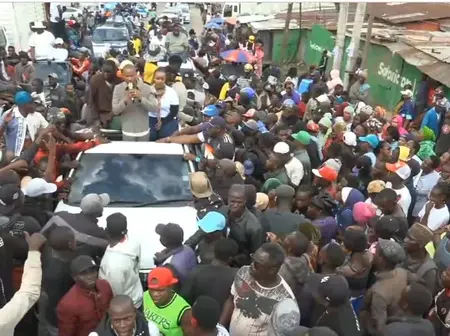
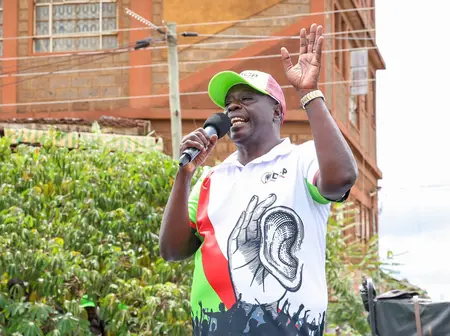
Embakasi East MP Babu Owino has promised to end Nairobi's garbage crisis within his first 100 days if elected governor. He plans to award waste collection tenders to youth and women and older people.
Speaking at a Mwananchi Party rally in Nairobi on Saturday he also pledged to improve water supply and roads and jobs. He said his record in Embakasi East could be replicated across the capital.
"Within the first 100 days there will be no problem with garbage here in Nairobi," Owino said.
Waste management and unreliable water supply and poor roads remain major concerns for many Nairobi residents.
He said young people and women and older citizens would be encouraged to register companies and compete for contracts. Successful contractors would be paid fairly.
He cited the construction of schools and the tarmacking of 85 roads in his constituency. He also pointed to efforts to improve water access and youth employment.
Owino also promised bursaries for needy learners and cheaper business licences for traders. He said he would prioritise residents struggling with the high cost of living. He said he understands ordinary residents' daily struggles.
The MP criticised Governor Johnson Sakaja and chanted "Sakaja must go" during the rally.
Earlier this month he said frustrations within ODM over the party's preferred Nairobi candidate influenced his decision to form The Mwananchi Party.
His pledges come as political alignments take shape ahead of the 2027 General Election. The Nairobi governorship is expected to attract intense competition.
However the 100 day garbage target would need a clear plan and enough funding. It would also require close coordination with the city's existing waste management systems. Residents will wait to see whether the promises turn into action.
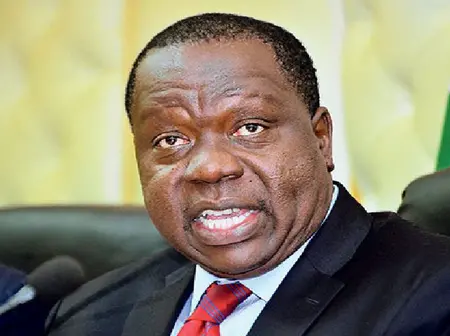
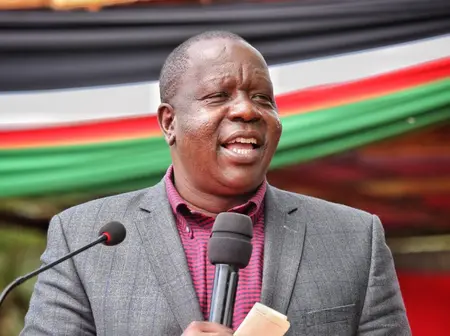
Matiang’i used the phrase to frame the coming election as a contest between supporters of President William Ruto and those who believe the country needs a different political direction. He did not name the leaders or parties that would make up the two sides.
The statement adds to the political debate surrounding the next election, as leaders and political groups seek support from voters. Matiang’i’s choice of words places public interests at the centre of his message and presents the election as a decision about who should speak for ordinary Kenyans.
The reference to “Kasongo” is a nickname used in political discussion to refer to President Ruto. By contrasting that side with “the side of Kenyans,” Matiang’i appeared to draw a distinction between the President’s political camp and the interests of citizens.
However, the brief remarks do not explain what policies or commitments would define the side he described as representing Kenyans. They also do not provide details of any political arrangement, coalition or campaign plan linked to the statement.
The statement also leaves questions about the issues that will shape the contest. These could include the economy, cost of living, jobs, public services and accountability, although Matiang’i did not list specific priorities.
As the election approaches, voters will have an opportunity to assess the competing messages and decide which leaders best represent their interests. Matiang’i’s statement sets out the choice in terms, but further details will be needed to show what each side would offer.
For now, his message is a pointed description of the political divide he believes Kenyans will face when they go to the ballot.
A confrontation involving Narok Senator Ledama Olekina and auctioneers may have faded from public attention, but the questions it raised about parliamentary employment, public funding and personal responsibility remain relevant.
The employment dispute involves a former staff member attached to Olekina’s office, as the senator disputes claims that his personal vehicle was being auctioned, maintaining that the incident involved a delivery truck belonging to a private company in which he holds shares.
In explaining his position, Olekina questioned why an individual elected to public office should personally bear obligations arising from the operations of a parliamentary institution.
“The Senate of the Republic of Kenya is a constitutional institution, not Ledama Olekina’s private estate.”
His argument brought attention to a wider question about how parliamentary offices are managed and where responsibility lies when employment relationships become contentious.
One of the less explored aspects of the controversy is the relationship between members of Parliament and the Parliamentary Service Commission (PSC), the institution responsible for facilitating parliamentary operations.
Kenya’s Parliamentary Service (Constituency Offices) Regulations provide for members to employ constituency office managers and other staff within salary limits approved by the Commission.
The regulations also provide that members initiate recruitment and determine employment terms and salary scales. Employment contracts are required, with copies submitted to the Clerk.
This distinction is important. Although the Commission provides funding for constituency office operations, the regulatory framework also assigns members specific responsibilities in staff recruitment and employment arrangements.
It would, however, be important to establish the precise employment framework applicable to the former employee attached to Olekina’s Senate office rather than assume that constituency office provisions automatically settle the question.
The distinction between providing funds and managing employment relationships is therefore central to understanding the broader debate.
Olekina’s controversy also highlights an issue that receives relatively little public attention: the working conditions of employees serving in parliamentary offices.
A National Assembly committee report on inspections of constituency offices in Nakuru County, discussed in Parliament in November 2026, identified concerns over staff remuneration, professional training, medical cover and delays in salary disbursement.
The report recommended improvements in staff welfare and training, pointing to the need for stronger administrative support across constituency offices.
The issue also featured in parliamentary debate, with Yatta MP Robert Basil raising concerns about delayed salary payments.
“My staff have not received salaries,” Basil told the National Assembly on November 11, 2026, while discussing challenges facing constituency offices.
He said employees had financial obligations that continued despite delays in receiving their wages.
These concerns demonstrate why employment arrangements in parliamentary offices deserve closer public scrutiny. Staff members provide services to constituents and support elected representatives, yet their employment conditions can be affected by administrative and funding arrangements.
Another important aspect of the Olekina controversy concerns the distinction between personal assets and property belonging to a privately owned company.
The senator maintained that the delivery truck involved in the incident belonged to a company in which he was a shareholder.
That explanation raises a broader corporate governance question.
A shareholder’s interest in a company does not automatically make the company’s vehicles, equipment or other assets personal property. A company operates as a separate legal entity, with its own assets and obligations.
Consequently, establishing who owns a particular asset is important when questions arise over business property and individual financial responsibilities.
The broader lesson is that public office, personal financial affairs and private commercial interests should be clearly distinguished, particularly when disputes attract public attention.
The accountability question Parliament cannot ignore. Beyond the individual controversy, the incident provides an opportunity to examine whether the arrangements governing parliamentary offices adequately protect employees, employers and public resources.
The Parliamentary Service Commission has an important role in ensuring that parliamentary offices receive the support required to operate effectively. At the same time, elected representatives who recruit and manage staff must understand their responsibilities under the applicable employment arrangements.
Greater clarity about recruitment, contracts, supervision, salary funding and employee benefits would help prevent misunderstandings and strengthen accountability.
The former employee’s perspective, the applicable employment arrangements and the Commission’s explanation of its responsibilities are essential to completing the picture.
Ultimately, the issue is bigger than one politician or one confrontation.
When public funds support parliamentary offices, employees and taxpayers alike have a legitimate interest in knowing who makes employment decisions, who safeguards workers’ rights and who is accountable when obligations arise.
That is the question raised by the Ledama Olekina controversy, and one that deserves an answer beyond the headlines.
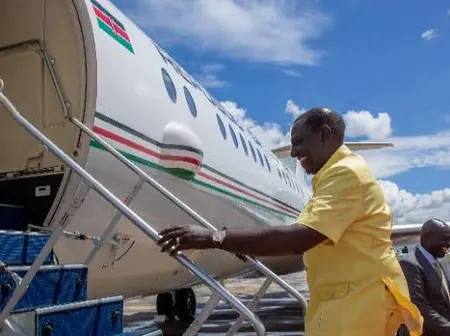
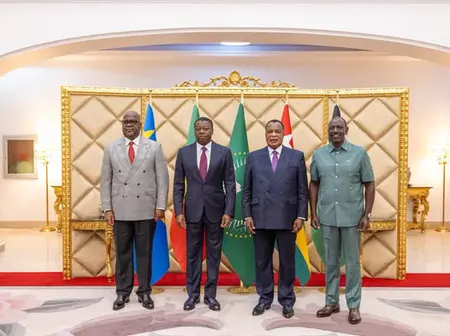
President William Ruto's visit to the Republic of Congo has drawn attention after details emerged of a diplomatic meeting he travelled to attend without a public announcement of his departure.
Ruto arrived in Oyo on Saturday, November 21, following his engagements in Western Kenya. The Congolese government confirmed his presence the following day, saying he had travelled to participate in a four-party meeting organised by President Denis Sassou Nguesso.
In a statement, the Congolese government said Ruto had arrived in the town to join discussions initiated by Nguesso. However, it did not provide details of the meeting's agenda or explain what the participating leaders intended to discuss.
Reports by Congolese media indicated that Democratic Republic of Congo President Félix Tshisekedi and Togo's Prime Minister Faure Gnassingbé were also expected to attend. Their participation had not been officially confirmed by the time the announcement was made.
The Kenyan president reportedly departed through Kisumu International Airport on Saturday after completing a tour of Western Kenya. His low-profile departure attracted interest because of the diplomatic difficulties that have affected relations between Kenya and the DRC in recent years.
The relationship between Nairobi and Kinshasa came under pressure in December 2023 when the Alliance Fleuve Congo (AFC), a political-military coalition associated with the M23 rebel movement, held a launch event in Nairobi.
The development angered the Congolese government, which accused Kenya of allowing a group it considered hostile to operate on its territory. Kenya, however, maintained that it had no legal grounds to block political expression.
Another disagreement emerged in October 2025 after Nairobi hosted a political gathering attended by Congolese opposition figures, including former DRC President Joseph Kabila. The meeting attracted criticism from Kinshasa and added to the diplomatic strain.
Ruto's presence at the Oyo gathering therefore comes at a time when the two neighbouring countries have had unresolved differences over political activities involving Congolese opposition groups.
Although the expected participation of Tshisekedi has drawn attention to the meeting, neither the complete list of attendees nor the issues scheduled for discussion had been officially released.
It also remains unclear whether the four-party engagement will produce any specific agreements or announcements concerning relations between the countries.
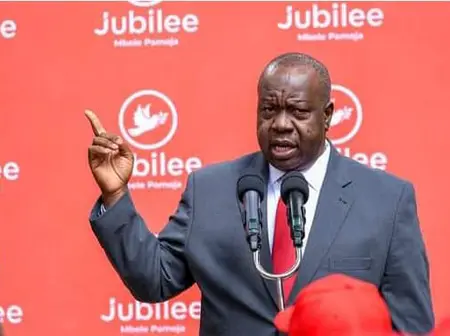
Jubilee Party leader Fred Matiang’i has ruled out working with political leaders whose views and approach he fundamentally disagrees with, highlighting the challenges facing opposition unity ahead of the 2027 General Election.
Speaking during a church service at ACK St Mary’s Church in Kimunye, Gichugu Constituency, Kirinyaga County, on Sunday, November 22, Matiang’i said he was prepared to engage leaders with whom he could find common ground.
“I cannot sit with someone we do not see eye to eye. I can only sit with people we can work with,” he said.
His remarks come amid political realignments within opposition, where leaders are seeking to build a united front against President William Ruto. However, differences over leadership, strategy and individual ambitions continue to test the possibility of a coalition.
Matiang’i did not name the leaders he was unwilling to work with, but his statement has raised questions about his relationship with other opposition figures, particularly former Deputy President Rigathi Gachagua, with whom political differences have recently become public.
The Jubilee leader also singled out Kiharu MP Ndindi Nyoro, describing him as a straightforward politician who understands the solutions needed to address Kenya’s challenges.
Matiang’i said his camp was focused on offering solutions rather than engaging in political exchanges. His comments suggest that shared priorities will be important considerations in any partnership he joins.
The former Interior Cabinet Secretary is among the figures being discussed in connection with the opposition’s 2027 presidential contest. His position could shape negotiations as parties consider how to select a flag bearer and balance competing interests.
With the election approaching, opposition leaders face the task of turning their desire for political change into a workable arrangement. Matiang’i’s remarks make clear that, for him, unity will require more than simply sitting at the same table.
Speaking while hosting a delegation from Gatundu North at his Wamunyoro residence in Nyeri County on Saturday, November 21, 2026, Gachagua recalled entering a political arrangement with Ruto when the President already controlled his own party structure.
Using the metaphor of traveling to a wedding in someone else’s vehicle only to be told to step out upon arrival, he explained that operating without an independent party left him exposed and unable to defend his position when their relationship deteriorated, culminating in his removal from office.
Drawing directly from that experience, Gachagua urged leaders and supporters across Mt. Kenya to rally behind DCP and elect a substantial bloc of lawmakers under its banner in the August 10, 2027 General Election.
He argued that commanding a strong parliamentary caucus gives a party real leverage inside government and prevents regional interests from being sidelined during political fallouts.
His remarks come amid an active recruitment drive at Wamunyoro that has seen sitting lawmakers such as Gilgil MP Martha Wangari, Gatundu South MP Gabriel Kagombe, Laikipia West MP Stephen Wachira Karani, and Nyeri Woman Representative Rahab Mukami cross over from UDA as Gachagua works toward a target of 60 MPs.
In Kenyan coalition politics, leaders who dissolve or forego independent party structures often discover that formal influence inside Parliament and party organs rests with whoever controls the sponsoring vehicle.
Ultimately, Gachagua’s candid reflection illustrates how past institutional vulnerability is shaping his organizational strategy roughly eight months before Kenyans go to the polls.
Building an independent party with loyal parliamentary representation offers stronger negotiating leverage, though sustaining unity across contested primaries and wider opposition talks will still test DCP’s discipline.
How effectively Gachagua turns hard-earned political lessons into a cohesive legislative bloc will define his influence heading into August 2027.
In remarks shared on social media, Gachagua claimed that Kasongo chased him away believing he would be unable to survive without the support and privileges that came with his former office.
The former deputy president used the statement to highlight his political fallout with Ruto, which eventually led to his removal from office in October 2024.
Gachagua and Ruto were once political allies who campaigned together during the 2022 General Election. Their relationship later deteriorated following disagreements over government decisions, political influence and the direction of the Kenya Kwanza administration.
Gachagua has since maintained that his removal was politically motivated and has repeatedly accused the president's administration of treating him unfairly. He has continued building his political support outside government while seeking to challenge Ruto's leadership.
His latest remarks revisit the circumstances surrounding his exit from government and the expectations he believes his former political allies had about his future.
The statement reflects the continuing hostility between the two leaders, which has reshaped political alliances. The specific occasion and setting in which Gachagua made the latest remarks were not clear from the words shared.
The political dispute is likely to remain part of the debate as leaders begin positioning themselves ahead of the next general election.
Jubilee Party leader Fred Matiang’i has sent a fresh message to Kenyans as opposition leaders continue their political engagements ahead of the 2027 General Election.
Speaking during a church service in Kirinyaga County on Sunday, November 22, Matiang’i maintained that opposition leaders understand the challenges facing ordinary citizens and know what Kenyans expect from their next government.
"We know what our people need, and we understand what matters most to them at this moment," Matiang’i stated.
His remarks come at a time when the opposition is facing growing public attention over its plans to challenge President William Ruto in the next general election.
The former Interior Cabinet Secretary attended the church service alongside People's Party leader Ndindi Nyoro, who also dismissed claims that opposition leaders were forming separate political camps.
Nyoro insisted that the opposition remained united despite some leaders attending different political gatherings across the country.
Matiang’i supported the position, arguing that the opposition had one team and would not allow political disagreements to destroy its chances ahead of the 2027 polls.
He further suggested that the coming election would present Kenyans with two major political choices, the current government and the opposition.
The latest remarks come amid efforts by opposition figures to strengthen their political networks in different regions as they prepare for the contest.
Former Deputy President Rigathi Gachagua also addressed supporters in Embu County on Sunday, where he spoke about the opposition's regional mobilisation plans.
However, the opposition has yet to agree on a presidential candidate, with several leaders expected to play key roles in determining the coalition's final direction.
Matiang'i's message now adds to the growing political debate over what an alternative government would offer Kenyans.
Whether the opposition will translate its promises into a common agenda remains a major question ahead of 2027.
President William Ruto has joined other African leaders at the Quadripartite Summit in Oyo, Republic of the Congo, bringing together four countries to strengthen diplomatic relations and explore areas of cooperation.
President Ruto's participation highlights Kenya's continued commitment to strengthening regional partnerships and promoting cooperation among African countries.
The meeting is expected to provide an opportunity for the four nations to exchange ideas on issues affecting the continent, including economic development, regional integration, trade, infrastructure and diplomatic relations.
Through such high-level engagements, African leaders seek to build stronger partnerships that can support economic growth, improve connectivity and create opportunities for their citizens.
Kenya has continued to pursue diplomatic and economic partnerships across Africa, with President Ruto emphasizing the importance of African countries working together to address shared challenges and unlock the continent's economic potential.
The involvement of the Republic of the Congo, the Democratic Republic of the Congo and Togo also demonstrates the importance of expanding cooperation beyond traditional bilateral relationships.
The Quadripartite Summit offers an opportunity for the participating countries to strengthen political ties and explore practical areas where joint initiatives could deliver meaningful benefits.
President Ruto's presence in Oyo comes as African nations continue to push for stronger regional cooperation and greater economic independence.
The discussions and outcomes of the summit could help shape future engagements among the four countries, particularly in areas of trade, investment and sustainable development.
As the meeting progresses, attention will be on the commitments made by the participating leaders and how they translate diplomatic discussions into practical initiatives that benefit their respective populations.
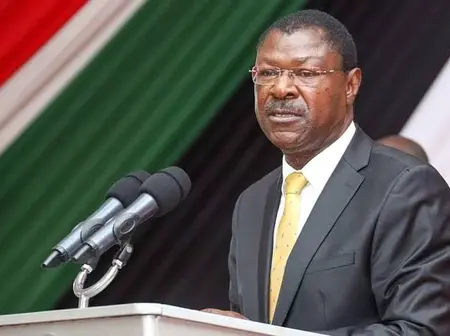
His declaration has already raised eyebrows, especially coming at a time when political leaders are positioning themselves ahead of the 2027 General Election.
Wetang’ula made it clear that he intends to offer himself for the presidency in 2032, after President William Ruto completes what he described as his final term in office.
In his remarks, the Speaker said his decision would depend on the support and blessings of Kenyans, suggesting that he believes he could have a chance to lead the country when the time comes.
The statement is significant because most political discussions have been focused on the 2027 contest, with several leaders already fighting to strengthen their influence and build political alliances.
However, Wetang’ula appears to be looking beyond the immediate election, sending a message that his political ambitions do not end with his current position as Speaker of the National Assembly.
His declaration could also spark fresh debate within the Kenya Kwanza political family, particularly as leaders begin thinking about succession and who could take over after Ruto leaves office.
Many people were left talking about the announcement, with some questioning whether Wetang’ula could become a serious presidential contender while others believe he has every right to pursue the country's top seat.
The incident sparked reactions online, as supporters appeared divided over his timing and political prospects. What happened next surprised many, as the declaration immediately brought the 2032 succession debate into focus.
With 2027 still ahead, do you believe Moses Wetang’ula has what it takes to become Kenya’s president in 2032? Share your thoughts in the comments.