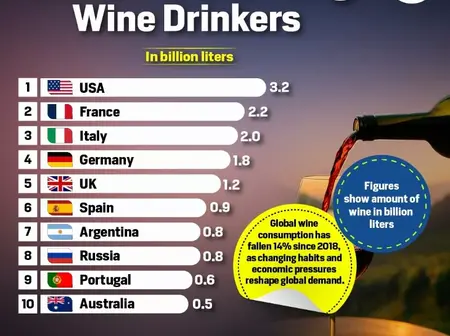
The United States leads the world in wine consumption, accounting for 3.2 billion litres, according to figures from the International Organisation of Vine and Wine.
France ranks second at 2.2 billion litres, followed by Italy with 2.0 billion litres and Germany at 1.8 billion litres. The United Kingdom completes the top five with 1.2 billion litres.
Spain, Argentina, Russia, Portugal and Australia also feature among the top 10. China leads the next group at 0.5 billion litres.
The figures show global wine consumption has fallen 14 per cent since 2018, amid changing habits and economic pressures across many major markets.
The Kenya Veterinary Association (KVA) has raised concerns over bacterial contamination and growing antimicrobial resistance in raw chicken meat sold through some non-supermarket retail outlets in Nairobi County, warning that unsafe handling, poor hygiene and inadequate storage conditions could expose consumers to significant public health risks.
In this storyAntony Mbugua is a executive chef whose expertise has seen him work for global hotel chains. Currently, he leads Ethiopian Airlines’ culinary operations as an executive chef.“I have built a distinguished career delivering exceptional dining experience for VIP clients, world leaders and high profile organisations,” he notes.
A Kenyan man is quietly running the kitchen behind one of Africa's most prominent airlines, and CNN's Larry Madowo just made sure the world knows about it.
Madowo shared a post on November 14 revealing that Chef Antony Mbugua, also known as Anto Kimotho Mbugua, is the executive chef responsible for all food served on Ethiopian Airlines. The disclosure drew over 1,100 likes and dozens of comments from Kenyans who were clearly delighted by the news.
South Africans mocks JKIA ahead of Harambee Stars clash, 2027 AFCON: "Which airport has potholes?"
According to a menu card featured in the post, Chef Antony Mbugua holds more than 17 years of international culinary experience and currently serves as Executive Chef for Ethiopian Airlines Inflight Catering. The role places him in charge of food production and quality across one of the continent's busiest carriers, a responsibility that spans every meal served to passengers on the airline's global routes.
PAY ATTENTION:TUKO is in WhatsApp Channels now! Subscribe and read news in your favourite messenger.
Inflight catering at a major international airline is no small undertaking. Menus must meet the dietary needs of passengers from dozens of countries, satisfy strict aviation food safety standards, and be prepared in large volumes while maintaining consistent quality. That a Kenyan chef holds the top position in that operation at Ethiopian Airlines is a detail that caught many by surprise.
Madowo's post, accompanied by a surprised emoji, was brief but the reaction it generated was anything but understated.
The comments section quickly filled with a mix of pride, banter and celebration.
Michael Olunga carries KSh 194k luxury bag in hand ahead of Bafana Bafana match
The reactions reflect a broader pride among Kenyans whenever one of their own rises to a senior position in an international institution, particularly in a field as competitive as professional culinary arts.
Chef Mbugua's achievement is a reminder that Kenyan talent continues to make its mark well beyond the country's borders, in this case, quite literally at 35,000 feet.
In other news, TUKO also highlighted facts about Brian Obuchi, the Kenyan broadcast professional who has joined the crew producing WWE live broadcasts as an EVS replay operator.
After growing up watching John Cena, The Undertaker and The Rock, Obuchi now helps bring wrestling’s biggest moments to television audiences. His journey from fan to the team behind the action marks a major career milestone.
AES Foods: Buy Farmers Choice Sausages and Authentic Kenyan Food Products in the USAAre you a Kenyan living in the United States and missing the authentic taste of home? AES Foods makes it easier to enjoy your favorite Kenyan food products, including the popular Farmers Choice sausages, with convenient nationwide shipping delivered right to your doorstep.
Kenya Breweries Limited (KBL) is taking its festive season push to more towns with the second wave of the activations by Tusker commencing this weekend.The brewer's flagship brand follows earlier fetes at Enkang in Kiserian and Nebraska in Ugunja with events at Pelikan Village on Kiambu Road, Space Next Door in Nakuru and Black Pearl in Kisumu.
Kenya Breweries Limited (KBL) is taking its festive celebrations to more towns across the country through its flagship brand, Tusker. The move follows successful events at Enkang in Kiserian and Nebraska in Ugunja.The second wave of the Tusker Beer Festival starts this weekend at three venues.
The plate reached the table, and I forgot that I was here to write about sushi pairing for a moment. Pink salmon rested on pale rice. One roll wore a coat of dark seaweed. Another glowed with orange fish eggs. Thin lines of sauce, brown and creamy white, curled across the plate. Beside it all sat a small green mound I did not trust. Beautiful food can still feel like a test you did not study for.
I had met that green mound before. Another time, I ate sushi somewhere else, and it left a bitter taste I will never forget. I never knew what it was. I only knew I had questions. What exactly was I eating? Was all of it raw? Which sauce belonged to which piece?
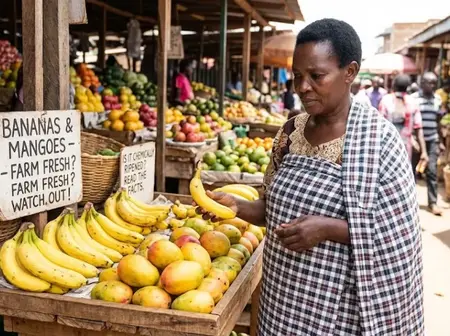
A banana with a bright yellow peel or a mango that looks perfectly ripe may appear ready to eat. But can consumers tell whether fruit has been exposed to potentially harmful ripening chemicals simply by looking at it?
A study by researchers from Kenya Methodist University raises concerns about fruit safety in Kenyan markets, particularly the use of calcium carbide and other chemicals to control ripening.
Published in the International Journal of Professional Practice, the study analysed 392 fruit samples and surveyed 180 farmers and traders in Nairobi, Meru, Murang’a and Kirinyaga counties between September 2024 and April 2025.
Its findings raise an important question for consumers: Can you identify chemically treated fruit before buying it?
The short answer is that appearance alone cannot reliably establish whether fruit has been treated with potentially harmful chemicals.
The study did not develop or validate a visual test that consumers can use to distinguish chemically treated fruit from naturally ripened produce. Its assessment relied on laboratory analysis and statistical modelling.
The researchers explain that artificial ripening and delaying agents are used to “synchronise ripening, extend shelf life, and preserve the visual appeal of produce during storage and transport”.
However, they warn that “improper usage, inadequate dosage control, and reliance on industrial-grade chemicals can compromise fruit quality”.
This means shoppers should be cautious about social media claims that colour, smell, texture or simple home experiments can conclusively reveal chemical treatment.
The research found that 63 per cent of surveyed farmers and traders used chemical agents to speed up ripening or delay maturity.
Calcium carbide was the most commonly reported agent, at 42 per cent, followed by ethephon at 27 per cent.
Laboratory analysis detected contaminants in 26 per cent of the 392 fruit samples. The researchers also reported that modelled acetylene concentrations in carbide-treated fruits exceeded the study’s stated reference threshold of 0.7 milligrams per kilogramme.
Bananas recorded the highest proportion of samples above relevant limits, at approximately 40 per cent. Mangoes followed at 20 per cent, while tomatoes recorded 17 per cent. Arsenic was detected in eight per cent of mango samples.
These findings apply to the fruits sampled in the four counties, not all fruit sold across Kenya.
The researchers identify calcium carbide as a particular concern because it releases acetylene gas to accelerate ripening. They state that it “poses recognized risks to human health”.
The report identifies potential health concerns associated with exposure to contaminants from inappropriate chemical use.
It describes possible effects from prolonged exposure, including “gastrointestinal disorders, neurological impairment, and possible long-term carcinogenic outcomes”.
The researchers also note that calcium carbide may contain toxic impurities, including arsenic and phosphine, which are associated with carcinogenic, neurological and respiratory health risks.
However, the study did not track consumers to establish whether eating the tested fruits caused illness. Its findings identify potential exposure risks, not confirmed cases of disease among consumers.
Washing fruit under clean running water remains a good food hygiene practice. However, it should not be treated as a guarantee that chemical residues or contaminants have been eliminated.
The study did not test household washing methods or establish that washing makes chemically contaminated fruit safe.
Consumers should also avoid relying on colour, smell, peeling or online home tests as proof that fruit is safe. The research provides no validated visual method for detecting harmful residues.
The researchers link chemical use to climate variability, market pressure and inadequate postharvest infrastructure.
They write that “climate variability and market pressure jointly drive chemical use in postharvest systems”.
Their analysis found rainfall variability was a significant predictor of chemical use, with a coefficient of 0.41, while market pressure recorded 0.36.
Changing weather can accelerate fruit maturation, shorten shelf life and increase postharvest losses. Traders may consequently turn to chemicals to preserve produce and maintain market value.
Limited access to safer alternatives, including controlled ethylene systems and cold storage, also contributes to the problem.
The researchers call for stronger coordination among the Kenya Bureau of Standards (KEBS), the Pest Control Products Board, the National Environment Management Authority, county governments and public health departments.
They recommend mobile residue-testing laboratories to enable “real-time screening of fruits and vegetables in high-risk markets”.
They also advocate stronger market inspections, farmer and trader training, improved traceability and investment in cold storage and solar-powered refrigeration.
For Kenyan consumers, the message is clear: a fruit’s attractive appearance cannot guarantee that it is free from harmful chemical residues. There is no reliable visual shortcut established by this study.
Protecting consumers will require better laboratory testing, safer fruit-handling practices and stronger enforcement across Kenya’s fruit supply chain—not leaving shoppers to guess whether the bananas and mangoes they buy are safe.
A few years ago, when Silas Ndung’u told his father he was going to South Africa to study to become a sommelier, his father had only one question: “Have you decided to be a drunkard?”
It was a reaction Silas had encountered often. At the time, most people had no idea what a sommelier was or what the profession entailed. But things have changed. With the growth of Kenya’s wine culture, the work of wine professionals is becoming more visible.