A Chuka University graduand has drawn an outpouring of sympathy from Kenyans online after a TikTok video showed him sitting alone and in tears on his graduation day, with no family member or friend present to celebrate with him.
The clip shows the young man looking on as his fellow graduates laughed, hugged their relatives and lined up for photos in their gowns. With nobody there to congratulate him, he reportedly broke down, and those who witnessed the scene described it as deeply painful.
The moment got even harder to watch afterwards. Instead of staying among the celebrations, he took off his academic gown, folded it into his bag and went to sit by himself, away from the crowd.
In Kenya, graduation is rarely a solo affair. Parents, siblings, neighbours and church members often travel long distances to attend, and the day is treated as a victory for the whole household.
For many families, a degree is the result of years of shared sacrifice, which is why the absence of even one familiar face can feel so heavy.
The video quickly made its way across other social media platforms, and thousands of people reacted to it. Many said they were heartbroken by what they saw, while others praised the graduand for keeping his composure in such a difficult moment.
Several commenters reminded him that completing a degree is a major achievement whether or not anyone is there to applaud it.
The university had not publicly commented on the video at the time of publishing, and it remains unclear why no one turned up to support him.
An emotional moment unfolded at Chuka University after a graduand was left alone during his graduation ceremony, with neither family nor friends present.
What should have been one of the happiest moments of his life turned into a painful experience of loneliness and disappointment.
According to footage circulating on social media, the graduand appeared overwhelmed as he watched other students enjoy special moments with their families.
Several graduates were seen embracing their relatives, taking photographs and celebrating years of academic struggles and sacrifices.
However, the young man had nobody beside him to share the milestone, making his experience particularly heartbreaking.
In an emotional moment that attracted attention online, he reportedly broke down in tears while watching the celebrations around him.
Rather than continue participating in the ceremony while surrounded by celebrating families, he quietly removed his graduation gown.
He reportedly folded the gown, packed it into his bag and sat alone, away from the festivities unfolding around him.
The incident was captured in footage that circulated widely on TikTok on Saturday, November 21, 2026.
The video attracted reactions from Kenyans, with many expressing sympathy for the graduand and questioning what might have prevented his loved ones from attending.
Others observed that graduating from university represents years of determination, financial sacrifices and personal struggles that deserve recognition.
For many Kenyan families, university graduation ceremonies are significant occasions that bring together relatives, neighbours and church members.
Parents and guardians often travel long distances to witness their children's achievements after supporting them throughout their education.
In many households, earning a university degree represents a collective achievement rather than an individual accomplishment.
Consequently, having loved ones present during graduation can make the occasion even more meaningful for many students.
The absence of familiar faces during such an important milestone can therefore become emotionally difficult, particularly when other graduates celebrate with their families.
The young man's experience has since sparked conversations about the importance of emotional support and family presence during significant life achievements.
Others called on families to recognise the emotional importance of showing up for their children during important occasions.
Despite the emotional moment, the graduand had still achieved an important academic milestone after completing his university studies.
His experience has reminded many Kenyans that behind every graduation gown are personal struggles and sacrifices that are not always visible.
However, the reasons his family and friends failed to attend the ceremony had not been established at the time of publication.
The incident continues to attract sympathy online, with many hoping the young man eventually receives the recognition and support he deserves.
Although the government has increased the number of teachers targeted for promotion to 50,000 in the 2026/2027 financial year, not every teacher seeking career advancement will automatically receive a promotion.
The Teachers Service Commission (TSC) will use a competitive selection process based on applicants' qualifications, professional experience, performance and the availability of promotion positions.
The revised Career Progression Guidelines also introduce separate pathways for teachers who want to advance through classroom teaching and those interested in school administration.
TSC Circular No. 13/2026, dated July 24, 2026, outlines the requirements and procedures for teacher promotions during the 2026/2027 financial year.
One of the basic requirements is that a teacher must have served for at least three years in their current grade to qualify for consideration.
However, meeting this requirement does not guarantee promotion. The Commission also assesses other professional qualifications and achievements before selecting candidates.
Apart from the minimum period of service, the TSC considers several factors when evaluating applicants.
These include academic qualifications, experience in the teaching profession, time spent in the current grade and performance in Teacher Performance Appraisal and Development (TPAD) assessments.
Teachers who have served in acting positions, including administrative roles in schools, may earn additional marks under the promotion assessment framework.
Professional assignments outside regular classroom duties can also contribute to a candidate's assessment. These include responsibilities involving the Kenya National Examinations Council (KNEC), Kenya Institute of Curriculum Development (KICD) and the Ministry of Education.
The guidelines also provide for shortlisting three candidates for every advertised vacancy. Those selected proceed to interviews conducted at the appropriate administrative level.
This makes the promotion exercise competitive. A teacher may meet the minimum qualifications but still miss out if other candidates perform better during the selection process.
The government initially advertised 34,016 promotion vacancies for the 2026/2027 financial year.
However, during the World Teachers' Day celebrations at Kasarani on October 5, 2026, President William Ruto directed the TSC to increase the promotion target to 50,000.
The revised target represents an additional 15,984 opportunities compared with the original figure.
According to reports by Citizen Digital, the President also announced an increase in the annual promotion budget from KSh1 billion to KSh2 billion to support the expanded exercise.
The decision is intended to create more opportunities for teachers seeking advancement within Kenya's public education system.
However, the increased target does not mean that all the additional positions have already been filled. Teachers will still have to go through the Commission's selection process.
The government made another funding announcement on November 12, 2026, during the Kenya Comprehensive School Heads Association (KECSHA) annual conference in Mombasa.
President Ruto announced an additional KSh4 billion to support teachers' career progression.
He also confirmed that the revised Career Progression Guidelines, negotiated between the TSC and teachers' unions, had received approval from the Salaries and Remuneration Commission (SRC).
The announcement is important because the revised framework is expected to change how teachers advance through different professional grades.
Public schools in Kenya are waiting to find out whether the government will increase the money allocated to support learners and whether funding will continue reaching institutions before the start of each term.
The two issues came into focus during the Kenya Comprehensive School Heads Association (KECSHA) annual conference in Mombasa on November 12, 2026.
President William Ruto directed the Ministry of Education and the Teachers Service Commission (TSC) to review school capitation and submit recommendations by January 2027.
The announcement has raised questions among school administrators about the amount of money they will receive and when any changes could take effect.
Capitation is government funding provided to public schools to support the education of learners.
The amount allocated is linked to the number of students in an institution. The funding helps schools meet expenses associated with teaching and learning.
However, the cost of running schools can change over time. This is why the amount allocated to each learner may need to be reviewed.
During the Mombasa conference, Ruto asked Education Cabinet Secretary Julius Ogamba and the TSC to examine the existing figures and recommend whether the allocations should be increased.
According to Kenya Broadcasting Corporation (KBC), primary school capitation had previously increased from KSh1,400 to KSh2,340 per learner.
The President indicated that the figures required further consideration, taking into account inflation and the financial demands facing schools.
Although the government has announced a review, schools should not assume that higher capitation rates have already been approved.
The Ministry of Education and TSC are expected to examine the current arrangements and submit their recommendations by January 2027.
Ruto will then consider the report before deciding on the way forward.
This means that the January deadline is for the recommendations, not a confirmed date for introducing new funding rates.
School administrators will therefore have to wait for the government's decision before knowing whether the amount allocated per learner will change.
The amount allocated to schools is only one part of the funding question. The timing of disbursement also matters.
School heads need to know when government funds will arrive so they can organise activities and plan expenditure at the beginning of each term.
During the same conference, Ruto said the government would release capitation before schools reopen each term from 2027.
He cited disbursements of KSh44 billion in January 2026, KSh23.4 billion in April and KSh18.5 billion in August.
The commitment is intended to make funding available before the beginning of each term rather than leaving school administrators waiting for the money after learners have returned.
It is important to distinguish this promise from the proposed review of capitation rates. Releasing funds earlier does not automatically mean that schools will receive a higher amount.
Another issue discussed during the conference was the government's plan to bring primary and junior schools together under a comprehensive school arrangement.
This change will require clear guidelines on how the institutions are managed, staffed and funded.
Ruto directed the Ministry of Education to work with KECSHA on proposals to amend the Basic Education Act.
The proposed amendments are intended to provide a legal framework for the governance, staffing and financing of comprehensive schools.
The funding arrangements will be particularly important because primary and junior school levels will operate within the same institutional structure.
However, the proposed legal changes should not be confused with an approved increase in the amount allocated to learners.
For school heads, the main issue will be whether the government changes the amount allocated to each learner and how the comprehensive school arrangement will affect institutional funding.
They will also be interested in whether the promised early disbursement of capitation becomes a consistent practice from 2027.
Parents should understand that the review concerns government funding to schools. It does not, by itself, announce a change in school fees or confirm that parents will pay less.
The recommendations expected in January 2027 should provide more information about the proposed funding adjustments.
Until the government makes a further announcement, schools should continue using the existing capitation arrangements.
In the footage circulating on social media, the graduate reportedly removed his academic gown, folded it and placed it in his bag before sitting alone away from the celebrations.
The incident has attracted attention online, with several social media users expressing sympathy for the young man following the emotional scenes.
Some viewers have reportedly highlighted the importance of family support during significant milestones, particularly graduation ceremonies, which often mark the culmination of years of academic commitment and personal sacrifice.
The incident comes as Chuka University held its 15th graduation ceremony on Friday, November 20, 2026, at its main campus in Tharaka Nithi County.
According to information published by the university, the ceremony was organised to celebrate the achievements of the Class of 2026.
Education News Kenya reported that 4,104 graduands received their degrees during the ceremony, which was presided over by Vice-Chancellor Professor Henry Mutembei.
The university's graduation newsletter also recognised the contributions of families, guardians, friends, lecturers and mentors in supporting students throughout their academic journeys.
However, details surrounding the young man's personal circumstances, including why his relatives and friends did not attend, have not been independently established.
The emotional footage continues to generate conversations about the importance of standing with loved ones during significant moments in their lives.
Sources: TUKO.co.ke, Chuka University official website and Education News Kenya.
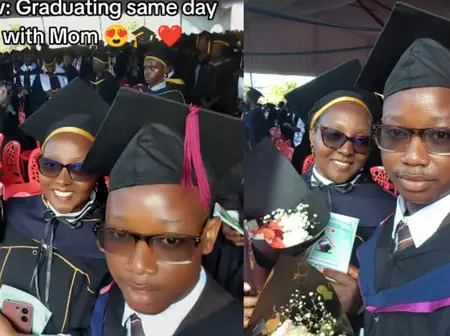
A heartwarming graduation moment involving a Kenyan mother and her son has captured the attention of social media users after the two celebrated their academic achievements on the same day.
The memorable moment unfolded at Chuka University in Tharaka-Nithi County during the institution's 15th graduation ceremony held on Friday, November 20, 2026.
The young man, identifying himself as Boni on TikTok, shared a video capturing the special occasion alongside his mother.
In the clip, the two are seen dressed in matching academic regalia, complete with graduation gowns, caps and sashes, as they celebrate their achievements together.
Boni captioned the video, "POV: Graduating same day with Mom," accompanied by love and graduation emojis.
The short video has since attracted attention, with many Kenyans celebrating the unusual but beautiful milestone.
For many social media users, the moment represented more than two people receiving academic qualifications.It was a celebration of determination, sacrifice and the importance of education across generations.
The fact that a mother and her son managed to complete their academic journeys and graduate during the same ceremony made the occasion even more memorable.
Following the graduation ceremony, Boni also shared another video showing an after-party organised to celebrate the achievement with family members.
The celebrations provided an opportunity for relatives to share in the joy of the two graduates.
The mother and son were among 4,104 graduands who received qualifications during Chuka University's 15th graduation ceremony.
Their story has offered a beautiful reminder that the pursuit of education has no single age or generation.
For Boni and his mother, November 20 will undoubtedly remain a memorable date: the day they wore graduation gowns not just as family members, but as fellow graduates.
The young man was surrounded by fellow graduands celebrating with their loved ones, taking photographs and embracing family members, but he had no one by his side.
The emotional moment reportedly became overwhelming as he watched others share the joy of completing their studies with the people closest to them.
Unable to hold back his tears, he broke down, drawing attention from people who witnessed the heartbreaking scene.
In footage circulating on social media, the graduand is seen removing his graduation gown, folding it and putting it away before sitting by himself, away from the celebrations.
His experience struck a chord with many Kenyans, who sympathised with him over the loneliness he experienced on a day that should have been filled with pride, happiness and celebration.
Graduation ceremonies are often significant family occasions in Kenya, with parents, siblings, relatives and friends travelling to attend and celebrate years of hard work and sacrifice.
For many graduates, earning a degree represents not only personal achievement but also the sacrifices made by their families to help them complete their education.
However, the young man's graduation took a different turn, as he appeared to have no one to share the moment with.
Despite the painful experience, completing university remains a significant personal achievement, marking the end of years of study and the beginning of a new chapter in his life.
The Head of State presided over the ceremony on Saturday, November 21, 2026, during his visit to Matungu Constituency, where he also launched other development projects.
The hostel project is expected to improve accommodation for students pursuing medical training at the institution. It forms part of the government's wider plan to expand student housing facilities in learning institutions across the country.
Ruto's visit comes as his administration continues to roll out development projects in different parts of Western Kenya, with investments targeting education, roads, electricity and affordable housing.
Earlier, the President announced several projects in Kakamega County, including road construction and last-mile electricity connectivity programmes.
During his development tour, he also laid the foundation stone for an affordable housing project in Butere and launched construction works on the Khayega-Malimili-Shimanyiro Road in Shinyalu Constituency.
The Matungu visit also comes amid political activity in the constituency following reports that a Linda Mwananchi Movement office was defaced ahead of the President's arrival.
Bumula MP Jack Wamboka condemned the incident, describing it as political intimidation and insisting that the movement would continue with its activities.
Despite the political developments, Ruto proceeded with his scheduled development engagements in the area.
The President's Western Kenya tour is part of a wider programme covering Kakamega, Busia, Bungoma and Vihiga counties.
His latest engagement at Matungu KMTC places student accommodation and access to medical training facilities among the issues receiving attention during the regional tour.
The government has continued presenting education infrastructure as part of its development agenda, with additional hostel projects planned or underway in different institutions.
The Teachers Service Commission (TSC) has directed heads of institutions across the country to establish whether teachers in the 20,000-intern cohort have received invitations for vetting.In an urgent communication to heads of institutions on Saturday, November 21, the commission asked school administrators to contact the affected interns and confirm receipt of the invitation messages.
A sombre mood filled Chimoi village in Manda Shivanga Ward, Malava Constituency, as relatives, colleagues, learners and leaders gathered to bid farewell to Madam Janet Makokha Andabwa, head teacher of Chamabele Comprehensive School.
Janet was among six teachers from Matete Sub-County in Kakamega County who died in a road accident near Burnt Forest along the Eldoret–Nakuru Highway on the night of October 30 and 31, 2026.
The teachers were travelling from Matete towards Nairobi to attend the wedding of a fellow teacher’s daughter.
Their journey came shortly after they had completed national examination supervision duties.
The crash brought grief to the education community, particularly in Matete, where the seven teachers had been serving.
Janet’s death was a painful loss to her family, colleagues, pupils and the wider community.
Mourners at her burial included serving and former students, teachers, friends, relatives and local leaders. They gathered to remember her life, share memories and stand with her family during a difficult period.
Mourners described Madam Janet as a devoted teacher who served learners with humility and passion. Many recalled her strong leadership at Chamabele Comprehensive School, her support for fellow teachers, and her concern for pupils’ welfare.
Speakers urged the community to remain united during the difficult period and to support the children and family she left behind.
Several leaders attended the ceremony to pay their last respects.
Kakamega Senator Boni Khalwale conveyed condolences to the family and praised Madam Janet’s service to the education sector.
Seth Panyako also sent condolences and encouraged the bereaved family to find strength in God and in the support of the community.
The tragedy has renewed calls for improved road safety along the Eldoret–Nakuru highway, especially at known accident-prone areas.
Leaders and residents asked motorists to observe speed limits, avoid night travel when possible, and exercise caution during busy travel periods.
Madam Janet's memory will live on through the school community and the many people she inspired.