
The Public Service Commission (PSC) will play a central role in determining the future of employees as the government moves to merge two state corporations under proposed changes aimed at streamlining Kenya's irrigation and water storage functions.•The proposed Irrigation (Amendment) Bill, 2026 provides that employees of the National Water Harvesting and Storage Authority (NWHSA) will automatically transfer to the new National Irrigation and Water Storage Authority once the law takes effect.
Category: Economy&Finance
-

Kenya Softens Stablecoin Capital Rules, Keeps Reserve Mandate
Kenya has lowered the highest capital hurdle in its new virtual-asset regime, trimming the paid-up capital required for stablecoin issuers by 40% after industry consultation while leaving intact some of the framework's most consequential controls over digital-dollar businesses.•The National Treasury's March draft regulations indicated stablecoin issuers would need up to KSh 500 million in paid-up capital but updated regulations gazetted last week instead require KSh 300 million, reducing the single highest capital threshold in the licensing regime.
-
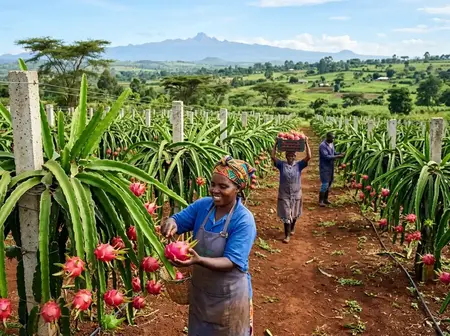
Dragon Fruit Farming in Kenya: Costs, Returns & Profitability Guide
Dragon fruit, also known as pitaya and often nicknamed “Pink Gold,” is quickly becoming one of Kenya’s most profitable fruit crops. Demand continues to rise among supermarkets, hotels, restaurants, and health-conscious consumers, while local production remains relatively low.However, unlike many fruit crops, dragon fruit farming requires a significant upfront investment.
-

Kenya Sets Rules for Tokenising Real-World Assets in Updated Crypto Guidelines
Kenya has established its first legal framework allowing land, buildings, and other real-world assets to be converted into blockchain-based digital tokens and sold in fractions, creating a solid regulated pathway for a market that has until now operated as a regulatory experiment.•The provisions, contained in the Virtual Asset Service Providers Regulations, 2026, allow businesses to issue digital tokens representing ownership or economic rights in tangible and intangible assets, subject to licensing and approval by the Capital Markets Authority (CMA).
-

Capital A, EFG Hermes Extend Brokerage Grip in Bonds and Equities
Capital A became the first intermediary to cross KSh 1 trillion in annual bond turnover as EFG Hermes retained the equities lead in 2025, according to the latest data by the Capital Markets Authority (CMA).•Bond turnover rose 75.5% to KSh 5.42 Tn from KSh 3.09 Tn in 2024, while double-sided equities turnover increased 37.5% to KSh 290.94 Bn from KSh 211.94 Bn.
-

Embedded insurance Gains Traction as Insurers Target Kenya’s Gig Economy
Kenya's insurance industry is increasingly embracing embedded insurance as firms seek to expand health cover beyond traditional employer schemes by integrating protection into digital platforms that millions of consumers already use.•The shift is gathering pace as insurers target informal workers, gig economy players and low-income households, groups that are underserved despite facing some of the highest financial risks from illness and accidents.
-

Kenya Remittances Post Steepest H1 Decline Since 2009
Kenya’s diaspora remittances fell 3.03% to KSh 315.74Billion (US$ 2.442Bn) in the first half of 2026, the steepest H1 contraction since the global financial crisis, as an 11.61% drop in North American inflows erased gains from Europe and other markets.•The country received KSh 9.87Bn (US$ 76.36Mn) less than the KSh 325.62Bn (US$ 2.518Bn) recorded in the corresponding period of 2025.
-

Kenya’s Forex Traders Lost KSh 7.12Billion in 2025, 85% of All Outcomes
Kenyan online forex traders suffered US$ 54.80Million (KSh 7.12Billion) in gross trading losses in 2025 despite a sharp decline in market participation, as the number of active accounts fell 46.2% to 152,110, according to the latest data by the Capital Markets Authority (CMA).
-

In Search of Unstoppable Africans, GABI Invites Nominations from Across the Continent
New York – The search is on for “Unstoppable Africans”. The Global Africa Business Initiative (GABI) has opened nominations for a new community-led campaign to recognize and celebrate entrepreneurs, business leaders and changemakers whose ideas, leadership and actions are driving Africa's economic transformation.
-
How petrol, diesel and kerosene will retail in major Kenyan towns up to December 14

The Energy and Petroleum Regulatory Authority (EPRA) has announced new fuel prices for the November 15 to December 14, 2026, pricing cycle, with motorists in Nairobi set to pay Ksh226.96 for a litre of Super Petrol.
In its latest review released on Saturday, November 14, 2026, EPRA retained the price of diesel in Nairobi at Ksh227.76 per litre, while kerosene will continue retailing at Ksh219.87.

In Mombasa, which serves as Kenya’s main petroleum import gateway, a litre of Super Petrol will retail at Ksh223.81, diesel at Ksh224.61 and kerosene at Ksh216.71.
The new rates will take effect at midnight on Saturday, November 15, and remain in force until December 14.
The EPRA schedule shows variations in pump prices across different towns, largely reflecting transportation and distribution costs.
Nairobi motorists will pay Ksh224.96 for petrol, Ksh227.76 for diesel and Ksh219.87 for kerosene.
In Mombasa, petrol will retail at Ksh223.81, diesel at Ksh224.61 and kerosene at Ksh216.71.
Kilifi residents will pay Ksh224.62 for petrol, Ksh225.42 for diesel and Ksh217.52 for kerosene.
In Nakuru, motorists will pay different rates from those in coastal towns, reflecting the additional costs associated with transporting petroleum products inland.
The price differences mean motorists travelling between counties may encounter varying pump prices even when purchasing the same petroleum products.
For motorists in Nairobi, the Ksh2 reduction in petrol offers modest relief, although the cost of filling a vehicle’s tank will remain relatively high.
A motorist purchasing 50 litres of Super Petrol in Nairobi will spend Ksh11,248, compared with Ksh11,348 under the previous pricing cycle, representing a saving of Ksh100.

However, diesel-powered vehicles will not enjoy similar relief because the price of the commodity has remained unchanged.
The continued high diesel price is particularly significant for public transport operators, truck owners and businesses that depend on road transportation to move goods.
The latest review is also likely to attract attention from public transport operators and businesses because fuel remains a major component of their operating expenses.
Matatus, buses, taxis and delivery vehicles depend heavily on petrol and diesel, meaning changes in pump prices can influence the cost of providing transport services.
However, the modest reduction in petrol prices does not necessarily mean passengers will immediately enjoy lower fares.
Diesel remains more expensive than petrol in Nairobi, placing continued pressure on operators of diesel-powered commercial vehicles.
Households that rely on kerosene for cooking and lighting will also continue paying Ksh219.87 per litre in Nairobi, with no reduction announced in the latest review.
EPRA calculates maximum retail prices by considering the landed cost of petroleum products, distribution expenses, applicable taxes and other components of the petroleum pricing formula.
Mombasa generally records lower pump prices because of its proximity to the country’s main petroleum import and distribution infrastructure.
Inland towns, including Nairobi and other regional commercial centres, incur additional transportation and distribution costs.
The regulator publishes maximum pump prices that oil marketing companies must observe, meaning retailers cannot legally sell fuel above the prescribed rates.
The new pricing schedule will remain in force for 30 days, with the next review expected in December.
Rono is a digital journalist with a proven track record in newsroom leadership and content creation. Currently a Digital Writer for People Daily Digital, Emmanuel’s career is rooted in a lifelong passion for storytelling. Let's talk here: emmanuel.rono@mediamax.ke or ronoemmanuel685@gmail.com