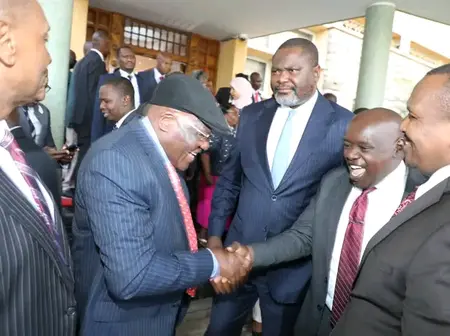
The former senator later took to social media, where he shared moments from the gathering, highlighting his interactions with several leaders who were present.
In his caption, Muthama wrote, “Sharing handshakes and laughter during the State Of The Nation Address,” accompanying the message with photographs capturing his engagements during the event.
Among those seen interacting with Muthama was Public Service Cabinet Secretary Geoffrey Ruku. Nandi Senator Samson Cherargei was also among the leaders spotted during the gathering.
The photographs showed Muthama exchanging greetings and sharing light moments with some of the attendees, offering a glimpse of the interactions that took place outside the formal proceedings.
Muthama's appearance at Parliament attracted attention, particularly among Kenyans familiar with his previous role in elective politics. He served as Machakos Senator before leaving the Senate after the 2022 General Election.
His social media post offered a glimpse into his engagements with senior officials and fellow leaders during the high-profile parliamentary occasion.
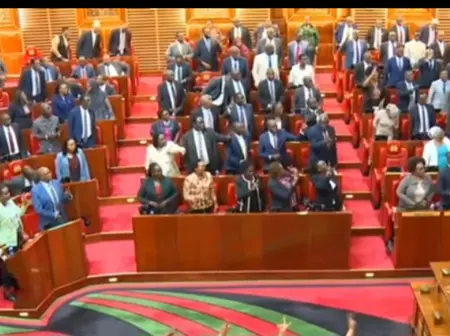
President William Ruto received repeated standing ovations from lawmakers allied to his broad-based administration during his fourth State of the Nation Address, as opposition legislators associated with the Linda Mwananchi faction stayed away from the parliamentary sitting.
Throughout the address, government-aligned MPs rose from their seats to applaud several achievements highlighted by the President, particularly in healthcare, affordable housing and education.
Among the programmes that attracted applause was the rollout of the Social Health Authority (SHA), which the administration has presented as a major step towards expanding access to healthcare.
Lawmakers also welcomed the progress reported under the affordable housing programme and the recruitment of 100,000 teachers, alongside plans to employ an additional 20,000.
Pro-government legislators argued that the initiatives demonstrated the administration’s commitment to expanding public services, creating employment opportunities and improving living standards across the country.
Kibwezi West MP Mwengi Mutuse also defended the broad-based government arrangement, linking political stability to economic development.
“For you to be able to enhance economic development, it is important also to get political stability first,” Mutuse said.
However, the address also drew criticism from opposition figures, who questioned the government's handling of governance concerns and the rising cost of living. Their absence from the parliamentary session further highlighted the political divisions surrounding the administration.
The contrasting reactions reflected the different positions taken by government supporters and opposition leaders as the country approaches the 2027 General Election.
In a statement released on Wednesday, November 18, the movement called for urgent and impartial investigations into the incidents, claiming that its leaders and their associates were being targeted through violence, intimidation and arrests.
The group specifically demanded that Inspector General of Police Douglas Kanja issue a public statement explaining the security situation in Western Kenya and the measures being taken to protect residents.
It also called for the arrest and prosecution of everyone found responsible for the attacks, including individuals suspected of financing the violence.
One of the incidents involved Amos Boaz Masika, a member of Natembeya's communications team, who reportedly survived an attack at his home on Monday, November 16.
According to the movement, the incident happened in front of his wife and children. His vehicle was also set on fire, while he was taken to hospital for treatment.
Linda Mwananchi further mentioned separate incidents involving the reported burning of homes belonging to individuals associated with Bumula MP Jack Wamboka.
The movement also raised concerns over the arrest of Trans Nzoia County Assembly Deputy Speaker Obed Mwale, describing the charges against him as politically motivated.
The latest demands come just hours after President William Ruto delivered his State of the Nation Address at Parliament Buildings in Nairobi.
During his address on November 18, Ruto called for political tolerance and warned leaders against sponsoring violence, intimidation and political gangs.
He urged Kenyans to respect political differences and pursue their interests peacefully.
The movement's demands now place renewed attention on security concerns in Trans Nzoia, Bungoma and Kakamega as political activities continue ahead of the 2027 General Election.
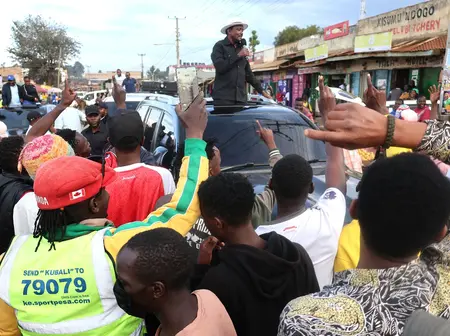
Instead of driving past the bustling crowds, Musyoka emerged from the sunroof of his vehicle to greet the gathered locals and deliver an impromptu address. Videos shared online captured hundreds of traders, youth, and motorists surrounding the convoy in the heart of Eldoret town, chanting and waving as the opposition principal waved back.
Speaking from atop his vehicle, Musyoka thanked the people of Uasin Gishu County for their warm and peaceful reception, noting that Kenyans across every region share common aspirations for a better economy. He emphasized that the stopover demonstrated the importance of peaceful political tolerance, contrasting the calm atmosphere in Eldoret with recent violent disruptions witnessed during opposition tours in other parts of the country.
Earlier in the day, Musyoka had been in Kondabilet, Marakwet West Sub-County, where he joined mourners at the funeral of Mama Joyce Jepchirchir Keitany, the late wife of his loyal security aide of 24 years, Luka Keitany. During that emotional service, he stood alongside local leaders, including Elgeyo Marakwet Governor Wisley Rotich and Machakos Senator Agnes Kavindu, to comfort the bereaved family.
As his motorcade made its return journey through Eldoret City, word of his presence quickly spread through the central business district. Residents and commercial motorcyclists blocked sections of the road, insisting that the Wiper leader pause and speak to them before continuing his trip.
In his brief remarks to the Eldoret crowd, Musyoka urged young people to remain peaceful, law-abiding, and focused on constructive civic engagement ahead of the 2027 General Election. He reiterated his call for national unity and equal development across all 47 counties, stating that leaders must be free to interact with citizens anywhere in the republic without intimidation.
The peaceful roadside engagement came just weeks after Musyoka's convoy was pelted with stones by suspected goons during an Ukombozi Alliance tour in Migori County on November 5, 2026. Following that earlier incident, the Wiper leader had strongly condemned political intolerance and called upon security agencies to guarantee equal protection for all political formations.
By stepping out to address the Eldoret crowd directly, Musyoka turned an unplanned traffic stoppage into a key grassroots outreach moment in President William Ruto's home turf. Local residents cheered as his convoy eventually cleared the town center, marking a calm and notable chapter in his ongoing nationwide engagements ahead of 2027.
Residents of Nyamthong’no Village in Migori County have been left shocked after the body of a 13-year-old girl was discovered in a thicket.
The girl, identified as Angel Akinyi, was a Grade Four pupil at Magongo Ribe Primary School. Her body was found on Tuesday morning, November 17, after she failed to return home the previous afternoon.
Police said Akinyi left home at about 2pm on Monday, November 16, to collect firewood across River Nyamthong’no. She did not return, raising concern among her family.
Her grandmother later teamed up with local resident Erick Odhiambo to search for her. They reportedly found a bundle of firewood in a thicket, tied together with the girl’s sweater.
They continued searching and discovered Akinyi’s body on a nearby farm.
Police who visited the scene established that the child had suffered severe injuries. Preliminary findings suggested she had been sexually assaulted before being killed.
Investigators recovered bloodstained clothes and pink sandals about three metres from the body. The firewood Akinyi had collected was found roughly 10 metres away. Officers also noted signs of a struggle.
Crime Scene Investigation officers documented and photographed the area before the body was taken to Migori County Referral Hospital mortuary, where it is awaiting a postmortem examination.
Detectives are yet to identify the attacker or establish the motive.
The killing has renewed concerns about children's safety, especially when they are sent alone to isolated places for household chores.
Residents are awaiting answers as investigators work to bring those responsible to justice. Parents are calling for stronger protection of children in the area.
First Lady Rachel Ruto has attracted public attention following her involvement in the launch of SIBOH School and Sports Academy in Eldoret City, Uasin Gishu County.
The First Lady officially launched the institution's website on August 18, 2026, marking an important step in preparations for the school's planned opening to students in 2027.
The institution, located in Eldoret, aims to combine classroom education with professional sports training, giving learners opportunities to develop their academic abilities and sporting talents.
SIBOH School and Sports Academy is designed to accommodate learners from pre-primary through senior school.
The institution plans to offer Kenya's Competency-Based Education curriculum alongside sports programmes intended to identify and nurture young talent.
Its development began with an idea conceived in 2022, followed by site selection in 2023 and construction activities beginning in 2024.
The academy is expected to attract families interested in an education system that gives considerable attention to both academic achievement and physical development.
The institution's design and appearance have also attracted attention as details of the development circulate online.
Its colour scheme has prompted comparisons with the colours associated with the United Democratic Alliance (UDA), the political party linked to President William Ruto.
However, there is no verified evidence that the school's colours were selected to represent the political party.
The academy presents itself as an educational institution focused on academic excellence, character development and sports training.
During the website launch, Rachel Ruto highlighted the importance of providing children with opportunities beyond conventional classroom learning.
She emphasised the need for an education system that recognises different abilities and prepares learners for future opportunities.
The academy's proposed facilities include spaces for athletics, football, swimming and other sporting activities.
Its location in Eldoret is significant because the city has produced numerous internationally recognised athletes and remains one of Kenya's leading centres for athletics.
According to information published by the institution, SIBOH intends to welcome its first group of learners in 2027.
The school has also established an online platform through which parents and guardians can access information about its academic programmes and admission arrangements.
As preparations continue, attention will turn to the completion of facilities, recruitment of qualified personnel and implementation of the proposed academic and sports programmes.
The development adds to the growing number of educational investments in Uasin Gishu County.
For families interested in combining formal education with sporting opportunities, the academy presents another option as it prepares to begin operations.
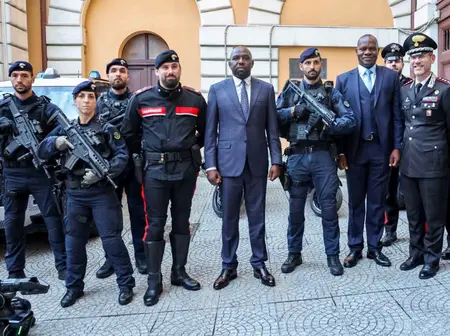
Interior Cabinet Secretary Kipchumba Murkomen's official visit to Rome, Italy, has attracted attention as he engages senior Italian security officials in discussions aimed at strengthening cooperation between the two countries.
The visit, which began on Monday, November 16, 2026, has involved meetings with Italian government representatives and law enforcement agencies responsible for national security, intelligence coordination and combating organised crime.
Murkomen's engagements come as Kenya seeks to improve its security capabilities through international partnerships, specialised training and modern policing technology.
During his visit, Murkomen held bilateral talks with Italy's Interior Minister, Matteo Piantedosi, in Rome.
The discussions resulted in the signing of a security cooperation agreement intended to strengthen collaboration between Kenyan and Italian law enforcement institutions.
The agreement focuses on several areas, including counterterrorism, human trafficking, organised crime, illegal migration and other cross-border security threats.
Both countries also agreed to explore opportunities for intelligence sharing, technical assistance and specialised training.
The partnership is expected to support Kenya's efforts to strengthen its security institutions and improve responses to emerging threats.
Murkomen's visit has also drawn interest because of the involvement of Italian security institutions in his official engagements.
Italy maintains several specialised law enforcement agencies, including the Carabinieri, a national military police force responsible for various security and policing functions.
The Carabinieri also operates specialised units trained to handle complex security assignments.
However, the specific units assigned to Murkomen's protection during the visit have not been independently confirmed.
The Cabinet Secretary's engagements with Italian authorities have primarily focused on strengthening institutional cooperation and exchanging knowledge on modern security operations.
As part of his programme, Murkomen visited the Questura di Roma, a police operations and control facility in the Italian capital.
During the visit, he examined how Italian security agencies use modern technology, intelligence systems and real-time surveillance to coordinate police operations.
The experience provided an opportunity for Kenyan officials to assess approaches that could contribute to ongoing police reforms.
Improved communication systems, coordinated emergency responses and effective information management are among the areas Kenya hopes to strengthen.
The government has continued to emphasise the importance of modernising security operations to address changing crime patterns and improve public safety.
Murkomen also met senior officials from the Guardia di Finanza, Italy's financial police agency.
The discussions focused on tackling money laundering, terrorism financing, illegal financial transactions and other economic crimes that cross international borders.
The two sides explored opportunities for cooperation in financial investigations, intelligence sharing and the recovery of assets linked to criminal activities.
Kenyan institutions expected to benefit from closer cooperation include the Directorate of Criminal Investigations, the Financial Reporting Centre and the Assets Recovery Agency.
Such partnerships could improve the country's ability to investigate sophisticated financial crimes and trace assets moved across international jurisdictions.
The Rome visit represents another step in the growing relationship between Kenya and Italy, particularly in matters involving security and law enforcement.
The latest agreement builds on earlier diplomatic engagements between the two countries, including discussions held during the Italian Interior Minister's visit to Nairobi in July 2026.
For Kenya, the priority will be translating the agreements into practical improvements in policing, investigations and institutional capacity.
The success of the cooperation will depend on implementation, continued engagement between the relevant agencies and the effective application of lessons gained from Italy's security systems.
Murkomen's visit highlights the government's efforts to establish international partnerships that could strengthen national security and improve the ability of law enforcement agencies to respond to emerging challenges.
“Kibaki was elected while standing on a wheelbarrow, and Uhuru, even when he was really drunk, did not end up serving only one term. Will it be Ruto?” Wanga was quoted as saying, in a remark that drew attention.
The statement brings back memories of Kenya’s changing political seasons. Former President Mwai Kibaki’s journey to State House was marked by a powerful opposition wave, while Uhuru Kenyatta also overcame strong political challenges before winning the presidency.
Wanga’s comparison appears to question the assumption that a president can easily be removed from power by a popular slogan or a growing opposition movement. The phrase “Wantam” has become part of the political conversation surrounding calls for Ruto to serve only one term.
Her remarks are likely to attract different interpretations, especially as politicians and their supporters continue positioning themselves ahead of the 2027 General Election. Some may view the statement as a reminder that Kenyan elections can produce surprising outcomes, while others may see it as a warning to those campaigning against the president.
Many people were left talking about the comparison because it places Kibaki, Uhuru and Ruto in one political argument. The incident sparked reactions online, with supporters appearing divided over whether history could repeat itself or whether the current political mood is different.
Still, the final decision will rest with voters when they head to the ballot. Political slogans can shape debate, but they do not automatically determine election results.
Do you think Ruto can overcome the pressure and win another term, or will the Wantam movement succeed? Share your thoughts in the comments.
Lawyer Donald Kipkorir has sparked an interesting national conversation after publicly naming two prominent Kenyans he believes deserve the country's highest national honours because of their contributions to patriotism, family values and society.
In a statement shared publicly, Kipkorir singled out businessman Mohammed Hersi and Kakamega Senator Boni Khalwale, praising the two personalities for what he described as their exceptional qualities and achievements.
Kipkorir reserved special praise for Hersi, whom he described as an eternal optimist who continues believing that corruption can eventually be eliminated in Kenya.
According to the prominent lawyer, Hersi's unwavering optimism and unmatched patriotism make him deserving of national recognition.
Kipkorir suggested that maintaining hope for a corruption-free Kenya, despite the challenges facing the country, was an important quality that should be celebrated.
He also recognised Khalwale, popularly known for his outspoken political positions, for what he described as his remarkable contribution to family life and the importance of education.
The lawyer particularly praised the senator for elevating polygamous family life and family education to a level he believes is difficult for other Kenyan families to match.
"The academic excellence of Khalwale progeny is enviable," Kipkorir remarked while explaining why he believes the senator deserves special recognition.
His comments placed the spotlight on Khalwale's children and their academic achievements, presenting the senator's family as an example of the importance of prioritising education.
Kipkorir's statement comes at a time when conversations about national honours, patriotism, leadership and the contributions of prominent citizens continue to attract public attention.
Although his remarks were personal recommendations rather than an official announcement of national awards, they generated an interesting discussion about the different ways Kenyans can contribute to society.
By recognising Hersi and Khalwale, Kipkorir highlighted two distinct qualities he believes deserve celebration: unwavering faith in Kenya's future and a strong commitment to family education.
His message also challenged Kenyans to appreciate individuals whose actions and values inspire others.
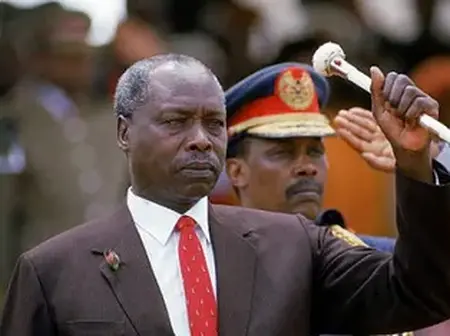
Former President Daniel arap Moi made specific arrangements to ensure that his 931-hectare ancestral land remained within his family across generations through instructions contained in his Will.
According to the document presented in court, Moi allocated the ancestral property to his five sons: Jonathan Kipkemboi Moi, Gideon Moi, Raymond Moi, Philip Moi and John Mark Moi.
He instructed trustees at Kabarak University to divide the 931-hectare parcel equally among the five beneficiaries, ensuring that each son received an equal share of the ancestral land.
However, Moi's instructions went beyond the initial distribution of the property. He directed his sons to transfer their respective portions to their children at a later stage.
This arrangement provided a clear succession plan for the ancestral property, with the next generation expected to inherit the land through their fathers.
By giving these instructions, Moi sought to ensure that the 931 hectares would remain within the family rather than being distributed outside his bloodline. His Will therefore outlined both how his five sons would inherit the property and how it would subsequently pass to their children.