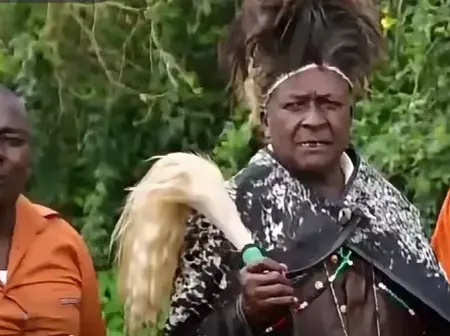
Residents of Kihumbu Ward in Kigumo Constituency, Murang’a County, have regained access to a road that had been blocked for nearly a month after Agikuyu elders performed traditional cleansing rituals to facilitate the removal of a sacred Muu tree.
The tree fell naturally across the Githembe-Gikarati road, disrupting transport and movement in the area as residents waited for elders to conduct the traditional ceremonies required before it could be removed.
Among the Agikuyu, the Muu is regarded as a sacred tree, alongside the Mugumo (fig tree), Mukuyu, Mukurwe and Muiri. Community traditions dictate that such trees cannot be cut, uprooted or removed without special ceremonies conducted by recognised elders.
According to Agikuyu beliefs, when sacred trees fall naturally, they may be communicating significant messages, including warnings of impending danger or changes in the community's fortunes.
Elder Kamau wa Mbugua, who led Tuesday's ceremony, said the process involved several traditional steps, including the use of sacrificial sheep to cleanse the site and seek protection against possible spiritual consequences.
“We first crossed the tree with sheep, which were used for the ritual. We took them to the mountain,” he said.
He explained that the sacrificial animals were subsequently burnt to ashes in accordance with the community's traditions.
Wa Mbugua said the removal of the tree's branches also required specific rituals, adding that the wood could not be used as ordinary firewood.
“The tree's branches, which we later cut into pieces, were done after a ritual. We have to wait for a place where they will be taken. When they get dry, we shall conduct another ritual of burning them,” he said.
“This tree can't be used as firewood by anyone, even a single branch. But if you would wish to use the firewood, you can take them; and you wait for the consequences,” he warned.
Under Agikuyu customs, the burning of the sacrificial animal is performed by a specially designated elder known as muthuuri wa horio or maturanguru. The exercise is conducted in the presence of other elders until the animal is reduced to ashes.
Elder Irungu Makungu wa Ngugi, who hails from the area, said sacred trees hold an important place in Agikuyu cultural beliefs and were historically associated with the community's political power and fortunes.
He cited the direction in which such trees fell as one of the traditional signs used to interpret the community's circumstances.
“When a sacred tree among the Agikuyu fell down facing the Maasailand, the community was in power. When the tree fell facing the Kikuyu land from the Maasailand, the community had lost power,” he said.
Meanwhile, Murang’a elders' chairperson Mwangi Njuguna said the ongoing rainy season had contributed to the falling of several sacred trees. He urged residents to report such incidents rather than attempt to remove the trees themselves.
“Because the rains season has started, anyone who sees a tree of this type falling, people should report to us so that we can plan ourselves on how to remove it, as there are steps on how they are transferred,” he said.
The elders said observing the traditional procedures was necessary to preserve Agikuyu cultural heritage and ensure sacred trees were handled with the respect they traditionally commanded.
Leave a Reply