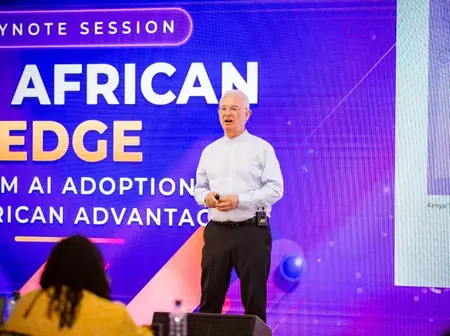
Africa must move beyond consuming artificial intelligence (AI) technologies developed elsewhere and harness its local knowledge, innovations and problem-solving capabilities to become a meaningful player in the global technology economy.
This was the central message delivered by Arthur Goldstuck, chief executive of World Wide Worx, at the opening of the CIO100 Symposium and Awards 2026 in Diani.
He challenged African technology leaders to rethink the continent's position in the rapidly evolving AI economy.
In a keynote titled The African Edge: From AI Adoption to African Advantage, Goldstuck argued that Africa's experience overcoming infrastructure, economic and social constraints could become a competitive advantage if translated into scalable technological solutions.
He cited M-Pesa as an example of African innovation with global relevance, arguing that technologies developed to address local challenges can influence markets beyond the continent.
Agriculture and locally developed language models, he said, offer similar opportunities, particularly in addressing problems that imported technologies may not adequately understand.
However, the opportunity comes with significant structural challenges.
A UNESCO report, AI for Africa, by Africa, published in 2025, estimates that the continent accounts for only about three per cent of global AI talent, while just five per cent of African AI researchers have access to the computing resources needed for advanced AI development.
Internet penetration is also estimated at approximately 37 per cent, against a global average of 67 per cent.
These gaps underline why Africa's AI ambitions must extend beyond deploying foreign platforms to investing in computing infrastructure, research, skills and locally relevant datasets.
The economic stakes are substantial. UNESCO estimates that AI could contribute $1.2 trillion to Africa's economy by 2030, equivalent to about six per cent of the continent's gross domestic product.
However, realising this potential will depend on whether African countries can retain skilled professionals, finance research and develop technologies that address their economic priorities.
Goldstuck cautioned that technology adoption alone does not guarantee commercial success, pointing to the growing gap between AI experimentation and measurable business outcomes.
Findings from the newly released South African AI Index 2026, produced by World Wide Worx in partnership with Altron Digital Business, illustrate the challenge.
Although 93 per cent of large South African organisations use generative AI, only 51 per cent of users report positive productivity effects.
Just 30 per cent have integrated AI into live business processes, while only 27 per cent have tools to measure its value.
"The real secret of that victory was trust. It wasn't tech, it was trust," Goldstuck said, drawing lessons from technology adoption in professional sport.
He challenged chief information officers (CIOs) to prioritise confidence in AI systems, warning that organisations risk wasting investments if employees and customers do not trust the technology.
He also cautioned that AI-generated documents, identities and videos were making fraud and impersonation increasingly sophisticated, elevating verification into an essential component of business operations.
"Verification becomes part of your product," he said.
The next frontier, he added, is agentic AI, which can independently execute tasks rather than simply provide recommendations.
This raises questions about authorisation, accountability and the ability to reverse automated decisions.
Goldstuck argued that AI-driven actions must be traceable, explainable and reversible, with human judgement remaining central to critical business decisions.
The governance challenge is particularly relevant across Africa.
An April 2026 OECD assessment involving 12 African countries identified inadequate computing infrastructure, skills shortages, fragmented datasets and weak institutional capacity as significant obstacles to responsible AI development.
It also highlighted the importance of developing language models that reflect African linguistic and cultural realities.
Kenya has already established a policy framework through its 2025-2030 National AI Strategy, anchored on digital infrastructure, data governance, and AI research, innovation and commercialisation.
The challenge now is translating these ambitions into commercially viable homegrown solutions.
Earlier, Harry Hare, chairman and co-founder of CIO Africa by dx5, challenged technology executives to expand their ambitions beyond managing IT departments and consider progressing into chief executive positions.
He argued that as businesses become increasingly dependent on digital systems, CIOs are gaining a strategic understanding of organisational operations, cybersecurity, costs and talent management that positions them for broader leadership responsibilities.
"Should I be planning my exit from the CIO into CEO? Just a thought," he told delegates.
The three-day symposium, running from November 25 to 27 at Diamonds Leisure Beach and Golf Resort, has attracted more than 400 technology leaders from over 10 African countries.
Held under the theme Innovation at Scale: Driving Business Growth Through IT Leadership, the gathering will culminate in Friday's CIO of the Year Gala Awards, recognising outstanding technology leadership across East, West, North and Southern Africa.
Leave a Reply