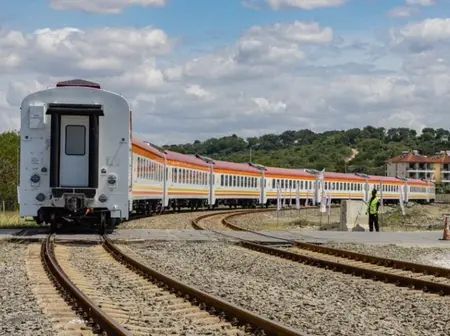
Kenya could have saved up to Ksh117 billion during the initial construction of the Mombasa–Nairobi Standard Gauge Railway (SGR) if it had matched Tanzania’s construction cost per kilometre, according to the World Bank.
The estimate, equivalent to US$900 million, appears in the lender’s November 2026 Kenya Economic Update, which examines how governance weaknesses affect public spending, economic growth and job creation.
“With the same cost metric as the Tanzanian line, Kenya could have saved up to US$900 million in initial construction costs,” the report states.
The World Bank estimates that at least 30 per cent of the potential savings is attributable to governance challenges, including non-competitive contracting, land speculation and fraud involving land titles, valuations and compensation payments.
The findings raise questions about value for money in major infrastructure projects as Kenya faces substantial public debt and repayment obligations.
The World Bank puts Kenya’s Mombasa–Nairobi SGR construction cost at US$7.6 million per kilometre, compared with US$5.7 million for Tanzania’s Dar es Salaam–Dodoma railway and US$5.3 million for the Djibouti–Addis Ababa line.
Using the report’s approximate Kenyan shilling equivalents, the costs were: Kenya SGR: Ksh988 million per kilometre, Tanzania railway: Ksh741 million per kilometre and Djibouti–Addis Ababa railway: Ksh689 million per kilometre.
Kenya’s railway therefore costs approximately Ksh247 million more per kilometre than Tanzania’s and Ksh299 million more than the Djibouti–Addis Ababa line, placing it about 33 per cent above Tanzania’s benchmark.
Applying Tanzania’s cost metric to Kenya’s railway produces the estimated US$900 million, or approximately Ksh116 billion to Ksh117 billion, in potential initial construction savings.
The figure is a hypothetical comparison, not a confirmed amount of recoverable public money or proof that the entire cost difference was stolen.
The report identifies governance weaknesses as a significant contributor to the potential savings.
“Of this amount, at least 30 percent is considered attributable to governance challenges,” the World Bank says.
The concerns include direct contracting instead of competitive tendering, land speculation, and fraud involving land titling, valuation and compensation payments.
The lender warns that limited competition can weaken scrutiny of contract prices and create opportunities for inflated costs.
“Once contracts are awarded to connected companies, this also raises the likelihood of further collusion and cost markups during project execution,” the report states.
The World Bank does not say that 30 per cent of the entire SGR budget has been proven stolen. Its estimate refers to at least 30 per cent of the potential savings.
The comparison is notable because Kenya’s SGR is diesel-powered, while the Tanzania and Djibouti–Addis Ababa lines are electrified. Electrification requires additional infrastructure, although the World Bank cautions that the projects differ in specifications, construction periods, terrain and other physical conditions.
All three railways are single-track lines. The Djibouti–Addis Ababa railway was built between 2011 and 2016 and has an elevation gain of approximately 2,300 metres. Kenya’s Mombasa–Nairobi line was constructed between 2014 and 2017, with an elevation gain of about 1,600 metres.
Tanzania’s Dar es Salaam–Dodoma line was built between 2017 and 2024, with an elevation gain of approximately 1,060 metres.
The Ethiopian line therefore faced more mountainous terrain and a greater elevation gain than Kenya’s railway.
The World Bank acknowledges that land acquisition costs were significantly higher in Kenya but says they do not fully explain the cost difference. Tanzania’s railway was also built later and to a higher specification, including electrification.
The comparison does not establish that every additional shilling spent on Kenya’s SGR resulted from corruption. It identifies governance weaknesses as an explanation for part of the potential savings.
SGR flagged in corruption risk assessment
The findings echo Transparency International Kenya’s June 2026 Corruption Risk Assessment of Infrastructure Projects in Kenya, which examined vulnerabilities in major public investments, including the SGR.
The World Bank references the assessment, noting that the railway was highlighted as particularly vulnerable to corruption risks. The assessment considered procurement transparency, public participation, oversight and access to project information.
The concerns are especially significant for infrastructure financed through public borrowing, where construction costs affect taxpayers through debt repayments and other fiscal commitments.
The SGR comparison forms part of a broader warning about corruption and collusion across Kenya’s economy.
The World Bank estimates that governance weaknesses linked to corruption and collusion increase Kenya’s annual fiscal deficit by approximately two percentage points of gross domestic product through higher public expenditure and lower revenue collection.
The resulting deficits increase borrowing requirements and add to the country’s debt pressures. The lender also identifies governance concerns in sectors such as electricity and logistics, where weak oversight and non-competitive contracts can raise costs for businesses and consumers.
The report argues that corruption can undermine investment and productivity while reducing resources available for essential public services.
The lender recommends stronger competition and transparency in public procurement, alongside more effective oversight of public investment.
Its proposals include fully implementing electronic government procurement, improving access to contract information, publishing comprehensive public-project data and increasing transparency around beneficial ownership to reveal who ultimately owns companies receiving government contracts.
Other recommendations include strengthening oversight institutions, following up on Auditor-General recommendations and applying procurement rules effectively to public-private partnerships and other contracting arrangements.
For taxpayers, the estimated Ksh116 billion to Ksh117 billion represents the potential cost of failing to achieve comparable construction costs, not a confirmed amount that can be recovered.
The World Bank’s central finding is that governance challenges account for at least 30 per cent of those potential savings. It does not establish that the entire difference was caused by corruption or that the full amount was stolen.
Leave a Reply