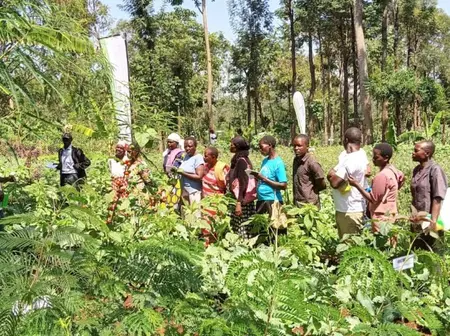
Smallholder farmers in western Kenya are turning to indigenous crops and zero-grazing dairy farming to increase household incomes and cope with the effects of climate change.
The shift was highlighted on Friday during a Farmers’ Field Day in Ematule Village, Kakamega County, where local farmers demonstrated how combining livestock keeping with traditional vegetable farming can help households earn more from small plots of land.
The event was organised by Resources Oriented Development Initiatives (RODI Kenya) and the Masaba Central Self Help Group, bringing together farmers, agricultural leaders and correctional officials.
Farmers in the region have been grappling with erratic rainfall, soil degradation and rising input costs, which have affected returns from traditional cash crops such as sugarcane and maize.
Moses Kidi, Executive Director of RODI Kenya, said farmers needed to look beyond producing food for household consumption and treat agriculture as a source of income and employment.
“Farming should not simply be about producing food for household consumption. It should also be an enterprise that generates income, creates employment, improves nutrition and provides economic opportunities, particularly for women and young people,” he said.
Demonstrations at the homestead of farmer Boaz Wang’uche focused on compact zero-grazing dairy units and the cultivation of indigenous vegetables, particularly black nightshade, commonly known as managu.
The approach allows farmers to keep livestock and grow crops on limited land while making use of available farm resources.
Wang’uche said livestock manure could be used to improve soil fertility, while crop residues provide supplementary animal feed, reducing the cost of production.
“When you combine dairy with traditional vegetables, nothing goes to waste—the livestock manure feeds the soil, and the crop residues supplement animal feed, cutting our production costs drastically,” he said.
Indigenous vegetables are also gaining attention because of their ability to withstand local growing conditions and demand in urban markets.
Farmers attending the event said the demonstrations had given them practical ideas on how to make better use of their land.
Malachi Khadiva said combining dairy farming with traditional crops could help improve earnings, particularly for households working with small pieces of land.
Alice Wepukhulu said the training had helped farmers understand how crops they already grow could become a reliable source of income.
RODI Kenya also works with correctional institutions to promote agricultural training, rehabilitation and seed multiplication.
A representative of the regional correctional services said inmates who acquire practical skills in agroecology and livestock management could use the knowledge to earn a living after leaving prison.
The approach is also intended to reduce repeat offending by helping former inmates become economically productive in their communities.
The programme receives support from European development partners, including Germany’s Brot für die Welt and GLS Zukunftsstiftung Entwicklung.
Despite the potential of diversified farming, agricultural analysts warn that increased production must be matched by reliable markets and better post-harvest handling.
Without adequate cold storage and structured supply agreements, farmers risk producing more than local markets can absorb, potentially pushing down farm-gate prices.
Kidi urged farmers to work through groups such as the Masaba Central Self Help Group to strengthen their bargaining power and secure better terms when selling their produce.
He also encouraged participants to put the lessons from the field day into practice rather than treating the event as a one-day gathering.
“Let us not leave this field day with photographs alone,” he told farmers. “Let us leave with practical knowledge, new ideas, stronger partnerships and a renewed commitment to transforming agriculture in our communities.”
Leave a Reply