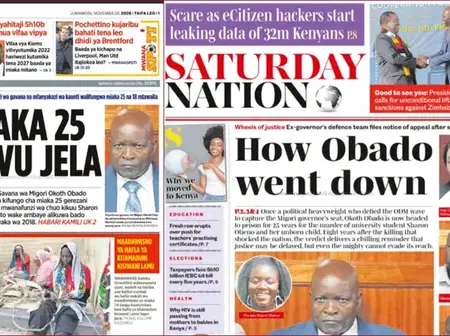
Kenya's Saturday newspapers on November 28, 2026, highlighted several significant developments, including the sentencing of former Migori Governor Okoth Obado over the murder of Sharon Otieno.
Other major issues featured in the newspapers included concerns about the country's preparedness for the 2027 General Election, with religious leaders calling for greater transparency from the electoral commission.
Here is a breakdown of the major stories featured in the Saturday editions.
Taifa Leo examined the difficult transition awaiting former Migori Governor Okoth Obado following his conviction and sentencing over Sharon Otieno's murder.
Obado appeared before the court on Friday, November 27, in formal civilian clothing as the High Court delivered its sentencing decision. The former county boss now faces 25 years in prison.
His life has changed dramatically from the days when he occupied one of the most influential political offices in Migori County.
According to the newspaper's report, Obado had spent 123 days in remand at Kamiti Maximum Prison between his conviction and sentencing. During that period, he operated under remand arrangements that allowed scheduled visits and attendance at Saturday religious services.
However, his status has now changed following the sentencing.
A prison officer explained that Obado and his two co-accused would undergo the normal admission procedures for convicted prisoners. These include registration, receiving prison uniforms, being assigned identification numbers and allocation to prison cells.
They may also be assigned duties as part of the prison's daily routine.
Obado was sentenced alongside his former personal assistant, Michael Oyamo, and former Migori County employee Caspal Ojang Obiero.
The Kenya Prisons Service also has the authority to transfer prisoners to different correctional facilities depending on security and administrative considerations.
The newspaper highlighted the contrast between Obado's previous public position and his new circumstances as he begins serving his sentence.
Saturday Nation focused on the evidence presented during the lengthy court proceedings that eventually resulted in Obado's conviction for Sharon Otieno's murder.
Justice Cecilia Githua sentenced the former governor to 25 years in prison on Friday, November 27. His former personal assistant, Michael Oyamo, received an equal sentence, while Caspal Obiero was handed an 18-year prison term.
The case dates back to September 3, 2018, when Sharon Otieno, who was seven months pregnant, disappeared after attending a meeting in Rongo alongside Nation Media Group journalist Barack Odour.
The two had reportedly been directed into a Toyota Fielder after arriving at Graca Hotel.
According to evidence presented in court, the vehicle later became the scene of an abduction. Odour managed to escape by jumping out of the moving car, but Sharon remained with the people who had taken control of the vehicle.
Her body was subsequently discovered with multiple stab wounds. Her unborn child also died.
During the trial, prosecutors presented evidence suggesting that disagreements surrounding Sharon's pregnancy were central to the events preceding her death.
Obado had been identified as the father of the unborn child. The prosecution argued that tensions developed after Sharon declined to terminate the pregnancy.
Her mother, Melinda Auma, told the court about changes in the relationship, including reduced financial support, unanswered telephone calls and an alleged offer of KSh 30,000 to facilitate an abortion.
The prosecution also relied on phone records, WhatsApp conversations and other communications involving the accused individuals.
Some messages reportedly concerned a three-bedroom house that Sharon believed Obado had promised to purchase for her in Kisumu.
Investigators also presented information about the vehicle allegedly used during the abduction. A vehicle-tracking company told the court that its GPS device had been switched off on the day Sharon disappeared before becoming active again the following day.
Journalist Barack Odour also testified about audio recordings of conversations between Sharon and Obado, which he said Sharon had shared with him.
In delivering the judgment, Justice Githua acknowledged that no eyewitness had directly seen the accused committing the murder.
Nevertheless, she ruled that the circumstantial evidence presented by the prosecution formed a sufficiently strong chain to establish their guilt beyond reasonable doubt.
The sentencing marked a major development in a case that had attracted nationwide attention since 2018.
The Saturday Standard highlighted concerns raised by the National Council of Churches of Kenya (NCCK) regarding the country's preparedness for the 2027 General Election.
The religious organisation warned that Kenya could face a difficult electoral period if concerns surrounding the Independent Electoral and Boundaries Commission (IEBC) are not addressed.
Speaking during a gathering at Jumuiya Centre in Limuru, NCCK chairman Dr Elias Otieno claimed that the country was only about 40% prepared for credible elections.
He also referred to survey findings indicating that fewer than 26% of Kenyans believed the electoral commission was adequately prepared to conduct the polls.
The church leaders expressed concern over the commission's perceived lack of transparency, particularly regarding allegations by politicians that the 2027 election could be manipulated to favour individuals currently holding public office.
According to the NCCK leadership, failing to address such concerns could weaken public confidence in the electoral process.
The organisation also urged Kenyans to reject political handouts, arguing that poverty should not be exploited to influence voting decisions.
During the meeting, church leaders agreed that political campaigns and fundraising activities should not be conducted within church premises.
NCCK Secretary General Chris Kinyanjui maintained that politicians seeking to address citizens should use designated public platforms rather than religious gatherings.
He explained that churches would continue engaging political leaders on national issues while avoiding partisan political activities.
The NCCK further pledged to promote civic education, discourage political violence and hate speech, and protect young people from political manipulation.
Beyond electoral matters, the organisation also expressed concern about the growing burden of non-communicable diseases, including cancer, diabetes and hypertension.
The church leadership indicated that health policy and other national concerns would remain important areas of public engagement.
The statements come as political activities and discussions surrounding the 2027 General Election continue to gain momentum across the country.
Leave a Reply