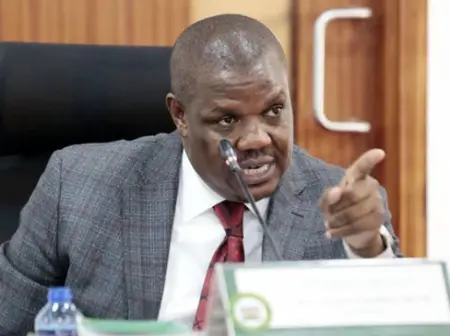
Wamboka raised concerns about the country's debt burden, arguing that the figures commonly presented as public debt might not capture all the financial obligations weighing on the economy.
He pointed out that some universities, Technical and Vocational Education and Training (TVET) institutions and schools were struggling with huge debts, which he argued were not adequately reflected in the public debt figures.
According to Wamboka, Kenya's borrowing history cannot be blamed on one administration because successive presidents have accumulated substantial debt.
He maintained that borrowing is not necessarily wrong, but the government must demonstrate how the borrowed money has benefited the economy and whether it has delivered value to taxpayers.
His remarks prompted a strong response from National Assembly Majority Leader Kimani Ichung’wah, who challenged him to provide specific figures to support his argument.
Ichung’wah's demand for evidence triggered a tense exchange, with Wamboka appearing unwilling to back down as he declared, "You will not intimidate me!"
Former National Assembly Majority Leader Junet Mohamed also weighed in, questioning Wamboka's understanding of the country's debt situation.
"Unless you are talking about another country, you don't know the exact figure," Junet remarked, further escalating the disagreement.
The figures surrounding Kenya's public debt provide further context to the disagreement. According to historical debt records, the country's public debt stood at approximately KSh630 billion when Mwai Kibaki took office in December 2002. By the time he left office in April 2013, it had risen to approximately KSh1.88 trillion.
Under Uhuru Kenyatta, the debt stock increased from approximately KSh1.88 trillion in April 2013 to KSh8.7 trillion by September 2022. This represented an increase of about KSh6.82 trillion.
Under President William Ruto, the debt has continued rising. The National Treasury's 2025/2026 Annual Debt Management Report puts public and publicly guaranteed debt at approximately KSh13.12 trillion as of June 30, 2026.
Kenya has had five presidents since independence, including Jomo Kenyatta, Daniel arap Moi, Mwai Kibaki, Uhuru Kenyatta and William Ruto. The figures above cover comparable debt records from the Kibaki administration onwards, rather than providing a complete breakdown for all five presidents.
The disagreement also raises an important distinction between government borrowing and other outstanding obligations, such as pending bills owed to institutions and suppliers. These are not necessarily included in the official public debt stock.
At the centre of Wamboka's argument was the need for accountability, with the MP insisting that Kenyans deserve to know not just how much the government borrows but also what the money accomplishes.
Watch the video here
https://x.com/a_m_media_ke/status/2125964919795491179/video/1?a=82KoM1PK4LVWxkVDi_U&s=19
Leave a Reply