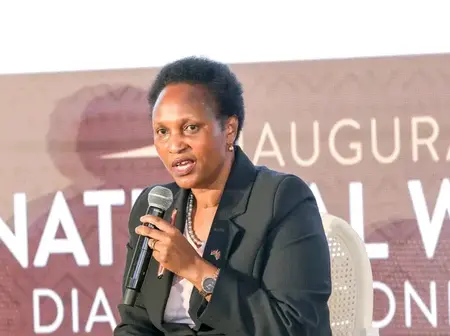
The Commission has warned that creating a fair political environment requires women to speak out against discrimination while also taking advantage of available reporting mechanisms to ensure that perpetrators are held accountable.
The message was delivered by IEBC Commissioner Dr Ann Nderitu, who represented Commission Chairperson Erastus Ethekon during the inaugural Women's Dialogue Conference in Nairobi.
The meeting brought together women candidates, voters, electoral administrators, peace monitors and community mobilisers to discuss their contribution to peaceful elections and national action.
"Women have a responsibility to condemn any incidents or utterances made against women who engage in election activities. Do not keep quiet. The Commission will educate women on the process of reporting any incidents of violence against women during campaigns or the election period," she said.
The commissioner explained that the IEBC had put in place measures intended to ensure that women can participate in elections without being subjected to intimidation or unfair treatment.
She revealed that the Commission has established an Election Code of Conduct, supported by a Code of Conduct Enforcement Committee responsible for addressing violations.
Those found breaching the code can be summoned, warned or fined, depending on the nature of their misconduct.
Nderitu also disclosed that the Commission intends to establish a gender desk where women can report incidents of violence and other forms of intimidation experienced during campaigns and the election period.
However, her address also drew attention to the persistent gap between women's population and their representation in Kenya's elected political leadership.
She observed that although women account for approximately half of the country's population, their numbers in directly elected parliamentary positions remain considerably low.
"Elections are about representation and women make up about half of Kenya's population, yet they hold only a small share of directly elected parliamentary seats — around 28 of the 290 open constituency seats in the National Assembly and three (3) of the 47 directly elected Senate seats. Remember, the participation of women in elections is not a favour but a right," Nderitu stated.
Her remarks brought renewed attention to the constitutional requirement on gender representation, which continues to be a major challenge in Kenya's political system.
Articles 27(8) and 81(b) of the Constitution require that not more than two-thirds of members of elective bodies should be of the same gender, effectively setting a minimum one-third representation threshold for the less-represented gender.
SOURCE
Leave a Reply